SOC 120 (Race, Class & Gender)
THEME 1
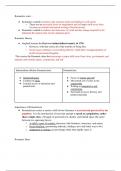
Stratification pyramid
Upper
class
Upper middle
Lower middle class
Working class
Working poor
Underclass
Stratification Teardrop
, Definitions
- Social stratification - describes inequalities that between individuals and social groups (Giddens,
2006: 295)
- It refers to structured inequalities between different groupings of people (Gidden, 2006: 295)
- Social inequality - a situation in which valued resources and desired outcomes are distributed in
such a way that people have unequal amounts and/or access to them (Ferrante, 2013)
Social stratification
- Often we think of social stratification in terms of asserts or property
- It can also occur because of other attributes - gender, age, religious affiliation or military rank
Characteristics of Stratification Systems
- The rankings apply to social categories of people who share a common characteristics without
necessarily interacting with one another
- People’s life experiences and opportunities depend heavily on how their social category is ranked
- The ranks of different social categories tend to change very slowly over time e.g in SA,
transformation in the workplace in terms of gender and leadership roles
Slavery
- People were owned as property by others
- Sometimes slaves were deprived of almost all rights by law
- Its an extreme form of inequality but economically inefficient because it is unstable
- Now outlawed but still happens in certain parts of the globe
- Think of the Atlantic slave trade I.e Roots, Django unchained, colonialism, Athens, etc
, Caste
- It is a social system in which one is given a social status for life
- Any form stratification in which people are categorised & ranked by characterised over which they
have no control & that they usually cannot change (Ferrante, 2013)
- Social levels in caste societies are closed i.e you are born in and remain in it
- Social status based on personal characteristics i.e perceived race or ethnicity, parental religion or
caste
- Caste is a special society in which status is ascribed at birth
- E.g India and South Africa (before 1994)
- Only allowed to marry within one’s social group (endogamy)
Estates
- Existed as part of a European feudalism and other traditional civilisations
- Consisted of different obligations and rights
- Highest (aristocracy and gentry); Clergy (lower level but have certain privileges); Commoners (serfs,
free peasants, merchants and artisans)
- In estates, one can move from level to another through intermarriages, buying knighthood, being
honoured by the monarchy, hereditary
- Character of estates varied with level, society and location
Class
- Class is a large scale of grouping of people who share common economic resources, which
strongly influence one’s lifestyle
- A system of social stratification in which people are ranked on the basis of achieved characteristics
I.e merit, talent or past performances
- Ownership of wealth and occupation inform class differences
- Class differs from slavery, caste and estate because:
- Class system is fluid
- Class position in some part are achieved (social mobility)
- Class is economically based
- Class system are large scale and impersonal i.e inequalities in pay and working conditions
THEME 1
Stratification pyramid
Upper
class
Upper middle
Lower middle class
Working class
Working poor
Underclass
Stratification Teardrop
, Definitions
- Social stratification - describes inequalities that between individuals and social groups (Giddens,
2006: 295)
- It refers to structured inequalities between different groupings of people (Gidden, 2006: 295)
- Social inequality - a situation in which valued resources and desired outcomes are distributed in
such a way that people have unequal amounts and/or access to them (Ferrante, 2013)
Social stratification
- Often we think of social stratification in terms of asserts or property
- It can also occur because of other attributes - gender, age, religious affiliation or military rank
Characteristics of Stratification Systems
- The rankings apply to social categories of people who share a common characteristics without
necessarily interacting with one another
- People’s life experiences and opportunities depend heavily on how their social category is ranked
- The ranks of different social categories tend to change very slowly over time e.g in SA,
transformation in the workplace in terms of gender and leadership roles
Slavery
- People were owned as property by others
- Sometimes slaves were deprived of almost all rights by law
- Its an extreme form of inequality but economically inefficient because it is unstable
- Now outlawed but still happens in certain parts of the globe
- Think of the Atlantic slave trade I.e Roots, Django unchained, colonialism, Athens, etc
, Caste
- It is a social system in which one is given a social status for life
- Any form stratification in which people are categorised & ranked by characterised over which they
have no control & that they usually cannot change (Ferrante, 2013)
- Social levels in caste societies are closed i.e you are born in and remain in it
- Social status based on personal characteristics i.e perceived race or ethnicity, parental religion or
caste
- Caste is a special society in which status is ascribed at birth
- E.g India and South Africa (before 1994)
- Only allowed to marry within one’s social group (endogamy)
Estates
- Existed as part of a European feudalism and other traditional civilisations
- Consisted of different obligations and rights
- Highest (aristocracy and gentry); Clergy (lower level but have certain privileges); Commoners (serfs,
free peasants, merchants and artisans)
- In estates, one can move from level to another through intermarriages, buying knighthood, being
honoured by the monarchy, hereditary
- Character of estates varied with level, society and location
Class
- Class is a large scale of grouping of people who share common economic resources, which
strongly influence one’s lifestyle
- A system of social stratification in which people are ranked on the basis of achieved characteristics
I.e merit, talent or past performances
- Ownership of wealth and occupation inform class differences
- Class differs from slavery, caste and estate because:
- Class system is fluid
- Class position in some part are achieved (social mobility)
- Class is economically based
- Class system are large scale and impersonal i.e inequalities in pay and working conditions