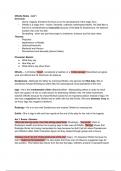
Othello Notes - Act 1
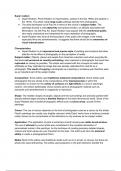
Overview:
- Genre: tragedy, therefore the focus is on the development of the tragic hero.
- Othello is a tragic hero - hubris, hamartia, catharsis (redemption/death). His fatal flaw is
that he is overwhelmed by insecurity because of his love for Desdemona. He believes
another man over his wife.
- Dovetailing - when two plot lines begin to intertwine, enhance and foil each other.
Themes:
- Prejudice
- Appearance vs Reality
- Jealousy/Insecurity
- Manhood and Honour
- Womanhood and Sexuality (femme fatale)
Character Sketch:
● What they say.
● How they act.
● What others say about them.
Othello - A Christian “moor”, considered a heathen or a “noble savage.” Described as logical,
wise and rational but he dissolves into jealousy.
Desdemona - Betrayed her father by marrying Othello, she ignores her filial duty. She is
sometimes forward thinking but often falls into stereotypical social standards of the time.
Iago - He is the irredeemable villain (Machiavellism - Manipulating others in order to reach
their own goals), he has no valid reason for destroying Othello’s life. He holds resentment
towards Othello because he chose Micheal Cassio for an important position instead of Iago. He
also has a suspicion that Othello had an affair with his wife Emilia. We have dramatic irony as
we know Iago has negative intentions.
Roderigo - He is in love with Desdemona and resents Othello for marrying her.
Emilia - She is Iago’s wife and has regrets at the end of the play for her role in the tragedy.
Act 1 Scene i Quotes:
“Who has had my purse / As if the strings were thine” (Roderigo) - “my purse” refers to
Roderigo’s wealth and shows he is paying Iago to take care of Othello. “Strings” shows that
Roderigo thinks he's being manipulated by Iago because he didn’t tell him about Desdemona
and Othello’s affair. Both Characters figure out they eloped through gossip and rumours.
“Despise me if I do not. Three great ones of the city” (Iago) - He despises Othello because he
didn't “make me his lieutenant.” He also states that three men of influence suggested Iago for
this position. This hatred also stems from the fact that lago, Othello's ancient or standard bearer
, has been passed over for promotion in favour of Michael Cassio, a younger, less experienced
soldier.
“But he, as loving his own pride and purposes / Horribly stuff’d with epithets of war.” (Iago) - He
suggests that Othello is too proud and that he tells endless tales of his great success at war.
Epithet - to write in praise of something.
“I have already chose my officer” - Othello has chosen “the bookish theoric” over Iago who is
older and has more experience at war. Iago suggests that Micheal Cassio has never been to
war and he is “damn’d in a fair wife” - he does not have a wife.
“His Moorship’s ancient” - Iago must serve Othello as an old man of no significance. Throughout
the whole scene, nobody has used Othello's name - although all three men have referred to him
several times.
“Trimm’d in forms of visages of duty” - Iago talks about two different types of servants; the old
and duteous or the one pretending to be duteous. Iago plans to trick Othello by appearing dutiful
- Appearance vs Reality.
“Were I the Moor, I would not be Iago.” (Iago) - Iago suggests they are foils of one another, they
are opposites in character. “Moor” refers to his skin colour as well as his assumed religion.
“I am not what I am.” (Iago) - Reference to the Bible: I am what I am, which implies honesty
whereas Iago changes the quote as he is dishonest. In this sense he is defying God and going
against the natural order. He calls Othello “the devil” but in reality Iago fits that description.
“What a full fortune does the thick-lips owe” (Roderigo) - “Fortune” refers to fate and destiny,
Roderigo insinuates that having Desedmona is the will of fate.
“Awake! What, ho, Brabantio! Thieves, thieves, thieves!” (Iago) - His diction is startling and puts
Brabantio into a state of panic. Brabantio is also not able to recognise Iago’s voice.
“An old black ram / is tupping your white ewe” (Iago) - “tupping” has animalistic connotations,
further dehumanising Othello. Contrasting Desdemona and Othello with imagery.
“Against the Moor; for I do know the state.” (Iago) - Showing the state will side with Othello
because he is integral in fighting the war in Cyprus.
“O treason of the blood!” (Brabantio) - Denotation is the betrayal of a country, connotation
suggests she has betrayed the head of her family. This reflects the patriarchal nature of the
time.
Overview:
- Genre: tragedy, therefore the focus is on the development of the tragic hero.
- Othello is a tragic hero - hubris, hamartia, catharsis (redemption/death). His fatal flaw is
that he is overwhelmed by insecurity because of his love for Desdemona. He believes
another man over his wife.
- Dovetailing - when two plot lines begin to intertwine, enhance and foil each other.
Themes:
- Prejudice
- Appearance vs Reality
- Jealousy/Insecurity
- Manhood and Honour
- Womanhood and Sexuality (femme fatale)
Character Sketch:
● What they say.
● How they act.
● What others say about them.
Othello - A Christian “moor”, considered a heathen or a “noble savage.” Described as logical,
wise and rational but he dissolves into jealousy.
Desdemona - Betrayed her father by marrying Othello, she ignores her filial duty. She is
sometimes forward thinking but often falls into stereotypical social standards of the time.
Iago - He is the irredeemable villain (Machiavellism - Manipulating others in order to reach
their own goals), he has no valid reason for destroying Othello’s life. He holds resentment
towards Othello because he chose Micheal Cassio for an important position instead of Iago. He
also has a suspicion that Othello had an affair with his wife Emilia. We have dramatic irony as
we know Iago has negative intentions.
Roderigo - He is in love with Desdemona and resents Othello for marrying her.
Emilia - She is Iago’s wife and has regrets at the end of the play for her role in the tragedy.
Act 1 Scene i Quotes:
“Who has had my purse / As if the strings were thine” (Roderigo) - “my purse” refers to
Roderigo’s wealth and shows he is paying Iago to take care of Othello. “Strings” shows that
Roderigo thinks he's being manipulated by Iago because he didn’t tell him about Desdemona
and Othello’s affair. Both Characters figure out they eloped through gossip and rumours.
“Despise me if I do not. Three great ones of the city” (Iago) - He despises Othello because he
didn't “make me his lieutenant.” He also states that three men of influence suggested Iago for
this position. This hatred also stems from the fact that lago, Othello's ancient or standard bearer
, has been passed over for promotion in favour of Michael Cassio, a younger, less experienced
soldier.
“But he, as loving his own pride and purposes / Horribly stuff’d with epithets of war.” (Iago) - He
suggests that Othello is too proud and that he tells endless tales of his great success at war.
Epithet - to write in praise of something.
“I have already chose my officer” - Othello has chosen “the bookish theoric” over Iago who is
older and has more experience at war. Iago suggests that Micheal Cassio has never been to
war and he is “damn’d in a fair wife” - he does not have a wife.
“His Moorship’s ancient” - Iago must serve Othello as an old man of no significance. Throughout
the whole scene, nobody has used Othello's name - although all three men have referred to him
several times.
“Trimm’d in forms of visages of duty” - Iago talks about two different types of servants; the old
and duteous or the one pretending to be duteous. Iago plans to trick Othello by appearing dutiful
- Appearance vs Reality.
“Were I the Moor, I would not be Iago.” (Iago) - Iago suggests they are foils of one another, they
are opposites in character. “Moor” refers to his skin colour as well as his assumed religion.
“I am not what I am.” (Iago) - Reference to the Bible: I am what I am, which implies honesty
whereas Iago changes the quote as he is dishonest. In this sense he is defying God and going
against the natural order. He calls Othello “the devil” but in reality Iago fits that description.
“What a full fortune does the thick-lips owe” (Roderigo) - “Fortune” refers to fate and destiny,
Roderigo insinuates that having Desedmona is the will of fate.
“Awake! What, ho, Brabantio! Thieves, thieves, thieves!” (Iago) - His diction is startling and puts
Brabantio into a state of panic. Brabantio is also not able to recognise Iago’s voice.
“An old black ram / is tupping your white ewe” (Iago) - “tupping” has animalistic connotations,
further dehumanising Othello. Contrasting Desdemona and Othello with imagery.
“Against the Moor; for I do know the state.” (Iago) - Showing the state will side with Othello
because he is integral in fighting the war in Cyprus.
“O treason of the blood!” (Brabantio) - Denotation is the betrayal of a country, connotation
suggests she has betrayed the head of her family. This reflects the patriarchal nature of the
time.