CAUSES OF INTERPERSONAL VIOLENCE:
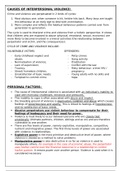
Crime and violence are perpetuated in 2 kinds of cycles:
1. Most obvious one; when someone is hit, he/she hits back. Many boys are taught
this behaviour at an early age to deal with victimisation.
2. More complex and reflects the habitual behaviour patterns carried over from
generation to generation.
The cycle is used to interpret crime and violence from a holistic perspective. It shows
that children who are exposed to abuse (physical, emotional, sexual, economic) are
more likely to become involved in criminal activities (the relationship between
perpetrator and victim, and the consequences).
CYCLE OF CRIME AND VIOLENCE INCLUDE:
VULNERABLE VICTIMS: OFFENDERS:
- Early childhood neglect and - Petty crimes
abuse; - Gang activity
- Normalisation of violence; - Prostitution
- Lack of supervision; - Conflict with the law
- Truancy; - Risky behaviour: crime/ HIV /
- Street/ homeless children; pregnancy
- Unsatisfaction of basic needs; - Young adults with no skills and
- Tempted to commit crime hope
PERSONAL FACTORS:
The cause of interpersonal violence is associated with an individual’s inability to
cope with everyday challenges, emotions and pressures.
This inability to cope is often associated with abuse and neglect.
the breeding ground of violence is deprivation, isolation and abuse which causes
feelings of powerlessness and apathy. This is linked to feelings of hopelessness
and no satisfaction of basic needs.
Abusive perpetrators use violent behaviour to compensate for their
feelings of inadequacy and their need for power.
Violence is most likely to occur between persons who are closely tied
emotionally (intimate partners, children, siblings and so on) and are therefore
vulnerable to one another.
There are five levels of power, namely exploitive, manipulative, competitive,
nutrient and integrative power. The first three levels of power are associated
with violence in relationships.
Exploitive power is the most primitive and destructive level of power, where
violence is viewed as a method to solve problems.
Manipulative power is also destructive in so far as violence is used to
manipulate others, for example in the case of economic abuse, the perpetrator
uses his/her control over the financial resources in a relationship to control
his/her partner. It means power over another person. Violence is used when it is
considered necessary
Crime and violence are perpetuated in 2 kinds of cycles:
1. Most obvious one; when someone is hit, he/she hits back. Many boys are taught
this behaviour at an early age to deal with victimisation.
2. More complex and reflects the habitual behaviour patterns carried over from
generation to generation.
The cycle is used to interpret crime and violence from a holistic perspective. It shows
that children who are exposed to abuse (physical, emotional, sexual, economic) are
more likely to become involved in criminal activities (the relationship between
perpetrator and victim, and the consequences).
CYCLE OF CRIME AND VIOLENCE INCLUDE:
VULNERABLE VICTIMS: OFFENDERS:
- Early childhood neglect and - Petty crimes
abuse; - Gang activity
- Normalisation of violence; - Prostitution
- Lack of supervision; - Conflict with the law
- Truancy; - Risky behaviour: crime/ HIV /
- Street/ homeless children; pregnancy
- Unsatisfaction of basic needs; - Young adults with no skills and
- Tempted to commit crime hope
PERSONAL FACTORS:
The cause of interpersonal violence is associated with an individual’s inability to
cope with everyday challenges, emotions and pressures.
This inability to cope is often associated with abuse and neglect.
the breeding ground of violence is deprivation, isolation and abuse which causes
feelings of powerlessness and apathy. This is linked to feelings of hopelessness
and no satisfaction of basic needs.
Abusive perpetrators use violent behaviour to compensate for their
feelings of inadequacy and their need for power.
Violence is most likely to occur between persons who are closely tied
emotionally (intimate partners, children, siblings and so on) and are therefore
vulnerable to one another.
There are five levels of power, namely exploitive, manipulative, competitive,
nutrient and integrative power. The first three levels of power are associated
with violence in relationships.
Exploitive power is the most primitive and destructive level of power, where
violence is viewed as a method to solve problems.
Manipulative power is also destructive in so far as violence is used to
manipulate others, for example in the case of economic abuse, the perpetrator
uses his/her control over the financial resources in a relationship to control
his/her partner. It means power over another person. Violence is used when it is
considered necessary