Auerello Matthaeus Pillay History 12 – Mrs Harvey
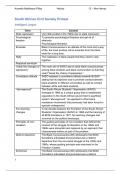
South African Civil Society Protest
Intelligent Jargon
Term Context
State repression Very little protest in the 1960s due to state repression.
Psychological To promote psychological freedom and get rid of
freedom inferiority.
Psychological liberation
Emanate Black Consciousness is an attitude of the mind and a way
of life, the most positive call to emanate from the black
world for a long time.
Rally The realization of black people that they need to rally
together.
Perpetual servitude
“break the changes of The main aim of SASO was to raise black consciousness
oppression” among black students and black communities so that they
could “break the chains of oppression.”
Conciliatory attitude SASO adopted a conciliatory attitude towards NUSAS
stating that its objective was to promote contact between
black students in different universities as well as contact
between white and black students.
“aboveground” The South African Students’ Organisation (SASO)
emerged in 1968 as a unique group that re-established
opposition to the South African government’s apartheid
system “aboveground,” as opposed to other black
resistance movements that previously had been forced to
operate underground.
Far-reaching In the decade between the formation of the South African
changes Students’ Organisation (SASO) in 1968 and the banning of
all BCM formations in 1977, far-reaching changes had
occurred on the political landscape.
Principles of non- The guiding principles of non-racialism that defined the
racialism conduct of the struggle for liberation in the 1950s and
1960s were discarded and replaced by an approach that
characterised whites as part of the problem.
Distinct departure The Black Consciousness (BC) philosophy that BCM
formations articulated and promoted was a distinct
departure from the non-racial struggle of the 1950s and
1960s, whose guiding principle was enshrined in the
Freedom Charter.
Enshrined The Black Consciousness (BC) philosophy that BCM
formations articulated and promoted was a distinct
1
South African Civil Society Protest
Intelligent Jargon
Term Context
State repression Very little protest in the 1960s due to state repression.
Psychological To promote psychological freedom and get rid of
freedom inferiority.
Psychological liberation
Emanate Black Consciousness is an attitude of the mind and a way
of life, the most positive call to emanate from the black
world for a long time.
Rally The realization of black people that they need to rally
together.
Perpetual servitude
“break the changes of The main aim of SASO was to raise black consciousness
oppression” among black students and black communities so that they
could “break the chains of oppression.”
Conciliatory attitude SASO adopted a conciliatory attitude towards NUSAS
stating that its objective was to promote contact between
black students in different universities as well as contact
between white and black students.
“aboveground” The South African Students’ Organisation (SASO)
emerged in 1968 as a unique group that re-established
opposition to the South African government’s apartheid
system “aboveground,” as opposed to other black
resistance movements that previously had been forced to
operate underground.
Far-reaching In the decade between the formation of the South African
changes Students’ Organisation (SASO) in 1968 and the banning of
all BCM formations in 1977, far-reaching changes had
occurred on the political landscape.
Principles of non- The guiding principles of non-racialism that defined the
racialism conduct of the struggle for liberation in the 1950s and
1960s were discarded and replaced by an approach that
characterised whites as part of the problem.
Distinct departure The Black Consciousness (BC) philosophy that BCM
formations articulated and promoted was a distinct
departure from the non-racial struggle of the 1950s and
1960s, whose guiding principle was enshrined in the
Freedom Charter.
Enshrined The Black Consciousness (BC) philosophy that BCM
formations articulated and promoted was a distinct
1