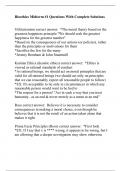
Bioethics Midterm #1 Questions With Complete Solutions
Utilitarianism correct answer: *The moral theory based on the greastest happiness principle "We should seek the greatest happiness for the greatest number" *Based on the consequences of our actions (or policies), rather than the principles or motivations for them *Sacrifice the few for the many *Jeremy Bentham & John Stuartmill Kantian Ethics (deontic ethics) correct answer: *Ethics is viewed as rational standards of conduct *As rational beings, we should act on moral principles that are valid for all rational beings (we should act only on principles that we can reasonably expect all reasonable people to follow) *EX: It's acceptable to lie only in circumstances in which any reasonable person would want to be lied to *The respect for a person! "Act in such a way that you treat humanity.. as an end & never merely as a mean to an end" Ross correct answer: Believes it is necessary to consider consequences in making a moral choice, even though he believes that it is not the result of an action taken alone that makes it right Prima Facie Principles (Ross) correct answer: *First look *EX: If I say that x is **** wrong, it appears to be wrong, but I am allowing that a deeper nevstigation may show otherwise *Idea is that moral principles are not absolute because they can conflect with each other (EX: Wrong to lie, but okay when it comes to saving someone's life. Justice as Fairness correct answer: Two principles- 1. Each person is to have an equal right to the most extensive total system of equal basic liberties compatible with a similar system of liberty to all 2. Social and economic inequalities are to be arranged so that they are both to the greatest benefit of the least advantaged and attached to offices and positions open to all under conditions of fair equality of opportunity Natural Law Theory correct answer: The general view that the rightness of actions is something determined by nature itself, rather than by the laws and customs of societies or the preferences of individuals Libertarianism correct answer: *One of the three most influential philosophical theories of government *Libertarian= holds that the fundamental principle of justice is liberty (or freedom or autonomy). Citizens should have the maximum freedom compatible with the equal freedom of others *In a purely *** society, we would have negative rights to: life, property, contract, freedom from taxation, & freedom from all paternalistic laws (laws against drugs, prosititutes, seat belts, etc.) Principle of Utility correct answer: We should act in such a way as to bring about the greatest benefit and least harm *EX: Train, homeless man cases Principle of Humanity correct answer: *"Never treat humanity merely as a means, but always as an end in itself" *Basic Kantian principle Categorical Imperative correct answer: Maxim (you can be thought of as endorsing a rule to the effect)- "all reasoned and considered actions can be regarded as having maxims." Maxims can be thought of as being candidates for moral rules—if they pass the test imposed by the categorical imperative, then we can say the actions are right Principle of Autonomy correct answer: *The moral principle that we should respect freedom of others in governing their lives *In medical ethics this almost always refers to decisions involving when, how, and if to be treated. The patient ultimately has the moral authority to make decisions aboout their self and body *This principle may have exceptions or conflict with other principles! *EX: Dax The Harm Principle correct answer: *A basis for state action, the next step is to further define the harm threshold by identifying the level of harm to be tolerated in parental decisions. *Parents should be given leeway- sometimes decisions benefit the family or meet the needs of another child. Parenthood decisions that do not significantly increase the likelihood of serious harm as compared to other options should be tolerated *EX: Twitchell Principle of Beneficence correct answer: We should act in ways that promote the welfare of other people Principle of Non-Malevolence correct answer: We ought to act in ways that do not cause needless harm or injury to others Principle of Veracity (principle of fidelity) correct answer: *The principle that doctors be sincere and honest to patient's needs. Usually refers to truth-telling and keeping promises *According to John Davenport= physicians keep their patient's interest first in mind above all others The Liberty Principle correct answer: *"Each person is to have an equal right to the most extensive total system of equal basic liberties compatible with a similar system of liberty for all." *This principle is forced by the difference principle Principle of Double Effect correct answer: This principle holds that such an action should be performed only in the intention is to bring about the good effect and the bad effect will be an unintended or indirect consequence- four conditions must be satisfied; 1. action itself must be morally indifferent/ morally good, 2. bad effect must not be the means by which the good effect is achieved, 3. the motive must be the achievement of the good effect only, 4. the good effect must be at least equivalent in importance to the bad effect Principle of Totality correct answer: *An individual has a right to dispose their organs or to destroy their capacity to function only to the extent that the general well-being of the whole body demands it. *This duty is based on the belief that each of our organs was designed by God to play a role in maintaining the functional integrity of our bodies that each has a place in the divine plan John Stuart Mill correct answer: Utilitarianism Immanuel Kant correct answer: Kantian ethics (deontic ethics-- moral principles) W.D. Ross correct answer: Prima-facie John Rawls correct answer: Difference principle (Justice), Liberty Principle (equalness) St. Thomas Aquinas correct answer: Goal and Purpose Krugman correct answer: Health economics & adverse selection Classic Utilitarism correct answer: *Points hapiness (or pleasure) as the supreme good of the individual *Maximize happiness Preference Utilitarism correct answer: *Seeks to maximally satisfy people desires (wants & preferences) *Many economics adopt because preferences is the fundamental good and preferences are measured by people's willingness to spend $$$ Classic form of Kantian Ethics correct answer: *Rational beigns to respect the rationality of other rational beings *Small children & animals do not demand out respect Deontic Ethics correct answer: *Any ethical theory based on principles rather than consequences or character *Pertaining to laws or rules Fidelity correct answer: truth, loyalty, faithfulness Difference Principle correct answer: *The second of Rawls two principles of justice: "Social and economic inequalities should be arranged so they are both: A) The greatest benefit of the least advantaged person and, B) Attached to offices and positions open to all under conditions of equality of opportunity." Consent correct answer: To permit, approve, or agree; comply or yield Assent correct answer: To give in, to agree or to cooperate (to concur) Clinical Trial Phases correct answer: Phase I: small number of people (10-80 ppl), evaluate safety, identify side effects, determine safe dose. aim of he trial is NOT to test the effectiveness of the therapy Pase II: investigators test the treatment (100-300 ppl) to determine whether the therapy is effective and to further test its safety. Safety and effectiveness measured Phase III: Investigators test the therapy in a larger number ( ppl) to confirm its effectiveness, montor side effects, compare to accepted therapies & collect data Phase IV: Investigators college data about the therapy's side effects after the therapy has become established as a standard treatment. Aim is to refine the use of therapy and improve safety *Phase I= healthy human volunteers, Phase II= patients who might be expected to benefit from it Informed Consent correct answer: *No more than agreement "yes" *Valid consent requires that we deliberate before we decide- both information and understanding *Some people say, *** is at worst a pointless charade and at best a polite fiction *Painents must understand enough about the proposed research and treatment to deliberate and reach a decision, make it valid Placebos correct answer: *In informed consent they are considered essential to determine the true effectiveness of the drug being tested.. they aren't receiving the best available treatment *Still have side effects= nervousness, vomiting, loss of appetite, etc. *Investigators can still test a treatment with known side affects/ what happens with a new treatment with a possible but not proven effectiveness Children Consent correct answer: * Lack phsyical, psychological, and intellectual maturity, nutritional needs are different, prone to certan types of diseases, suffer diferently from adults in many treatments, rely a lot on parents *Parental Consent= what age is a child *Therapeutic Benefits *Guidelines- permission, responsibility, supplied with an "advocate" to represent her and his interest Children and Placebos correct answer: *Some children will not receive medical care considered to be the best. A child who is a subject in such research is then put in a situation in which he or she is subjected to definite hazard. *Consequence of doing this would be to restrict the development of new and potentially more effective medications and treatment techniques- future generations of children would be deprived of at least some possible medical advances Paternalism correct answer: *The view that people often need to be protected from themselves or their own decisions. *We are typically quite this way toward children and attitudes towards adults is more controversial. *EX: of laws include seat belt laws, laws against recreational drugs, and laws that forbid you from selling yourself into slavery. In each case conflicts with a prima facie principle of autonomy. State Paternalism correct answer: *Control exerted by a legislature, agency, or other government body over particular kids of practices or procedures *EX: laws, licensing requirements, technical specifications, and operational guidelines and regulations Personal Paternalism correct answer: *Individual deciding on the basis of his own priciple or values that he know what is best for another person *Personal when it's not a matter of public or semipublic policy but is a result of private, moral decision making HIPA (Health Insurance Portability and Accountabilty Act of 1996) correct answer: Protects information about patients as it's transferred from one computer database to another when a patient changes insurers or physicians HIPA in 2005 correct answer: *Ruling by the U.S. Department of Justice raised a doubt about whether HIPA rules will protect privacy *Covered only "entities", not people who worked for these "entities" (entities=something that has a real existence; thing) *Physicians were fined as much as $250,000 or sent to prison for selling a mailing list of their patients who take drugs for heart problems, insurance clerk who did the same thing was not liable for prosectuion *Basically= confidentially! ***WHAT HAPPENED? First Amendment correct answer: *Right to refuse and religious rights *Free excercise of religion, freedom of speech, press, assembly, or petition Two expections in the law (when can doctors override my right to refuse on religious grounds for myself?) correct answer: 1. Serious infectious disease 2. Immediate dependents (dependents=relying on someone or something else for aid, support, etc) Child neglect laws correct answer: Spiritual healing and prosecuting parents State intervention laws correct answer: *Case 1: Insulin/ Jehovah's witnesses (and the child dies) *Case 2: Blood transfusions/ Christain Scientist EIGHT CONDITIONS MUST BE MET (p 141) Single- Payer System correct answer: Access to health care would be recongnized as a right of all citizens, and everyone would be included automatically in a program of national health insurance established by the federal governemnt United Kingdom's Health Care correct answer: *Hospitals want government fundig to provide the best care and services *Long waits- patient's conditions can worsen before being seen Japan's Health Care correct answer: *Best technology *Timely manner *Little complaining *Pay= 30% patient, 70% government Germany's Health Care correct answer: *Birth rates decreased, less people pay = health cost increase *Health care similar to U.S. employment *Difference= government picks up the tab on the poor Taiwan's Health Care correct answer: *Every citizen provided health care *No waiting in lines *Individual cost are low *No key holders that limit your access to specialists standarized cost for treatments Switzerland's Health Care correct answer: *Everyone has to buy insurance *Insurance companies must accept everyone *Poor are backed by the government when purchasing insurance Adverse Selection correct answer: *Private markets for health insurance suffer from a severe case of economic problem- bad risks drive out good *Why we have a screening process and many insurance agencies decline people with preexisting conditions or other indicators of high future expenses Employer- based system correct answer: *Reduce costs by pooling risk, tax subsidies keep costs low, which encourages good health risk to remain in the risk pool *Employment-based group coverage Coverage over individual coverage- this induces more good risk to demand insurance; as the demand rises, more employees participate therby reducing the effects of adverse selection
Written for
- Institution
- Bioethics
- Course
- Bioethics
Document information
- Uploaded on
- October 21, 2023
- Number of pages
- 11
- Written in
- 2023/2024
- Type
- Exam (elaborations)
- Contains
- Questions & answers
Subjects
-
bioethics midterm 1
-
utilitarianism
-
natural law theory
-
principle of utility
-
principle of huma
-
bioethics midterm 1 questions with complete solut
-
kantian ethics deontic ethics
-
prima facie principles ross

Document also available in package deal