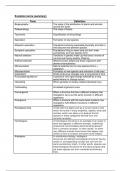
Evolution terms (summary):
Term Definition
Biogeography The study of the distribution of plants and animals
around the world.
Palaeontology The study of fossils.
Taxonomy Classification of living things
Speciation Formation of new species
Allopatric speciation Populations become separated physically and after a
time become two different species
Sympatric speciation Populations living in same area but don’t mate
successfully and new species form
Natural selection Variations in genetic make-up that favour chance of
survival and having healthy offspring
Artificial selection Where humans breed only those organisms with
desired characteristics
Microevolution Natural selection but no new species forms =
adaptation
Macroevolution Formation of new species and extinction of old ones
Gradualism Small continuous changes over a long period of time
Punctuated equilibrium A period of very rapid change followed by a long
period where no change occurs
Inbreeding When gametes of closely related individuals fuse
Outbreeding Unrelated organisms cross
Convergence When a structure that has a different anatomy has
changed to carry out the same function in different
organisms
Divergence When a structure with the same basic anatomy has
changed to fulfil different functions in different
organisms
Pentadactyl limb A limb with five digits such as a human hand or foot
which are found in many amphibia, reptiles, birds and
animals, which can allow us to deduce that all
species in these categories derived from one
common ancestor.
Homologous A homologous structure is an example of an organ or
bone that appears in different animals, underlining
anatomical commonalities demonstrating descent
from a common ancestor. In other words, it's when
very different animals have bones that appear very
similar in form or function and seem to be related.
Analogous In evolutionary biology, analogous
structures are defined as biological structures having
similar or corresponding function but not from the
same evolutionary origin. In other words, species use
these biological structures for the same purpose and
yet these species are from unrelated evolutionary
lines.