

Biology
Where is parenchyma found
- mesophyll of leaves ( internal layers)
- Cortex of roots and stems ( outer layers)
Module 1 - Pith of stems (innermost part)
1.1 support and structure in plants - Pulp of fruit
- Endosperm of seeds
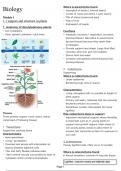
1. Anatomy of dicotyledonous plants
- two cotyledons Functions
- Peas, spinach, potatoes, coral trees - metabolic functions ( respiration, secretion,
photosynthesis ) take place in parenchyma
(ground tissue) because they retain their
protoplasts.
- Provide support and shape. Large uid lled
vacuoles, when full, give cell turgidity
- Stores food and water
- Contains chloroplasts (chlorenchyma) that
photosynthesise.
2. Collenchyma
Supporting
Where is collenchyma found
• Under epidermis
• Bordering large veins in leaves
Characteristics
• Living, elongated cells run parallel to length of
plant organs
• Primary cell walls ( cellulose) that are unevenly
thickened (thicker at corners)
• Sometimes contain chloroplasts but never
ligni ed
Tissues Role collenchyma plays in support
Three primary organs: roots, stems, leaves • Important mechanical support where exibility
comprised of following tissues: is important such as in: young plants to
support new growth regions, older stems of
1. Parenchyma non woody plants, leaves to allow them to
Supportive, packing tissue present at, horizontal surface for exposure to
Characteristics sun rays.
- least specialised
- Living ( protoplast ) 3. Sclerenchyma
- Rounded and simple with intercellular air Heavily ligni ed cells, often occur in bundles.
spaces between adjacent cells
- Thin and fairly exible cellulose walls. Where is sclerenchyma found
- Have central vacuole surrounded by layer of Almost anywhere, common in vascular tissue.
cytoplasm which contains amyloplasts.
Ligni ed = become woody and relatively rigid
Page 1
fifi fl fi fl fl fl fi
, - in roots = produce root hairs therefore
Characteristics of sclerenchyma epidermis = piliferous layer ( hair producing).
Very elongated and slender ( tapering ends Used to increase surface area for water and
interlock, providing max support) minerals.
Evenly, thickened ligni ed secondary walls - In stems and leaves = secrete cutin ( waxy
Dead and empty at maturity ( lost protoplasts, substance that forms continuous layer of
lumen in narrow) cuticle) cuticle = waterproof so prevents loss
of water vapor from plant and cutle protects
Role of sclerenchyma against entry of pathogens
Fibres are thick with ligni ed walls that provide - In leaves = surrounding stomata = guard cells (
tensile strength and support to large herbs. control opening and closing of stomata to
regulate loss of water vapor )
Tensile strength = resistance of a body to tensile
forces that tend to pull it apart.
Pathogen = something that can cause disease
4. Epidermal cells 5. Vascular tissue
Form epidermis, made of specialised
parenchyma. Vascular = uid carrying vessels, blood vessel in
Is the outermost layer, covering roots, stem, leaf, animals.
ower, fruit, seed.
Consists of xylem (dead) and phloem ( living)
May be lost as plant ages.
- in roots = vascular cylinder
- Stems = vascular bundle
Xylem
Complex tissue: tracheids, vessels, xylem
parenchyma and bres
Tracheids
Found in all vascular plants
Characteristics of tracheids
• Cigar shaped with overlapping ends
• Thick cell walls containing lignin
• Dead and hollow at maturity
Functions of modi ed epidermal cells
Lignin = complex polymer deposited in cell walls
which makes woody and rigid.
Page 2
fl
fl fi fi fi fi
Where is parenchyma found
- mesophyll of leaves ( internal layers)
- Cortex of roots and stems ( outer layers)
Module 1 - Pith of stems (innermost part)
1.1 support and structure in plants - Pulp of fruit
- Endosperm of seeds
1. Anatomy of dicotyledonous plants
- two cotyledons Functions
- Peas, spinach, potatoes, coral trees - metabolic functions ( respiration, secretion,
photosynthesis ) take place in parenchyma
(ground tissue) because they retain their
protoplasts.
- Provide support and shape. Large uid lled
vacuoles, when full, give cell turgidity
- Stores food and water
- Contains chloroplasts (chlorenchyma) that
photosynthesise.
2. Collenchyma
Supporting
Where is collenchyma found
• Under epidermis
• Bordering large veins in leaves
Characteristics
• Living, elongated cells run parallel to length of
plant organs
• Primary cell walls ( cellulose) that are unevenly
thickened (thicker at corners)
• Sometimes contain chloroplasts but never
ligni ed
Tissues Role collenchyma plays in support
Three primary organs: roots, stems, leaves • Important mechanical support where exibility
comprised of following tissues: is important such as in: young plants to
support new growth regions, older stems of
1. Parenchyma non woody plants, leaves to allow them to
Supportive, packing tissue present at, horizontal surface for exposure to
Characteristics sun rays.
- least specialised
- Living ( protoplast ) 3. Sclerenchyma
- Rounded and simple with intercellular air Heavily ligni ed cells, often occur in bundles.
spaces between adjacent cells
- Thin and fairly exible cellulose walls. Where is sclerenchyma found
- Have central vacuole surrounded by layer of Almost anywhere, common in vascular tissue.
cytoplasm which contains amyloplasts.
Ligni ed = become woody and relatively rigid
Page 1
fifi fl fi fl fl fl fi
, - in roots = produce root hairs therefore
Characteristics of sclerenchyma epidermis = piliferous layer ( hair producing).
Very elongated and slender ( tapering ends Used to increase surface area for water and
interlock, providing max support) minerals.
Evenly, thickened ligni ed secondary walls - In stems and leaves = secrete cutin ( waxy
Dead and empty at maturity ( lost protoplasts, substance that forms continuous layer of
lumen in narrow) cuticle) cuticle = waterproof so prevents loss
of water vapor from plant and cutle protects
Role of sclerenchyma against entry of pathogens
Fibres are thick with ligni ed walls that provide - In leaves = surrounding stomata = guard cells (
tensile strength and support to large herbs. control opening and closing of stomata to
regulate loss of water vapor )
Tensile strength = resistance of a body to tensile
forces that tend to pull it apart.
Pathogen = something that can cause disease
4. Epidermal cells 5. Vascular tissue
Form epidermis, made of specialised
parenchyma. Vascular = uid carrying vessels, blood vessel in
Is the outermost layer, covering roots, stem, leaf, animals.
ower, fruit, seed.
Consists of xylem (dead) and phloem ( living)
May be lost as plant ages.
- in roots = vascular cylinder
- Stems = vascular bundle
Xylem
Complex tissue: tracheids, vessels, xylem
parenchyma and bres
Tracheids
Found in all vascular plants
Characteristics of tracheids
• Cigar shaped with overlapping ends
• Thick cell walls containing lignin
• Dead and hollow at maturity
Functions of modi ed epidermal cells
Lignin = complex polymer deposited in cell walls
which makes woody and rigid.
Page 2
fl
fl fi fi fi fi



