
Human endocrine system
The environment in and around cells is constantly changing
In order to survive, the human body must adapt to these changes
This is accomplished by maintaining a constant internal equilibrium in the body,
known as HOMEOSTASIS, despite the changes in the internal/external
environment
The nervous system and hormones enable animals to respond to external
changes and to control conditions inside the body
the endocrine system consists of endocrine glands that secrete organic compounds,
chemical messengers called hormones
different endocrine glands do not function in isolation, but interact continuously by
means of their hormone secretions
this contributes to the maintenance of homeostasis in that almost all metabolic
activities in the body are controlled and coordinated by the endocrine system
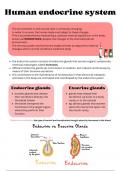
Endocrine glands Exocrine glands
ductless glands that release glands that release their
their secretions directly into secretions via ducts to a body
the blood stream cavity or to the outside
the blood transports the eg: salivary glands that secrete
hormones to the target organs saliva into ducts that open into
where they perform their the mouth cavity
function
Chemical coordination: the type of control and coordination brought about by hormones in the blood
, Hormones
Organic chemical messengers
most hormones are proteins, while some are steriods
hormones are secreted in small quantities directly into the bloodstream by endocrine
glands
hormones are transported to the target organs by the bloodstream
an organ that is affected by a specific hormone and it
has receptors for this specific hormone, enabling it to
respond to the hormone
hormones have a regulatory function that can be stimulating or inhibiting
hormones may be regulated by a positive or negative feedback mechanism
Negative feedback mechanism:
Any deviation from the normal levels (of a substance or temperature) elicits a response that
restores the normal levels


