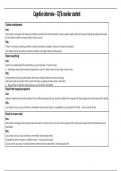
Cognitive interview – 12/16 marker content
Context reinstatement:
How:
Interviewer encourages interviewee to mentally recreate environment (weather, smells, people nearby) and how they were feeling by asking interviewee
to think back to before, during and after event occurred
Why:
If there is mental consistency between incident and mental recreation, witness will recall more details.
Also helps improve accuracy as mental recreation will trigger details of actual event.
Report everything:
How:
Report every detail about the event that you can recall even if it seems trivial
Information about event should be reported on, even if it doesn't seem he has a bear on the crime.
Why:
Unrestrained recall may reveal details which were mentally edited out without realising
Interviewer gets all relevant info to event and makes a judgement about what is important
May uncover information which acts as a cue for further information.
Recall from changed perspective:
How:
Asked to mentally recreate the situation from a different perspective (e.g. describe incident from viewpoint of other people who were present at the times)
Why:
Less likely to rely on usual schemas to remember and describe events so compelled to use perspective of other - more accurate recall.
Recall in reverse order:
How:
Interviewer encourages interviewee to describe event in reverse order or to start with an aspect of the scene which seems most memorable and work
backwards.
Why:
Less likely to rely on usual schemas to remember and describe events
Compelled to think of events in a different order - more accurate recall
Can also verify accuracy of original testimony when event was described in chronological order
Context reinstatement:
How:
Interviewer encourages interviewee to mentally recreate environment (weather, smells, people nearby) and how they were feeling by asking interviewee
to think back to before, during and after event occurred
Why:
If there is mental consistency between incident and mental recreation, witness will recall more details.
Also helps improve accuracy as mental recreation will trigger details of actual event.
Report everything:
How:
Report every detail about the event that you can recall even if it seems trivial
Information about event should be reported on, even if it doesn't seem he has a bear on the crime.
Why:
Unrestrained recall may reveal details which were mentally edited out without realising
Interviewer gets all relevant info to event and makes a judgement about what is important
May uncover information which acts as a cue for further information.
Recall from changed perspective:
How:
Asked to mentally recreate the situation from a different perspective (e.g. describe incident from viewpoint of other people who were present at the times)
Why:
Less likely to rely on usual schemas to remember and describe events so compelled to use perspective of other - more accurate recall.
Recall in reverse order:
How:
Interviewer encourages interviewee to describe event in reverse order or to start with an aspect of the scene which seems most memorable and work
backwards.
Why:
Less likely to rely on usual schemas to remember and describe events
Compelled to think of events in a different order - more accurate recall
Can also verify accuracy of original testimony when event was described in chronological order