MCB2020F MODULE 1 — FIRST YEAR BIO RECAP
IMPORTANT MILESTONES
• 1865 —> Mendel Pea Experiments
• 1944 —> Transforming principle of DNA
• 1952 —> Crystallise DNA bres X-ray photographs
• 1953 —> Discovery of DNA double helix structure
• 2001 —> PCR
• Sequencing of the entire human genome rst occurs
• Info in DNA = responsible for diversity of living organisms but all are closely related
• DNA variation results in species and functional diversity
• Phenotype is made up of proteins
• Central dogma = DNA —> RNA —> amino acids —> polypeptide chains/proteins (transcription
and translation)
REVISION OF DNA STRUCTURE
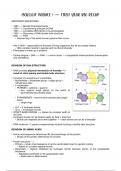
• DNA provides physical mechanism of heredity —>
result of strict pairing and double helix structure
• Consists of a sequence of nucleotides
• Nucleotides = phosphate group + sugar group +
nitrogenous base
• 4 nucleotides
• PURINES = adenine + guanine
• two organic rings (about 2x the width of
pyrimidines) (aka double base)
• PYRAMIDINES = thymine and cytosine (aka single
base)
• single rings
• A+T = 2 hydrogen bonds
• G+C = 3 hydrogen bonds
• STRICT BASE PAIRING —> Allows for constant width of
the helix
• Hydrogen bonds can be broken easily by heat + enzymes
• Bonds can separate and come together —> each strand can act as a template
• DNA molecule = 2 paired complementary strands forming a double helix structure
REVISION OF AMINO ACIDS
• Amino acid sequence determines 3D structure/shape of the protein
• Shape of the protein determines its function
• Protein structure —>
• Primary = linear chain/sequence of amino acids determined by genetic coding
• Based on covalent peptide bonds
• Secondary = regions stabilised by hydrogen bonds between atoms of the polypeptide
backbone
• Repeated coils/folds in the polypeptide chain
• Alpha helix vs Beta sheets
fi fi
, • Tertiary = 3D shape stabilised by side chain interactions
• Overall shape caused by side chain interactions of various amino acids
• Eg. Ionic binds, hydrogen bonds, disulphide bridges
• Quaternary = association of 2 or more polypeptides
• Conversion of biological information occurs from a 1D to a 4D state
• Biological systems function as complex interacting networks of proteins and DNA
• Proteins interact with proteins and proteins interact with DNA
• Model species = can be used in experiments where it may be di cult to work with humans
• Eg. Fruit ies
• Short generational turnover + quick reproduction w/ short lifespan
WHAT IS A GENE —>
In classical genetics:
• Gene = physical and functional unit of heredity and a discrete sequence of DNA that encode
proteins (enzymes, regulatory proteins, structural proteins)
• Can be associated with regulatory regions, transcribed regions and or other functional regions
•
More recently…
• Gene is a locatable region of genomic sequence corresponding to a unit of inheritance
• Gene = DNA segment that contributes to phenotype/function. In the absence of demonstrated
function a gene may be characterised by sequence, transcription or homology
• Chromosome = a collection of genes packaged in a compacted manner to manage the storage,
duplication, expression + evolution of DNA (smaller than a genome —> make up the genome)
• Genome = entire collection of chromosomes in each cell of an organism (coding and noncoding
included within the nucleus of a cell)
• Locus = designated location on a chromosome, can be a gene or noncoding region of DNA
• Humans have:
• 24 kinds of chromosomes (humans have 46 chromosomes where 1-22 are autosomes and
23 is a sex chromosome)
• Genome has 3x10^9 base pairs (nucleotide unit)
• 30 000 genes
WHAT IS AN ALLELE —>
fl ffi
, • Allele/gene locus= di erent version of the same gene (same functions!)
• Eg. Eye colour in ies
• More than one allele in population = polymorphic trait
• Eg. Eye colour, hair texture
• Wild type = most common form of an allele
• Monomorphic traits = one type of allele exists for that trait eg. Haemoglobin and other protein
coding genes
• Homologous chromosomes/homologs = pair of chromosomes with the same length,
centromere position and staining pattern (one from maternal and one from paternal)
• Carry genes controlling the same characteristics
• Diploid = 2 alleles of each gene/locus —> cells have two matching sets of chromosomes
• Haploid = cells have a single set of chromosomes (eg. Human gametes, pollen, egg)
• Homozygous = when two copies of the alleles at a locus are identical
• Heterozygous = two copies of the alleles at a locus are di erent
• Phenotype = observable characteristics seen in an individual (eg. Tall pea plants)
• Genotype = actual alleles present in an individual ( TT )
EUKARYOTIC CELL PROKARYOTIC CELL
Complex internal structure Simple internal structure
Internal organelles bound by membranes No internal organelles
DNA in membrane bound nucleus No nucleus
Have plastids with their own DNA (mitochondria, No plastids
chloroplasts)
Multicellular organisms eg. Plants, animals, fungi, Unicellular organisms eg. Bacteria
protozoans
PROTEINS
• Made up of a particular sequence of amino acids
• 20 types of amino acids
• Each amino acid is encoded by a speci c codon (set of 3 nucleotides
• Triplet code = genetic instructions for a polypeptide chain are written in the DNA as a series of
non-overlapping, three nucleotide words termed codons.
• Sequence conservation and high levels of homology in proteins —> still end up with very
di erent proteins albeit that there are a small number of amino acids
• Genetic code = redundant/degenerate in that multiple codons code for a single amino acid
but NOT ambiguous (each codon only codes for a single amino acid)
• Genetic code has:
• 61 triplet codons (universal across all living organisms)
• Representing 20 amino acids
• 3 codons are STOP codons
• Methionine = START codon (only one codon for Met “initiation codon” - AUG —> U shows its
the RNA code)
ff
fl ff fi ff
IMPORTANT MILESTONES
• 1865 —> Mendel Pea Experiments
• 1944 —> Transforming principle of DNA
• 1952 —> Crystallise DNA bres X-ray photographs
• 1953 —> Discovery of DNA double helix structure
• 2001 —> PCR
• Sequencing of the entire human genome rst occurs
• Info in DNA = responsible for diversity of living organisms but all are closely related
• DNA variation results in species and functional diversity
• Phenotype is made up of proteins
• Central dogma = DNA —> RNA —> amino acids —> polypeptide chains/proteins (transcription
and translation)
REVISION OF DNA STRUCTURE
• DNA provides physical mechanism of heredity —>
result of strict pairing and double helix structure
• Consists of a sequence of nucleotides
• Nucleotides = phosphate group + sugar group +
nitrogenous base
• 4 nucleotides
• PURINES = adenine + guanine
• two organic rings (about 2x the width of
pyrimidines) (aka double base)
• PYRAMIDINES = thymine and cytosine (aka single
base)
• single rings
• A+T = 2 hydrogen bonds
• G+C = 3 hydrogen bonds
• STRICT BASE PAIRING —> Allows for constant width of
the helix
• Hydrogen bonds can be broken easily by heat + enzymes
• Bonds can separate and come together —> each strand can act as a template
• DNA molecule = 2 paired complementary strands forming a double helix structure
REVISION OF AMINO ACIDS
• Amino acid sequence determines 3D structure/shape of the protein
• Shape of the protein determines its function
• Protein structure —>
• Primary = linear chain/sequence of amino acids determined by genetic coding
• Based on covalent peptide bonds
• Secondary = regions stabilised by hydrogen bonds between atoms of the polypeptide
backbone
• Repeated coils/folds in the polypeptide chain
• Alpha helix vs Beta sheets
fi fi
, • Tertiary = 3D shape stabilised by side chain interactions
• Overall shape caused by side chain interactions of various amino acids
• Eg. Ionic binds, hydrogen bonds, disulphide bridges
• Quaternary = association of 2 or more polypeptides
• Conversion of biological information occurs from a 1D to a 4D state
• Biological systems function as complex interacting networks of proteins and DNA
• Proteins interact with proteins and proteins interact with DNA
• Model species = can be used in experiments where it may be di cult to work with humans
• Eg. Fruit ies
• Short generational turnover + quick reproduction w/ short lifespan
WHAT IS A GENE —>
In classical genetics:
• Gene = physical and functional unit of heredity and a discrete sequence of DNA that encode
proteins (enzymes, regulatory proteins, structural proteins)
• Can be associated with regulatory regions, transcribed regions and or other functional regions
•
More recently…
• Gene is a locatable region of genomic sequence corresponding to a unit of inheritance
• Gene = DNA segment that contributes to phenotype/function. In the absence of demonstrated
function a gene may be characterised by sequence, transcription or homology
• Chromosome = a collection of genes packaged in a compacted manner to manage the storage,
duplication, expression + evolution of DNA (smaller than a genome —> make up the genome)
• Genome = entire collection of chromosomes in each cell of an organism (coding and noncoding
included within the nucleus of a cell)
• Locus = designated location on a chromosome, can be a gene or noncoding region of DNA
• Humans have:
• 24 kinds of chromosomes (humans have 46 chromosomes where 1-22 are autosomes and
23 is a sex chromosome)
• Genome has 3x10^9 base pairs (nucleotide unit)
• 30 000 genes
WHAT IS AN ALLELE —>
fl ffi
, • Allele/gene locus= di erent version of the same gene (same functions!)
• Eg. Eye colour in ies
• More than one allele in population = polymorphic trait
• Eg. Eye colour, hair texture
• Wild type = most common form of an allele
• Monomorphic traits = one type of allele exists for that trait eg. Haemoglobin and other protein
coding genes
• Homologous chromosomes/homologs = pair of chromosomes with the same length,
centromere position and staining pattern (one from maternal and one from paternal)
• Carry genes controlling the same characteristics
• Diploid = 2 alleles of each gene/locus —> cells have two matching sets of chromosomes
• Haploid = cells have a single set of chromosomes (eg. Human gametes, pollen, egg)
• Homozygous = when two copies of the alleles at a locus are identical
• Heterozygous = two copies of the alleles at a locus are di erent
• Phenotype = observable characteristics seen in an individual (eg. Tall pea plants)
• Genotype = actual alleles present in an individual ( TT )
EUKARYOTIC CELL PROKARYOTIC CELL
Complex internal structure Simple internal structure
Internal organelles bound by membranes No internal organelles
DNA in membrane bound nucleus No nucleus
Have plastids with their own DNA (mitochondria, No plastids
chloroplasts)
Multicellular organisms eg. Plants, animals, fungi, Unicellular organisms eg. Bacteria
protozoans
PROTEINS
• Made up of a particular sequence of amino acids
• 20 types of amino acids
• Each amino acid is encoded by a speci c codon (set of 3 nucleotides
• Triplet code = genetic instructions for a polypeptide chain are written in the DNA as a series of
non-overlapping, three nucleotide words termed codons.
• Sequence conservation and high levels of homology in proteins —> still end up with very
di erent proteins albeit that there are a small number of amino acids
• Genetic code = redundant/degenerate in that multiple codons code for a single amino acid
but NOT ambiguous (each codon only codes for a single amino acid)
• Genetic code has:
• 61 triplet codons (universal across all living organisms)
• Representing 20 amino acids
• 3 codons are STOP codons
• Methionine = START codon (only one codon for Met “initiation codon” - AUG —> U shows its
the RNA code)
ff
fl ff fi ff