Principles of Marketing by ProfessorBurgerQueen
Marketing Channels
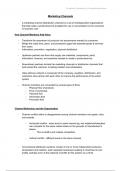
- A marketing channel (distribution channel) is a set of interdependent organisations
that help make a product/service available for use or consumption by the consumer
or business user
How Channel Members Add Value
- Transform the assortment of products into assortments wanted by customers
- Bridge the major time, place, and possession gaps that separate goods & services
from users
- Information, promotion, negotiation, physical distribution
- Upstream partners are firms that supply raw materials, components, parts,
information, finances, and expertise needed to create a product/service
- Downstream partners include the marketing channels or distribution channels that
look toward the customer, including retailers and wholesalers
- Value delivery network is composed of the company, suppliers, distributors, and
customers who partner with each other to improve the performance of the entire
system
- Channel members are connected by several types of flows
- Physical flow of products
- Flow of ownership
- Payment flow
- Information flow
- Promotion flow
Channel Behaviour and the Organisation
- Channel conflict refers to disagreement among channel members over goals, roles,
and rewards
- Horizontal conflict - same level in same channel eg. two retailers/wholesalers
can compete for the same market share on the grounds of manufacturer’s
biases
- This is healthy and creates competition
- Vertical conflict - different levels in the same channel
- Conventional distribution systems consist of one or more independent producers,
wholesalers and retailers, each separate businesses seeking to maximise its own
profits, perhaps even at the expense of profits for the system as a whole
Marketing Channels
- A marketing channel (distribution channel) is a set of interdependent organisations
that help make a product/service available for use or consumption by the consumer
or business user
How Channel Members Add Value
- Transform the assortment of products into assortments wanted by customers
- Bridge the major time, place, and possession gaps that separate goods & services
from users
- Information, promotion, negotiation, physical distribution
- Upstream partners are firms that supply raw materials, components, parts,
information, finances, and expertise needed to create a product/service
- Downstream partners include the marketing channels or distribution channels that
look toward the customer, including retailers and wholesalers
- Value delivery network is composed of the company, suppliers, distributors, and
customers who partner with each other to improve the performance of the entire
system
- Channel members are connected by several types of flows
- Physical flow of products
- Flow of ownership
- Payment flow
- Information flow
- Promotion flow
Channel Behaviour and the Organisation
- Channel conflict refers to disagreement among channel members over goals, roles,
and rewards
- Horizontal conflict - same level in same channel eg. two retailers/wholesalers
can compete for the same market share on the grounds of manufacturer’s
biases
- This is healthy and creates competition
- Vertical conflict - different levels in the same channel
- Conventional distribution systems consist of one or more independent producers,
wholesalers and retailers, each separate businesses seeking to maximise its own
profits, perhaps even at the expense of profits for the system as a whole