
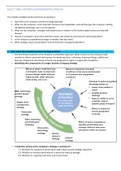
BLOCK THREE: INTERNAL ENVIRONMENTAL ANALYSIS
The analytic spotlight will be trained on six questions:
1. How well is the company’s present strategy working?
2. What are the company’s most important resources and capabilities, and will they give the company a lasting
competitive advantage over rival companies?
3. What are the company’s strengths and weaknesses in relation to the market opportunities and external
threats?
4. How do a company’s value chain activities impact cost structure and customer value proposition?
5. Is the company competitively stronger or weaker than key rivals?
6. What strategic issues and problems merit front burner managerial attention?
1. How well is the company’s present strategy working?
→ The first thing to examine is the company’s competitive approach. What moves has the company made
recently to attract customers and improve its market position – cut prices, improved design, added new
features, stepped up advertising, entered new geographical region, merged with competitor.
→ Identifying the Components of a Single- Business Company Strategy
→ 3 indicators of how well a company’s strategy is working are:
(1) Whether the company is achieving its stated financial and strategic objectives
(2) Whether its financial performance is above the industry average
(3) Whether its is gaining customers and market share
, → Specific indicators of how well a company’s strategy is working includes:
Trends in the company’s sales and earnings growth
Trends in the company’s stock price
The company’s overall financial strength
The company’s customer retention rate
The rate at which new customers are acquired
Evidence of improvement in internal processes such as defect rate, order fulfilment, delivery times,
days of inventory, and employee productivity.
→ The stronger a company’s current overall performance the more likely it has a well-conceived, well executed
strategy. The weaker a company’s financial performance and market standing, the more its current strategy
must be questioned and the more likely the need for radical changes.
Strategic Management Principle:
Sluggish financial performance and second-rate market accomplishments almost always signal weak strategy, weak
execution, or both
2. What are the company’s most important resources and capabilities, and will they give the company a lasting
competitive advantage over rival companies?
→ A company’s resources and capabilities are its competitive assets and determine whether its competitive
power in the marketplace will be impressively strong or disappointingly weak. Competitive assets are what a
firm’s strategy depends on to develop sustainable competitive advantage over its rivals.
→ Def. Resources and Capability analysis is a powerful tool for sizing up a company’s competitive assets and
determining whether the assets can support a sustainable competitive advantage over market rivals.
→ Resource and capability Analysis is a Two Step Process:
1) Identify the company’s resources and capabilities.
2) Examine them more closely to ascertain which are the most competitively important and whether
they can support a sustainable competitive advantage over rival firms.
(four tests of a resource’s competitive power)
1.) Identify the company’s resources and capabilities.
→ Def. Resource is a competitive asset that is owned or controlled by a company.
→ A resource is a productive input or competitive asset that is owned or controlled by the firm. Firms have
many different types of resources at their disposal that vary not only in kind but in quality as well.
→ Def. Capability (or Competence) is the capacity of a firm to perform some internal activity competently.
Capabilities are developed and enabled through the deployment of a company’s resources.
→ Types of Resources:
o Tangible Resources:
Physical resources
Financial Resources
Technological Resources
Organisational Resources
o Intangible Resources
Human Assets and intellectual capital
Brands, company image, reputational assets
Relationship
Company culture and incentive system
→ Identifying Capabilities
o Def. Organisational Capability Is the intangible but observable capacity of a firm to perform a
critical activity proficiently using a related combination (cross-functional bundle) of its resources,
is knowledge-based, residing in people and in a firm’s intellectual capital or in its organizational
processes and systems, embodying tacit knowledge
The analytic spotlight will be trained on six questions:
1. How well is the company’s present strategy working?
2. What are the company’s most important resources and capabilities, and will they give the company a lasting
competitive advantage over rival companies?
3. What are the company’s strengths and weaknesses in relation to the market opportunities and external
threats?
4. How do a company’s value chain activities impact cost structure and customer value proposition?
5. Is the company competitively stronger or weaker than key rivals?
6. What strategic issues and problems merit front burner managerial attention?
1. How well is the company’s present strategy working?
→ The first thing to examine is the company’s competitive approach. What moves has the company made
recently to attract customers and improve its market position – cut prices, improved design, added new
features, stepped up advertising, entered new geographical region, merged with competitor.
→ Identifying the Components of a Single- Business Company Strategy
→ 3 indicators of how well a company’s strategy is working are:
(1) Whether the company is achieving its stated financial and strategic objectives
(2) Whether its financial performance is above the industry average
(3) Whether its is gaining customers and market share
, → Specific indicators of how well a company’s strategy is working includes:
Trends in the company’s sales and earnings growth
Trends in the company’s stock price
The company’s overall financial strength
The company’s customer retention rate
The rate at which new customers are acquired
Evidence of improvement in internal processes such as defect rate, order fulfilment, delivery times,
days of inventory, and employee productivity.
→ The stronger a company’s current overall performance the more likely it has a well-conceived, well executed
strategy. The weaker a company’s financial performance and market standing, the more its current strategy
must be questioned and the more likely the need for radical changes.
Strategic Management Principle:
Sluggish financial performance and second-rate market accomplishments almost always signal weak strategy, weak
execution, or both
2. What are the company’s most important resources and capabilities, and will they give the company a lasting
competitive advantage over rival companies?
→ A company’s resources and capabilities are its competitive assets and determine whether its competitive
power in the marketplace will be impressively strong or disappointingly weak. Competitive assets are what a
firm’s strategy depends on to develop sustainable competitive advantage over its rivals.
→ Def. Resources and Capability analysis is a powerful tool for sizing up a company’s competitive assets and
determining whether the assets can support a sustainable competitive advantage over market rivals.
→ Resource and capability Analysis is a Two Step Process:
1) Identify the company’s resources and capabilities.
2) Examine them more closely to ascertain which are the most competitively important and whether
they can support a sustainable competitive advantage over rival firms.
(four tests of a resource’s competitive power)
1.) Identify the company’s resources and capabilities.
→ Def. Resource is a competitive asset that is owned or controlled by a company.
→ A resource is a productive input or competitive asset that is owned or controlled by the firm. Firms have
many different types of resources at their disposal that vary not only in kind but in quality as well.
→ Def. Capability (or Competence) is the capacity of a firm to perform some internal activity competently.
Capabilities are developed and enabled through the deployment of a company’s resources.
→ Types of Resources:
o Tangible Resources:
Physical resources
Financial Resources
Technological Resources
Organisational Resources
o Intangible Resources
Human Assets and intellectual capital
Brands, company image, reputational assets
Relationship
Company culture and incentive system
→ Identifying Capabilities
o Def. Organisational Capability Is the intangible but observable capacity of a firm to perform a
critical activity proficiently using a related combination (cross-functional bundle) of its resources,
is knowledge-based, residing in people and in a firm’s intellectual capital or in its organizational
processes and systems, embodying tacit knowledge


