Study Unit 8
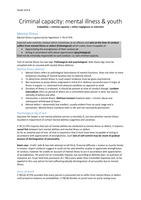
Criminal capacity: mental illness & youth
Culpability = criminal capacity + either negligence or intention
Mental illness
Mental illness is governed by legislation. S 78 of CPA.
A person who commits conduct which constitutes as an offence and who at the time of conduct
suffers from mental illness or defect (Pathological) which makes them incapable of:
Appreciating the wrongfulness of their conduct or
Acting in accordance with above appreciation (psychological)
Shall not be criminally responsible to such conduct. I.e. lack criminal capacity.
Test of mental illness has two legs. Pathological and psychological. Both these legs must be
complied with to succeed with mental illness defence.
Mental illness defined
1. Mental illness refers to pathological disturbance of mental functions. Does not refer to mere
temporary clouding of mental faculties due to external stimuli.
2. To determine mental illness in court expert evidence must be given psychiatrists
3. Not necessary to prove illness originated in mind of X: defence successful even if origin of
illness is organic i.e. stemmed from physical condition as opposed to mind.
4. Duration of illness is irrelevant. It should be present at time of conduct though. Lucidum
intervallum refers to period of where act is committed when person is sane, but was/is
mentally ill before and after.
5. Intoxication ≠ mental illness. Delirium tremens however does = chronic abuse and
subsequent withdrawal of liquor.
6. Mental defect = abnormally low intellect, usually evident from an early stage and is
permanent. Mental illness manifests later in life and not necessarily permanent.
Psychological leg of test
Question for lawyer is not merely whether person is mentally ill, but also whether mental illness
resulted in impairment of certain mental abilities (cognitive and conative).
S 78 (1) CPA requires that lack of mental abilities be attributed to mental illness or defect, it requires
causal link between lack mental abilities and mental illness or defect.
As far as conative part of test, all that is required is that X must have been incapable of acting in
accordance with appreciation of wrongfulness. Such lack of self-control may be result of gradual
process of disintegration of personality.
Kavin case - X kills’ wife & two kids attempt to kill third, financial difficulty + motive to reunite family
in heaven. Expert evidence suggest it could not be said whether unable to appreciate wrongfulness
of conduct, however he unable on account of mental illness to act in accordance with appreciation
of wrongfulness. He acted not on irresistible impulse, but according to definite plan: no question of
impulsive act. Court held that provisions of s 78(1) were wider then irresistible impulsive test, to be
applied to this case where he had suffered gradually disintegration of personality due to mental
illness.
Onus of proof
S 78(1A) of CPA provides that every person is presumed not to suffer from mental illness or defect
until proved on balance on probabilities. S 78(1B) Burden on proof rests on party raising issue.
Criminal capacity: mental illness & youth
Culpability = criminal capacity + either negligence or intention
Mental illness
Mental illness is governed by legislation. S 78 of CPA.
A person who commits conduct which constitutes as an offence and who at the time of conduct
suffers from mental illness or defect (Pathological) which makes them incapable of:
Appreciating the wrongfulness of their conduct or
Acting in accordance with above appreciation (psychological)
Shall not be criminally responsible to such conduct. I.e. lack criminal capacity.
Test of mental illness has two legs. Pathological and psychological. Both these legs must be
complied with to succeed with mental illness defence.
Mental illness defined
1. Mental illness refers to pathological disturbance of mental functions. Does not refer to mere
temporary clouding of mental faculties due to external stimuli.
2. To determine mental illness in court expert evidence must be given psychiatrists
3. Not necessary to prove illness originated in mind of X: defence successful even if origin of
illness is organic i.e. stemmed from physical condition as opposed to mind.
4. Duration of illness is irrelevant. It should be present at time of conduct though. Lucidum
intervallum refers to period of where act is committed when person is sane, but was/is
mentally ill before and after.
5. Intoxication ≠ mental illness. Delirium tremens however does = chronic abuse and
subsequent withdrawal of liquor.
6. Mental defect = abnormally low intellect, usually evident from an early stage and is
permanent. Mental illness manifests later in life and not necessarily permanent.
Psychological leg of test
Question for lawyer is not merely whether person is mentally ill, but also whether mental illness
resulted in impairment of certain mental abilities (cognitive and conative).
S 78 (1) CPA requires that lack of mental abilities be attributed to mental illness or defect, it requires
causal link between lack mental abilities and mental illness or defect.
As far as conative part of test, all that is required is that X must have been incapable of acting in
accordance with appreciation of wrongfulness. Such lack of self-control may be result of gradual
process of disintegration of personality.
Kavin case - X kills’ wife & two kids attempt to kill third, financial difficulty + motive to reunite family
in heaven. Expert evidence suggest it could not be said whether unable to appreciate wrongfulness
of conduct, however he unable on account of mental illness to act in accordance with appreciation
of wrongfulness. He acted not on irresistible impulse, but according to definite plan: no question of
impulsive act. Court held that provisions of s 78(1) were wider then irresistible impulsive test, to be
applied to this case where he had suffered gradually disintegration of personality due to mental
illness.
Onus of proof
S 78(1A) of CPA provides that every person is presumed not to suffer from mental illness or defect
until proved on balance on probabilities. S 78(1B) Burden on proof rests on party raising issue.