

Magnetism
Magnetism is an interaction that allows certain types of objects to exert certain types
of forces (attraction or repulsion) on each other without physically touching.
A magnetic field is a region in space where a magnet or magnetic object will
experience a non contact, magnetic force.
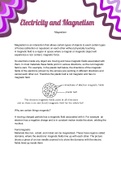
So electrons inside any object are moving and have magnetic fields associated with
them. In most materials these fields point in various directions, so the net magnetic
field is zero. For example, in the plastic ball below, the directions of the magnetic
fields of the electrons (shown by the arrows) are pointing in different directions and
cancel each other out. Therefore the plastic ball is not magnetic and has no
magnetic field.
Why are certain things magnetic?
A moving charged particle has a magnetic field associated with it. For example an
electron has a negative charge and is in constant motion inside the atom, orbiting the
nucleus.
Ferromagnetic
Materials like iron, cobalt, and nickel can be magnetised. These have regions called
domains, where the electrons’ magnetic fields line up with each other. The picture
shows a piece of an iron needle zoomed in to show the domains with the electric
fields lined up inside them
, Permanent magnets
In permanent magnets, many domains are lined up, resulting in a net magnetic field.
Permanet Magnets
The poles of permanent objects
Magnetism is an interaction that allows certain types of objects to exert certain types
of forces (attraction or repulsion) on each other without physically touching.
A magnetic field is a region in space where a magnet or magnetic object will
experience a non contact, magnetic force.
So electrons inside any object are moving and have magnetic fields associated with
them. In most materials these fields point in various directions, so the net magnetic
field is zero. For example, in the plastic ball below, the directions of the magnetic
fields of the electrons (shown by the arrows) are pointing in different directions and
cancel each other out. Therefore the plastic ball is not magnetic and has no
magnetic field.
Why are certain things magnetic?
A moving charged particle has a magnetic field associated with it. For example an
electron has a negative charge and is in constant motion inside the atom, orbiting the
nucleus.
Ferromagnetic
Materials like iron, cobalt, and nickel can be magnetised. These have regions called
domains, where the electrons’ magnetic fields line up with each other. The picture
shows a piece of an iron needle zoomed in to show the domains with the electric
fields lined up inside them
, Permanent magnets
In permanent magnets, many domains are lined up, resulting in a net magnetic field.
Permanet Magnets
The poles of permanent objects



