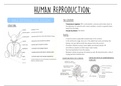
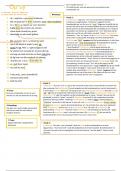
1. MALE REPRODUCTIVE SYSTEM:
- Temperature regulator → in cold weather, scrotum pulls testes closer to
the abdomen for warmth and in warm weather, scrotum suspends testes
away from the body
- Houses & protects the testes
- 2 oval structures suspended outside body in the scrotum
- In the embryonic stage, they are in the abdominal cavity just below the
kidneys, but just before birth they descend into the scrotum.
- Chambers (lobules) contain many highly convoluted tubules →
seminiferous tubules (± 250m long in each testes)
- Germinal epithelium lines the tubules
- Between tubules are groups of endocrine cells → interstitial cells / cells of
Leydig (secrete testosterone)
CROSS SECTION OF A TESTIS: CROSS SECTION OF SEMINIFEROUS
- protects head & can be removed by circumcision for
TUBULES:
foreskin
cultural / medical reasons
scrotum
Cells of Leydig
, - Continuation of seminiferous tubules - Consists of spongy tissue → erectile tissue
- highly convoluted - 3 sections = 2 x corpus cavernosa, 1 x corpus spongiosum
- ± 5m long - Erection → the dilation of arteries supplying blood to the penis, which
increases blood flow, causing the penis to lengthen & stiffen.
- No erection = no ejaculation
- Penis deposits sperm into female’s vagina (close deposition = ↑ chance of
fertilisation)
- Muscular continuation of epididymis
- WHAT IS DISTINCTIVE ABOUT THE HUMAN PENIS?
- Leaves scrotum, passes through accessory glands, then enters urethra.
> No erectile bone (baculum) like other mammals → relies on blood
- Pushes mature sperm forward by peristaltic waves from epididymis into
flow to causes an erection.
urethra → ejaculation (expulsion of semen)
> Not attached to abdominal wall, but hangs free while in other
mammals it is stored internally until erection.
- Leads to exterior of the body
- Transports semen & urine (never at the same time!)
- Plum-sized, at the base of bladder
- Secretes fluid that aids transport of sperm, containing enzymes that make
sperm more active
1
- That fluid =makes up 3
of seminal fluid (semen) - Made up of sperm & seminal fluid from prostate gland
- Seminal fluid: activates & transports sperm; nourishes & provides sperm
with energy; neutralises acidity of female tract
- Ejaculation = 2.5ml – 5ml containing 700 million sperm
- Sperm-count of less than 20 million per ml = infertile
- Temperature regulator → in cold weather, scrotum pulls testes closer to
the abdomen for warmth and in warm weather, scrotum suspends testes
away from the body
- Houses & protects the testes
- 2 oval structures suspended outside body in the scrotum
- In the embryonic stage, they are in the abdominal cavity just below the
kidneys, but just before birth they descend into the scrotum.
- Chambers (lobules) contain many highly convoluted tubules →
seminiferous tubules (± 250m long in each testes)
- Germinal epithelium lines the tubules
- Between tubules are groups of endocrine cells → interstitial cells / cells of
Leydig (secrete testosterone)
CROSS SECTION OF A TESTIS: CROSS SECTION OF SEMINIFEROUS
- protects head & can be removed by circumcision for
TUBULES:
foreskin
cultural / medical reasons
scrotum
Cells of Leydig
, - Continuation of seminiferous tubules - Consists of spongy tissue → erectile tissue
- highly convoluted - 3 sections = 2 x corpus cavernosa, 1 x corpus spongiosum
- ± 5m long - Erection → the dilation of arteries supplying blood to the penis, which
increases blood flow, causing the penis to lengthen & stiffen.
- No erection = no ejaculation
- Penis deposits sperm into female’s vagina (close deposition = ↑ chance of
fertilisation)
- Muscular continuation of epididymis
- WHAT IS DISTINCTIVE ABOUT THE HUMAN PENIS?
- Leaves scrotum, passes through accessory glands, then enters urethra.
> No erectile bone (baculum) like other mammals → relies on blood
- Pushes mature sperm forward by peristaltic waves from epididymis into
flow to causes an erection.
urethra → ejaculation (expulsion of semen)
> Not attached to abdominal wall, but hangs free while in other
mammals it is stored internally until erection.
- Leads to exterior of the body
- Transports semen & urine (never at the same time!)
- Plum-sized, at the base of bladder
- Secretes fluid that aids transport of sperm, containing enzymes that make
sperm more active
1
- That fluid =makes up 3
of seminal fluid (semen) - Made up of sperm & seminal fluid from prostate gland
- Seminal fluid: activates & transports sperm; nourishes & provides sperm
with energy; neutralises acidity of female tract
- Ejaculation = 2.5ml – 5ml containing 700 million sperm
- Sperm-count of less than 20 million per ml = infertile