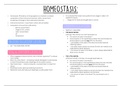
Homeostasis → tendency of living organisms to maintain a constant o O2 is removed from body more quickly & more oxygen is taken in &
composition of their internal environment, within narrow limits, supplied to tissues.
irrespective of changes in their external environment. o Oxygen & CO2 levels are brought back to normal.
Internal environment = tissue fluid in which cells are bathed
Composition of tissue fluid is affected by:
- glucose concentration
OSMOREGULATION:
- oxygen & CO2 content o Nephron is responsible
- water concentration o TOO MUCH WATER:
- pH (cold day; little activity; too much liquid taken in)
- temperature ▪ The volume of water in the blood ↑
▪ Osmoreceptors in the hypothalamus detect this and stimulate the
BLOOD GLUCOSE LEVELS: pituitary gland to secretes less ADH into the blood.
▪ ∴ permeability of the walls of the distal convoluted tubule &
collecting tubule ↓.
o SEE “THE ENDOCRINE SYSTEM” ▪ ∴ less water leaves tubules via osmosis & enters the medulla to be
reabsorbed by blood capillaries.
▪ ∴ the amount of water in the blood ↓ (less is being reabsorbed) &
CO2 & OXYGEN LEVELS: dilute urine is formed.
o When engaging in physical activity, rate of cellular respiration ↑ to release o TOO LITTLE WATER:
more energy. (strenuous activity; a hot day; not enough liquid taken in)
o More CO2 enters blood stimulating medulla oblongata to send impulses ▪ The volume of water in the blood ↓
to heart & breathing muscles (diaphragm & intercostal muscles). ▪ The osmoreceptors in the hypothalamus detect this and stimulate
o Heart beats faster blood carrying CO2 is pumped faster to lungs from the pituitary gland to secrete more ADH into the blood.
tissues. ▪ ∴ permeability of the walls of the distal convoluted tubule &
o Breathing muscles speed up breathing movements collecting tubule.
o Abdominal cavity also helps push diaphragm up with greater force. ▪ ∴ more water leaves tubules via osmosis & enters the medulla to be
reabsorbed by blood capillaries into the blood.
▪ ∴ the amount of water in the blood ↑ & concentrated urine is
formed.
composition of their internal environment, within narrow limits, supplied to tissues.
irrespective of changes in their external environment. o Oxygen & CO2 levels are brought back to normal.
Internal environment = tissue fluid in which cells are bathed
Composition of tissue fluid is affected by:
- glucose concentration
OSMOREGULATION:
- oxygen & CO2 content o Nephron is responsible
- water concentration o TOO MUCH WATER:
- pH (cold day; little activity; too much liquid taken in)
- temperature ▪ The volume of water in the blood ↑
▪ Osmoreceptors in the hypothalamus detect this and stimulate the
BLOOD GLUCOSE LEVELS: pituitary gland to secretes less ADH into the blood.
▪ ∴ permeability of the walls of the distal convoluted tubule &
collecting tubule ↓.
o SEE “THE ENDOCRINE SYSTEM” ▪ ∴ less water leaves tubules via osmosis & enters the medulla to be
reabsorbed by blood capillaries.
▪ ∴ the amount of water in the blood ↓ (less is being reabsorbed) &
CO2 & OXYGEN LEVELS: dilute urine is formed.
o When engaging in physical activity, rate of cellular respiration ↑ to release o TOO LITTLE WATER:
more energy. (strenuous activity; a hot day; not enough liquid taken in)
o More CO2 enters blood stimulating medulla oblongata to send impulses ▪ The volume of water in the blood ↓
to heart & breathing muscles (diaphragm & intercostal muscles). ▪ The osmoreceptors in the hypothalamus detect this and stimulate
o Heart beats faster blood carrying CO2 is pumped faster to lungs from the pituitary gland to secrete more ADH into the blood.
tissues. ▪ ∴ permeability of the walls of the distal convoluted tubule &
o Breathing muscles speed up breathing movements collecting tubule.
o Abdominal cavity also helps push diaphragm up with greater force. ▪ ∴ more water leaves tubules via osmosis & enters the medulla to be
reabsorbed by blood capillaries into the blood.
▪ ∴ the amount of water in the blood ↑ & concentrated urine is
formed.