Unit 1, Task 1
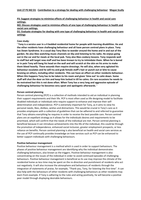
P1- Explain different types of relationships that can be built in health, social care or child care
environments
“Building positive relationships with adults, children and young people requiring care and support is
an essential part of effective practice. All work in health, social care and child care environments will
involve working in partnership with individuals who are vulnerable, at risk of harm, or in need of
support; for example, recovering from an operation in hospital, requiring assistance to live
independently because of a mental health need or requiring support while living with a foster
family.” (Ferreiro Peteiro et al., 2016) There are five types of relationships; individuals who require
care and support, families and advocates of individuals who require care and support, colleagues or
peers, senior workers and managers, professionals and practitioners. A health care environment
may be a hospital, where people may either be inpatients or outpatients. A social care setting may
be a care home, and an early year’s setting may be a crèche.
Relationships will either be formal or informal. Formal relationships are professional, include
colleagues and line manager as well as patient or client. This type of relationship is defined by rules,
policies and are regulated. Informal relationships are not defined by rules and regulations. Whereas,
caring for a family member at home is an informal relationship as the care is being carried out by the
individual’s family, but then if they also have carers come in to help, this is formal care when the
carers are there. Group relationships will be different from one-to-one relationships, as it depends
on circumstances. It is likely to be more informal within the group between the non-professionals,
however, professionals will remain formal. Group relationships require people to work in
partnership more often, but they will also need to do this during a one-to-one relationship. One-to
one relationship are where the most support can be offered as it is personalised for the individual
the professional is working with, it can positively impact how a relationship is built as they feel they
can ask for support from the worker, as they would have built up a relationship.
“An advocate is those who represent the views, needs and interests of individuals who are unable to
represent themselves.” (Ferreiro Peteiro et al., 2016) This can be done by professionals or family
members. An advocate cannot give their personal opinion. Patient advocacy means upholding
patient safety and quality of care which includes protecting patients, being the patients voice,
provision of quality care and educating patients. For example, if someone was hospitalised with
Parkinson’s, the family can decide with advice from the doctors not to have a feeding tube fitted as it
would just prolong the illness. They were being the family members advocate as he was unable to
speak as his vocal cords had also been affected by the Parkinson’s. This was able to be carried out as
the individual suffering from Parkinson’s had signed a power of attorney agreement form before the
illness progressed to say that his family could be his advocate and make decisions on his behalf if he
was unable to do so for himself.
M1- Analyse the role that context plays in different relationships in health, social care and child
care environments
Context has a role in how relationships are built within health and social care. There are different
types of contexts when it comes to relationships. There are formal relationships, informal
relationships, one-to-one and group relationships. Context will be different in different situations.
For example, when playing with a child on the floor in the preschool, workers would be more
informal, as they would be making noises to be included in the play, such as farm noises if they are
playing with farm animals, to engage the child. Whereas, when they are with the parents, the
context would change to more formal, as the worker would be informing the parents what their
P1- Explain different types of relationships that can be built in health, social care or child care
environments
“Building positive relationships with adults, children and young people requiring care and support is
an essential part of effective practice. All work in health, social care and child care environments will
involve working in partnership with individuals who are vulnerable, at risk of harm, or in need of
support; for example, recovering from an operation in hospital, requiring assistance to live
independently because of a mental health need or requiring support while living with a foster
family.” (Ferreiro Peteiro et al., 2016) There are five types of relationships; individuals who require
care and support, families and advocates of individuals who require care and support, colleagues or
peers, senior workers and managers, professionals and practitioners. A health care environment
may be a hospital, where people may either be inpatients or outpatients. A social care setting may
be a care home, and an early year’s setting may be a crèche.
Relationships will either be formal or informal. Formal relationships are professional, include
colleagues and line manager as well as patient or client. This type of relationship is defined by rules,
policies and are regulated. Informal relationships are not defined by rules and regulations. Whereas,
caring for a family member at home is an informal relationship as the care is being carried out by the
individual’s family, but then if they also have carers come in to help, this is formal care when the
carers are there. Group relationships will be different from one-to-one relationships, as it depends
on circumstances. It is likely to be more informal within the group between the non-professionals,
however, professionals will remain formal. Group relationships require people to work in
partnership more often, but they will also need to do this during a one-to-one relationship. One-to
one relationship are where the most support can be offered as it is personalised for the individual
the professional is working with, it can positively impact how a relationship is built as they feel they
can ask for support from the worker, as they would have built up a relationship.
“An advocate is those who represent the views, needs and interests of individuals who are unable to
represent themselves.” (Ferreiro Peteiro et al., 2016) This can be done by professionals or family
members. An advocate cannot give their personal opinion. Patient advocacy means upholding
patient safety and quality of care which includes protecting patients, being the patients voice,
provision of quality care and educating patients. For example, if someone was hospitalised with
Parkinson’s, the family can decide with advice from the doctors not to have a feeding tube fitted as it
would just prolong the illness. They were being the family members advocate as he was unable to
speak as his vocal cords had also been affected by the Parkinson’s. This was able to be carried out as
the individual suffering from Parkinson’s had signed a power of attorney agreement form before the
illness progressed to say that his family could be his advocate and make decisions on his behalf if he
was unable to do so for himself.
M1- Analyse the role that context plays in different relationships in health, social care and child
care environments
Context has a role in how relationships are built within health and social care. There are different
types of contexts when it comes to relationships. There are formal relationships, informal
relationships, one-to-one and group relationships. Context will be different in different situations.
For example, when playing with a child on the floor in the preschool, workers would be more
informal, as they would be making noises to be included in the play, such as farm noises if they are
playing with farm animals, to engage the child. Whereas, when they are with the parents, the
context would change to more formal, as the worker would be informing the parents what their