

Rate and extent of reaction
Reaction Rate
Describes the speed at which reactants are converted into products for a reaction
The concentration of the reactants decreases and that of the products increases
By measuring the concentration at beginning & end the rate can be determined
change in concentration f inal−initial concentration
rate of reaction = change in time
= change in time
Concentration can be mass, volume, moles etc
Collision Theory
For a reaction to occur between two particles an effective collision must take place ie. a collision which results in products
forming
Factors that increase rate of an effective collision also increase rate of reaction
If all collisions are effective then reaction should virtually be instantaneous
This doesn't happen so most collisions are ineffective
Factors that make an effective collision:
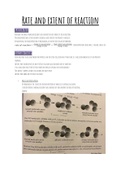
1. Molecular Orientation
Determined by the structure and orientation of molecules during collisions
If orientation is wrong reactants will bounce off one another instead of reacting
Example:
, 2. Molecular kinetic energy
When orientation is correct few collisions form a product
In order to react molecules must collide with minimum Ek known as activation energy
If molecules approach each other slowly they’ll bounce off each other
The molecules need enough energy to collide at a high speed & overcome repulsive forces
When the combined kinetic energy of reactants > the activation energy and orientation is correct an effective
collision has occurred
- Shaded area gives fraction of molecules which have kinetic energy > than activation energy
Factors affecting reaction rate
1. Chemical nature of reactants
Some reactions are slow while others are fast which is out of our control
Example: if zinc & copper are dropped into nitric acid the zinc will react faster because it is more reactive than copper
The more complex a reactant the higher the activation energy needed and therefore more energy is needed to break bonds
2. Surface area of solid reactants
Liquid or gas particles can collide freely
Particles can collide on surface of solids
If the surface area is increased more collisions take place and the rate of reaction increases
Most effective is to grind solid to powder
3. Concentration of reactants
When concentration is high there are more reactant particles per unit volume
Therefore the chances of effective collisions will be higher than a dilute solution
Works for gaseous reactions too so if the pressure is high the particles are closer and the concentration is high
Reaction Rate
Describes the speed at which reactants are converted into products for a reaction
The concentration of the reactants decreases and that of the products increases
By measuring the concentration at beginning & end the rate can be determined
change in concentration f inal−initial concentration
rate of reaction = change in time
= change in time
Concentration can be mass, volume, moles etc
Collision Theory
For a reaction to occur between two particles an effective collision must take place ie. a collision which results in products
forming
Factors that increase rate of an effective collision also increase rate of reaction
If all collisions are effective then reaction should virtually be instantaneous
This doesn't happen so most collisions are ineffective
Factors that make an effective collision:
1. Molecular Orientation
Determined by the structure and orientation of molecules during collisions
If orientation is wrong reactants will bounce off one another instead of reacting
Example:
, 2. Molecular kinetic energy
When orientation is correct few collisions form a product
In order to react molecules must collide with minimum Ek known as activation energy
If molecules approach each other slowly they’ll bounce off each other
The molecules need enough energy to collide at a high speed & overcome repulsive forces
When the combined kinetic energy of reactants > the activation energy and orientation is correct an effective
collision has occurred
- Shaded area gives fraction of molecules which have kinetic energy > than activation energy
Factors affecting reaction rate
1. Chemical nature of reactants
Some reactions are slow while others are fast which is out of our control
Example: if zinc & copper are dropped into nitric acid the zinc will react faster because it is more reactive than copper
The more complex a reactant the higher the activation energy needed and therefore more energy is needed to break bonds
2. Surface area of solid reactants
Liquid or gas particles can collide freely
Particles can collide on surface of solids
If the surface area is increased more collisions take place and the rate of reaction increases
Most effective is to grind solid to powder
3. Concentration of reactants
When concentration is high there are more reactant particles per unit volume
Therefore the chances of effective collisions will be higher than a dilute solution
Works for gaseous reactions too so if the pressure is high the particles are closer and the concentration is high


