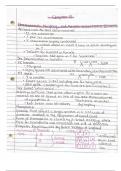
Functions and
Inverse
Functions
, Functions
WHAT MAKES A FUNCTION A FUNCTION?
It is a relationship where every element in the domain (x) and the range (y), where every element of the
domain is associated with one & only one element of the range
1. Vertical Line Test: determines if it is a function or not
IF A VERTICAL LINE CUTS THE GRAPH ONCE THE GRAPH IS A FUNCTION
Function: Not a function:
There are two types of functions:
One to one function: one element of the domain is associated with one element of the range
Many to one function: many elements of the range are associated with the same element of the domain
2. Horizontal Line Test: determines what type of function it is
a. IF THE HORIZONTAL LINE CUTS FUNCTION ONCE = ONE TO ONE FUNCTION
b. IF THE HORIZONTAL LINE CUTS THE FUNCTION MORE THAN ONCE = MANY TO ONE FUNCTION
One to one function: Many to one function:
EXAMPLE:
CONSIDER WHETHER THE GRAPH IS A FUNCTION OR NOT & EXPLAIN
Function, because every element of the domain is associated with one element of the range.
The vertical line test cuts the graph in one place
IF THE GRAPH IS A FUNCTION, STATE THE TYPE AND EXPLAIN
one to one function, because one element of the domain is associated with one element of
the range. The horizontal line test cuts the graph in one place
WRITE DOWN THE DOMAIN AND RANGE
∈
Domain: x R
∈
Range: y R
, Terminology
Definition: rule with two variables
Flow diagram:
input x RULE output y
input: x -> independent variable = domain
output: y -> dependent variable = range
Ordered pair: any point represented by (x;y)
the abscissa: x-coordinate
the ordinate: y-coordinate
DISCRETE CONTINUOUS
continued i.e cant have decimals measured i.e can have decimals
Function Notation NOTE:
method of writing y=3x as f(x) = 3x, where f represents the function IF THERE IS A
f(x) describes the elements of the range of a function FUNCTION WITHIN A
x = independent variable ; f(x) = dependent variable FUNCTION, DO THE
INNER FIRST
EXAMPLE: F(x) = 2x -4
EVALUATE CALCULATE IF F(x) =2 GIVEN FUNCTION: p(x) = 2 - 4x
f (-2) = 2 (-2) -4 2x - 4 =2 Determine the expressions
= -4 -4 2x = 6 2p(x) = 2 (2 - 4x) p(2x) = 2 - 4 (2x)
= -8 x=3 = 4 - 8x = 2 - 8x
Inverse
Functions
, Functions
WHAT MAKES A FUNCTION A FUNCTION?
It is a relationship where every element in the domain (x) and the range (y), where every element of the
domain is associated with one & only one element of the range
1. Vertical Line Test: determines if it is a function or not
IF A VERTICAL LINE CUTS THE GRAPH ONCE THE GRAPH IS A FUNCTION
Function: Not a function:
There are two types of functions:
One to one function: one element of the domain is associated with one element of the range
Many to one function: many elements of the range are associated with the same element of the domain
2. Horizontal Line Test: determines what type of function it is
a. IF THE HORIZONTAL LINE CUTS FUNCTION ONCE = ONE TO ONE FUNCTION
b. IF THE HORIZONTAL LINE CUTS THE FUNCTION MORE THAN ONCE = MANY TO ONE FUNCTION
One to one function: Many to one function:
EXAMPLE:
CONSIDER WHETHER THE GRAPH IS A FUNCTION OR NOT & EXPLAIN
Function, because every element of the domain is associated with one element of the range.
The vertical line test cuts the graph in one place
IF THE GRAPH IS A FUNCTION, STATE THE TYPE AND EXPLAIN
one to one function, because one element of the domain is associated with one element of
the range. The horizontal line test cuts the graph in one place
WRITE DOWN THE DOMAIN AND RANGE
∈
Domain: x R
∈
Range: y R
, Terminology
Definition: rule with two variables
Flow diagram:
input x RULE output y
input: x -> independent variable = domain
output: y -> dependent variable = range
Ordered pair: any point represented by (x;y)
the abscissa: x-coordinate
the ordinate: y-coordinate
DISCRETE CONTINUOUS
continued i.e cant have decimals measured i.e can have decimals
Function Notation NOTE:
method of writing y=3x as f(x) = 3x, where f represents the function IF THERE IS A
f(x) describes the elements of the range of a function FUNCTION WITHIN A
x = independent variable ; f(x) = dependent variable FUNCTION, DO THE
INNER FIRST
EXAMPLE: F(x) = 2x -4
EVALUATE CALCULATE IF F(x) =2 GIVEN FUNCTION: p(x) = 2 - 4x
f (-2) = 2 (-2) -4 2x - 4 =2 Determine the expressions
= -4 -4 2x = 6 2p(x) = 2 (2 - 4x) p(2x) = 2 - 4 (2x)
= -8 x=3 = 4 - 8x = 2 - 8x