

Chapter 6:
Consumer Attitudes
https://www.geektonight.com/what-is-attitude-meaning-functions-types-importance-components/
1. Introduction
• Attitude is widely used to describe the way people feel, think or behave towards something,
including products, other people, events and issues.
• Attitude is not tangible
• Attitude influences the way consumers respond to their products and services, including the
decision to buy or not buy a product or service and whether or not to recommend it.
2. Defining Attitudes
Gordan Allport: a learned predisposition to respond in a consistently favourable or unfavourable
manner with respect to a given object.
The main characteristics of attitudes:
• Attitudes are specific
• Attitudes are learnt
• Attitudes are predispositions to respond
• The response to attitude objects is consistent
• Attitudes have valence (direction)
• Attitudes have strength
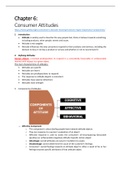
3. Components of Attitudes
→ Affective Component
o This component is about feeling people have towards attitude objects.
o They are response to a person’s evaluation of an object.
o Affective response is used to assess the consumers’ all-encompassing favourable
(positive) or unfavourable (negative) attitude towards certain object.
o Advantage: overall attitudes are easy for marketers to assess
o Disadvantage: cannot determine the cause of the customer’s feelings.
o Consumers’ overall feelings towards an attitude object is often a result of his or her
feelings towards specific attributes of that attitude object.
, o Marketers must identify the influence on customers to find out why they have these
feelings.
→ Cognitive Component
o Cognitive component is about a person’s knowledge and perception towards
attributes of an attitude object. This knowledge and these perceptions are expressed
in the form of beliefs.
o Beliefs of a customer may not always be correct or factual evidence may not be
available.
o What makes a customer’s beliefs important is that they influence buying behaviour.
– the companies’ benefit supplies the market continuously with correct information
that reinforces positives beliefs about the product and to shape consumer’s beliefs in
a positive direction.
→ Behavioural Component
o Behavioural component is concerned with the consumer’s intentions or likelihood to
behave a certain way with regard to an attitude object.
o Conative Component of Attitudes
o Positive behavioural intention indicates a positive attitude towards an attitude object,
while negative behavioural intentions indicate a negative attitude towards a specific
object.
o Consumer behavioural intentions help in predicting how customers will act towards
their company’s products.
o Helps with product planning and production schedules
4. Models of Attitudes
→ Single Component Models
o Measures attitudes as one-dimensional and consisting of the affective component of
attitudes.
o Attitude can be understood by simply examining the affect one has for or against an
attitude object.
→ Multi- Attribute Models
o Portray consumer attitudes towards a product as a function of three components:
▪ The attribute of the product
▪ Beliefs about the attributes
▪ The level of importance attached to the attributes or benefits associated with
the attributes.
o Multi-attribute models show that consumers have positive attitudes towards
products that have more of the attributes that they regard as important.
o Consumers will therefore have negative attitudes towards products that have fewer
of the attributes that they consider important.
→ Tri-component Models
o ABC Model of attitudes:
▪ A → Affective
▪ B → Behavioural
▪ C → Cognitive
o Advocates of the tri-component model maintain that consumers’ attitudes toward a
product cannot be determined by beliefs, feelings or behavioural intentions alone,
but that all three of these components are interrelated and internally consistent. This
Consumer Attitudes
https://www.geektonight.com/what-is-attitude-meaning-functions-types-importance-components/
1. Introduction
• Attitude is widely used to describe the way people feel, think or behave towards something,
including products, other people, events and issues.
• Attitude is not tangible
• Attitude influences the way consumers respond to their products and services, including the
decision to buy or not buy a product or service and whether or not to recommend it.
2. Defining Attitudes
Gordan Allport: a learned predisposition to respond in a consistently favourable or unfavourable
manner with respect to a given object.
The main characteristics of attitudes:
• Attitudes are specific
• Attitudes are learnt
• Attitudes are predispositions to respond
• The response to attitude objects is consistent
• Attitudes have valence (direction)
• Attitudes have strength
3. Components of Attitudes
→ Affective Component
o This component is about feeling people have towards attitude objects.
o They are response to a person’s evaluation of an object.
o Affective response is used to assess the consumers’ all-encompassing favourable
(positive) or unfavourable (negative) attitude towards certain object.
o Advantage: overall attitudes are easy for marketers to assess
o Disadvantage: cannot determine the cause of the customer’s feelings.
o Consumers’ overall feelings towards an attitude object is often a result of his or her
feelings towards specific attributes of that attitude object.
, o Marketers must identify the influence on customers to find out why they have these
feelings.
→ Cognitive Component
o Cognitive component is about a person’s knowledge and perception towards
attributes of an attitude object. This knowledge and these perceptions are expressed
in the form of beliefs.
o Beliefs of a customer may not always be correct or factual evidence may not be
available.
o What makes a customer’s beliefs important is that they influence buying behaviour.
– the companies’ benefit supplies the market continuously with correct information
that reinforces positives beliefs about the product and to shape consumer’s beliefs in
a positive direction.
→ Behavioural Component
o Behavioural component is concerned with the consumer’s intentions or likelihood to
behave a certain way with regard to an attitude object.
o Conative Component of Attitudes
o Positive behavioural intention indicates a positive attitude towards an attitude object,
while negative behavioural intentions indicate a negative attitude towards a specific
object.
o Consumer behavioural intentions help in predicting how customers will act towards
their company’s products.
o Helps with product planning and production schedules
4. Models of Attitudes
→ Single Component Models
o Measures attitudes as one-dimensional and consisting of the affective component of
attitudes.
o Attitude can be understood by simply examining the affect one has for or against an
attitude object.
→ Multi- Attribute Models
o Portray consumer attitudes towards a product as a function of three components:
▪ The attribute of the product
▪ Beliefs about the attributes
▪ The level of importance attached to the attributes or benefits associated with
the attributes.
o Multi-attribute models show that consumers have positive attitudes towards
products that have more of the attributes that they regard as important.
o Consumers will therefore have negative attitudes towards products that have fewer
of the attributes that they consider important.
→ Tri-component Models
o ABC Model of attitudes:
▪ A → Affective
▪ B → Behavioural
▪ C → Cognitive
o Advocates of the tri-component model maintain that consumers’ attitudes toward a
product cannot be determined by beliefs, feelings or behavioural intentions alone,
but that all three of these components are interrelated and internally consistent. This


