

DNA: The code of life
DNA is often referred to as the code of life because:
• It contains instructions on how to build various proteins.
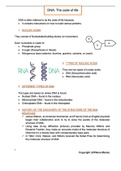
1. NUCLEIC ACIDS
They consist of Nucleotides/building blocks (or monomers)
Each nucleotide is made of:
• Phosphate group
• A sugar (Deoxyribose or ribose)
• Nitrogenous base (adenine, thymine, guanine, cytosine, or uracil)
2. TYPES OF NUCLEIC ACIDS
They are two types of nucleic acids:
• DNA (Deoxyribonucleic acid)
• RNA (ribonucleic acid)
3. DIFFERENT TYPES OF DNA
The types are based on where DNA is found:
• Nuclear DNA – found in the nucleus.
• Mitochondrial DNA – found in the mitochondria.
• Chloroplastic DNA – found in the chloroplast.
4. HISTORY OF THE DISCOVERY OF THE STRUCTURE OF THE DNA
MOLECULE
✓ James Watson, an American biochemist, and Francis Crick an English physicist
began their collaborative work to try to solve the puzzle of the molecular
structure of DNA.
✓ Using data (X-ray diffraction pictures) provided by Maurice Wilkins and
Rosalind Franklin, they made an accurate model of the molecular structure of
DNA that it’s a double helix with complementary base pairs.
✓ In 1962, Crick, Watson, and Wilkins received the Nobel Prize for determining
the molecular structure of DNA
1
Copyright @Wilene Marais
, 5. STRUCTURE OF DNA
• Question: Describe the structure of DNA.
✓ It is made up of Nucleotides.
✓ Each Nucleotide has a phosphate group, deoxyribose sugar, and nitrogenous
base.
✓ The nucleotides are joined together by phosphate –sugar bond to form a
strand.
✓ They are four nitrogenous bases, A, T, C, G which are
✓ complementary to each other i.e., adenine (A) to thymine (T), cytosine (C) to
guanine (G)
✓ Nitrogenous bases link by weak hydrogen bonds to form two strands.
✓ The two-strand twist to form a Double helix.
6. FUNCTIONS OF DNA:
• Sections of DNA forming genes carry hereditary information
• DNA contains coded information for protein synthesis
7. DNA REPLICATION:
• What is DNA replication?
✓ It is the process by which DNA makes an exact copy of itself that is
identical to the original molecule.
• When in the cell cycle it take place?
✓ During interphase, before cell division
• Where does it take place?
✓ In the nucleus of the cell
• Why does it take place (significance)?
✓ To double the chromosome number/ genetic material
✓ Results in the formation of identical daughter cells during mitosis.
2
Copyright @Wilene Marais
, 8. DNA REPLICATION PROCESS
• How DNA replication takes place?
✓ DNA double helix unwinds.
Weak hydrogen bonds break (unzip)
To form two separate strands.
Each acting as a template.
✓ Using free-floating DNA nucleotide from the
nucleoplasm.
A complementary DNA strand is formed
Where A pairs with T and G with C
✓ Two new DNA molecules are formed which
are
genetically identical, with one original strand and one new strand.
The daughter DNA molecules twist to form a double helix.
The process is controlled by an enzyme – DNA polymerase.
9. DNA PROFILING
This is a technique of identifying someone’s
unknown DNA profile using a known DNA profile
• Uses of DNA profiling:
✓ Personal Identification
✓ Paternity and Maternity
✓ Diagnosis Inherited Diseases
✓ Criminal Identification and
✓ Forensics
✓ Identifying suitable organ donors
• Disadvantages of DNA profiling:
✓ Expensive
✓ Human error
✓ Not all hospitals have the
necessary requirements to carry out DNA profiling.
✓ It is possible to plant DNA at a crime scene giving false evidence, or an
innocent person's DNA might be at the scene even though it had nothing to
do with the crime.
10. DIFFERENT TYPES OF RNA
3
Copyright @Wilene Marais
, • Messenger RNA (mRNA):
Responsible for carrying the genetic code that is transcribed from DNA to
specialized sites of the ribosomes where the information is translated for protein
synthesis
• Ribosomal RNA (rRNA):
Forms the ribosomes and produce the proteins, based on the information
received from the tRNA.
• Transfer RNA (tRNA):
Has anticodons that code for a specific amino acid. The anticodons are
complementary to the mRNA codon, during the production of proteins.
11. THE ROLE OF RNA IN PROTEIN SYNTHESIS
• Messenger RNA (mRNA) molecules carry the coding sequences for protein
synthesis.
• Ribosomal RNA (rRNA) molecules form the core of a cell's ribosomes.
• Transfer RNA (tRNA) molecules carry amino acids to the ribosomes
during protein synthesis.
12. STRUCTURE OF RNA:
✓ A single-stranded molecule consisting of nucleotides.
✓ Each nucleotide is made up of sugar(ribose), phosphate, and a nitrogen base.
✓ 4 nitrogenous bases of RNA are:
adenine(A), uracil (U), cytosine (C), guanine (G)
4
Copyright @Wilene Marais
, 13. FUNCTION OF RNA:
Carries instructions from DNA in the nucleus to the ribosomes in the cytoplasm of
a cell where it controls the synthesis of proteins from amino acids.
14. PROTEIN SYNTHESIS
• Protein synthesis is the process by which proteins are made in each cell of an
organism to form enzymes, hormones, and new structures for cells.
• Transcription: (the formation of mRNA)
✓ Double helix DNA unwinds.
✓ When the weak hydrogen bonds break (unzips) one strand is used as a template
to form an mRNA strand, using free mRNA nucleotides from the nucleoplasm.
✓ mRNA is complementary to the DNA (where A to U and C to G)
✓ mRNA now has the coded message for protein synthesis.
✓ mRNA moves from the nucleus through the nuclear pore to the cytoplasm and
attaches to the ribosome.
• Translation (the formation of a polypeptide chain)
✓ Each tRNA carries a specific amino acid.
✓ When the anticodon on the tRNA matches the codon on the mRNA, then tRNA
brings the required amino acid to the ribosome.
✓ Amino acids become attached by peptide bonds to form the required protein.
15. Gene mutation
• A gene mutation is a permanent
alteration in the DNA sequence that
makes up a gene.
5
Copyright @Wilene Marais
DNA is often referred to as the code of life because:
• It contains instructions on how to build various proteins.
1. NUCLEIC ACIDS
They consist of Nucleotides/building blocks (or monomers)
Each nucleotide is made of:
• Phosphate group
• A sugar (Deoxyribose or ribose)
• Nitrogenous base (adenine, thymine, guanine, cytosine, or uracil)
2. TYPES OF NUCLEIC ACIDS
They are two types of nucleic acids:
• DNA (Deoxyribonucleic acid)
• RNA (ribonucleic acid)
3. DIFFERENT TYPES OF DNA
The types are based on where DNA is found:
• Nuclear DNA – found in the nucleus.
• Mitochondrial DNA – found in the mitochondria.
• Chloroplastic DNA – found in the chloroplast.
4. HISTORY OF THE DISCOVERY OF THE STRUCTURE OF THE DNA
MOLECULE
✓ James Watson, an American biochemist, and Francis Crick an English physicist
began their collaborative work to try to solve the puzzle of the molecular
structure of DNA.
✓ Using data (X-ray diffraction pictures) provided by Maurice Wilkins and
Rosalind Franklin, they made an accurate model of the molecular structure of
DNA that it’s a double helix with complementary base pairs.
✓ In 1962, Crick, Watson, and Wilkins received the Nobel Prize for determining
the molecular structure of DNA
1
Copyright @Wilene Marais
, 5. STRUCTURE OF DNA
• Question: Describe the structure of DNA.
✓ It is made up of Nucleotides.
✓ Each Nucleotide has a phosphate group, deoxyribose sugar, and nitrogenous
base.
✓ The nucleotides are joined together by phosphate –sugar bond to form a
strand.
✓ They are four nitrogenous bases, A, T, C, G which are
✓ complementary to each other i.e., adenine (A) to thymine (T), cytosine (C) to
guanine (G)
✓ Nitrogenous bases link by weak hydrogen bonds to form two strands.
✓ The two-strand twist to form a Double helix.
6. FUNCTIONS OF DNA:
• Sections of DNA forming genes carry hereditary information
• DNA contains coded information for protein synthesis
7. DNA REPLICATION:
• What is DNA replication?
✓ It is the process by which DNA makes an exact copy of itself that is
identical to the original molecule.
• When in the cell cycle it take place?
✓ During interphase, before cell division
• Where does it take place?
✓ In the nucleus of the cell
• Why does it take place (significance)?
✓ To double the chromosome number/ genetic material
✓ Results in the formation of identical daughter cells during mitosis.
2
Copyright @Wilene Marais
, 8. DNA REPLICATION PROCESS
• How DNA replication takes place?
✓ DNA double helix unwinds.
Weak hydrogen bonds break (unzip)
To form two separate strands.
Each acting as a template.
✓ Using free-floating DNA nucleotide from the
nucleoplasm.
A complementary DNA strand is formed
Where A pairs with T and G with C
✓ Two new DNA molecules are formed which
are
genetically identical, with one original strand and one new strand.
The daughter DNA molecules twist to form a double helix.
The process is controlled by an enzyme – DNA polymerase.
9. DNA PROFILING
This is a technique of identifying someone’s
unknown DNA profile using a known DNA profile
• Uses of DNA profiling:
✓ Personal Identification
✓ Paternity and Maternity
✓ Diagnosis Inherited Diseases
✓ Criminal Identification and
✓ Forensics
✓ Identifying suitable organ donors
• Disadvantages of DNA profiling:
✓ Expensive
✓ Human error
✓ Not all hospitals have the
necessary requirements to carry out DNA profiling.
✓ It is possible to plant DNA at a crime scene giving false evidence, or an
innocent person's DNA might be at the scene even though it had nothing to
do with the crime.
10. DIFFERENT TYPES OF RNA
3
Copyright @Wilene Marais
, • Messenger RNA (mRNA):
Responsible for carrying the genetic code that is transcribed from DNA to
specialized sites of the ribosomes where the information is translated for protein
synthesis
• Ribosomal RNA (rRNA):
Forms the ribosomes and produce the proteins, based on the information
received from the tRNA.
• Transfer RNA (tRNA):
Has anticodons that code for a specific amino acid. The anticodons are
complementary to the mRNA codon, during the production of proteins.
11. THE ROLE OF RNA IN PROTEIN SYNTHESIS
• Messenger RNA (mRNA) molecules carry the coding sequences for protein
synthesis.
• Ribosomal RNA (rRNA) molecules form the core of a cell's ribosomes.
• Transfer RNA (tRNA) molecules carry amino acids to the ribosomes
during protein synthesis.
12. STRUCTURE OF RNA:
✓ A single-stranded molecule consisting of nucleotides.
✓ Each nucleotide is made up of sugar(ribose), phosphate, and a nitrogen base.
✓ 4 nitrogenous bases of RNA are:
adenine(A), uracil (U), cytosine (C), guanine (G)
4
Copyright @Wilene Marais
, 13. FUNCTION OF RNA:
Carries instructions from DNA in the nucleus to the ribosomes in the cytoplasm of
a cell where it controls the synthesis of proteins from amino acids.
14. PROTEIN SYNTHESIS
• Protein synthesis is the process by which proteins are made in each cell of an
organism to form enzymes, hormones, and new structures for cells.
• Transcription: (the formation of mRNA)
✓ Double helix DNA unwinds.
✓ When the weak hydrogen bonds break (unzips) one strand is used as a template
to form an mRNA strand, using free mRNA nucleotides from the nucleoplasm.
✓ mRNA is complementary to the DNA (where A to U and C to G)
✓ mRNA now has the coded message for protein synthesis.
✓ mRNA moves from the nucleus through the nuclear pore to the cytoplasm and
attaches to the ribosome.
• Translation (the formation of a polypeptide chain)
✓ Each tRNA carries a specific amino acid.
✓ When the anticodon on the tRNA matches the codon on the mRNA, then tRNA
brings the required amino acid to the ribosome.
✓ Amino acids become attached by peptide bonds to form the required protein.
15. Gene mutation
• A gene mutation is a permanent
alteration in the DNA sequence that
makes up a gene.
5
Copyright @Wilene Marais



