
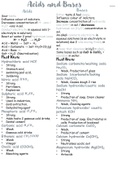
Acids and Bases
Acids Bases
Sour taste. Bitter taste & feel soapy.
Influence colour of indictors. Influence colour of indictors.
Increases concentration of H+ -ions / Increase concentration of hydroxide
H3O+ -ions in sol. ions (OH−) in sol / decreases
Conduct electricity in aqueous sols (= hydronium ion (H3O+) concentration in
electrolyte in solution). sol.
React w/ water 2 prod hydronium ions: An alkali conducts electricity in
H+ + H2O → H3O+ aqueous solutions (is an electrolyte in
Acid + Metal → Salt + H2 solutions) due 2 ions moving freely in
Acid + Carbonate → Salt +H2O+CO2(g) sol.
Acid + Base → A base that dissolves in H2O = alkali.
Salt + H2O (Neutralisation) Some bases such as CuO & CaCO3 =
insoluble in water.
Must Know
Must Know
Hydrochloric acid HCℓ
• Strong Sodium carbonate/washing soda
• Na2CO3
Stomach acid,
• • Weak, Production of glass
swimming pool acid,
• Soldering Sodium bicarbonate/baking
Nitric acid 𝑯𝑵𝑶𝟑 soda NaHCO3
• Strong • Weak, Causes dough 2 rise
• Fertilisers, Sodium hydroxide/caustic soda
• Explosives NaOH
Sulphuric acid 𝑯𝟐𝑺𝑶𝟒 • Strong
• Strong • Production of soap, Drain cleaner
• Used in industries, Ammonia NH3
• Gold extraction, • Weak, Cleaning agents
• Dehydrating agent Potassium hydroxide/ caustic
Phosphoric acid 𝑯𝟑𝑷𝑶𝟒 potash KOH
• Strong • Strong
• Adds taste 2 gaseous cold drinks, • Production of soap, Electrolytes in
• Dental cement cells, Production of biodiesel
Carbonic acid 𝑯𝟐𝑪𝑶𝟑 Calcium carbonate CaCO3
• Weak • Weak,
• Gaseous cold drinks • Production of cement
Ethanoic acid 𝑪𝑯𝟑𝑪𝑶𝑶𝑯 Calcium hydroxide Ca(OH)2
• Weak • Strong
• Vinegar • Neutralises acidic soil
Oxalic acid (COOH)2 Magnesium hydroxide Mg(OH)2
• Weak • Strong
• Bleaching agents • Antacids
, Ionization of Acids Acid-Base Models
Acids ionize in water. Arrhenius Theory
Bcz = molecular compound does not An Arrhenius acid releases H+ -ions in
contain ions. aqueous solutions.
When dissolves in water, water HCℓ → H+ + Cℓ−
molecule remove proton thereby An Arrhenius base releases OH− -ions
creating ionic substance. in aqueous solutions.
Hydrochloric acid in water: NaOH → Na+ + OH−
HCℓ(g) + H2O(ℓ) ⇋ H3O+(aq) + Cℓ−(aq)
Sulphuric acid in water:
Brønsted-Lowry Theory
H2SO4(g) + 2H2O(ℓ) ⇋ 2H3O+(aq) + SO42−(aq) A Brønsted-Lowry acid = proton
Dissociation of Bases donor.
Most bases dissociate= breaks up in2 HCℓ → H+ + Cℓ−
ions w/e dissolved in water. NH4+ → H+ + NH3
The ions = already present b4 sub A Brønsted-Lowry base = proton
added 2 water & merely separate from acceptor.
e/o. OH− + H+ → H2O
Sodium hydroxide in water: Conjugate Acid-Base Pairs
NaOH(s) → Na+(aq) + OH−(aq) An acid-base reaction = reaction in
*Exception is NH3. Because it is which there = transfer of proton (H+)
molecular it will ionize in water* from acid to base & = called protolytic
Ammonia in water: reaction.
NH3(g) + H2O(ℓ) ⇋ NH4+(aq) + OH−(aq) Conjugated Bases
(Ionisation)
W/e acid donates proton (H+), a
Mono and Polyprotic Acids conjugated base is produced.
Some acids = only 1 proton (H+) 2 Acid ⇌ Conjugated Base + H+
donate while oths have more. Strong acid always produces weak
Acids = classified acc 2 # protons (H+) conjugate base.
can donate. HCℓ ⇌ H+ + Cℓ−
Monoprotic Acids Strong acid weak conjugated base
Can only donate 1 proton (H+) per H2CO3 ⇌ H+ + HCO3-
Weak acid strong conjugated base
formula unit.
Conjugated Acids
HCℓ, HNO3, CH3COOH
W/e base receives proton (H+), a
Polyprotic Acids
conjugated acid = produced.
Can donate more than 1 proton (H+)
Base + H+ ⇌ Conjugated Acid
per formula unit.
The strong base always produces a
• Diprotic acids weak conjugated acid
Can donate 2 protons (H+) per formula OH− + H+ ⇌ H2O
unit. H2SO4, H2CO3 Strong base Weak conjugated acid
• Triprotic acids HSO4 − + H+ ⇌ H2SO4
Can donate 3 protons (H+) per formula Weak base Strong conjugated acid
unit. H3PO4
Acids Bases
Sour taste. Bitter taste & feel soapy.
Influence colour of indictors. Influence colour of indictors.
Increases concentration of H+ -ions / Increase concentration of hydroxide
H3O+ -ions in sol. ions (OH−) in sol / decreases
Conduct electricity in aqueous sols (= hydronium ion (H3O+) concentration in
electrolyte in solution). sol.
React w/ water 2 prod hydronium ions: An alkali conducts electricity in
H+ + H2O → H3O+ aqueous solutions (is an electrolyte in
Acid + Metal → Salt + H2 solutions) due 2 ions moving freely in
Acid + Carbonate → Salt +H2O+CO2(g) sol.
Acid + Base → A base that dissolves in H2O = alkali.
Salt + H2O (Neutralisation) Some bases such as CuO & CaCO3 =
insoluble in water.
Must Know
Must Know
Hydrochloric acid HCℓ
• Strong Sodium carbonate/washing soda
• Na2CO3
Stomach acid,
• • Weak, Production of glass
swimming pool acid,
• Soldering Sodium bicarbonate/baking
Nitric acid 𝑯𝑵𝑶𝟑 soda NaHCO3
• Strong • Weak, Causes dough 2 rise
• Fertilisers, Sodium hydroxide/caustic soda
• Explosives NaOH
Sulphuric acid 𝑯𝟐𝑺𝑶𝟒 • Strong
• Strong • Production of soap, Drain cleaner
• Used in industries, Ammonia NH3
• Gold extraction, • Weak, Cleaning agents
• Dehydrating agent Potassium hydroxide/ caustic
Phosphoric acid 𝑯𝟑𝑷𝑶𝟒 potash KOH
• Strong • Strong
• Adds taste 2 gaseous cold drinks, • Production of soap, Electrolytes in
• Dental cement cells, Production of biodiesel
Carbonic acid 𝑯𝟐𝑪𝑶𝟑 Calcium carbonate CaCO3
• Weak • Weak,
• Gaseous cold drinks • Production of cement
Ethanoic acid 𝑪𝑯𝟑𝑪𝑶𝑶𝑯 Calcium hydroxide Ca(OH)2
• Weak • Strong
• Vinegar • Neutralises acidic soil
Oxalic acid (COOH)2 Magnesium hydroxide Mg(OH)2
• Weak • Strong
• Bleaching agents • Antacids
, Ionization of Acids Acid-Base Models
Acids ionize in water. Arrhenius Theory
Bcz = molecular compound does not An Arrhenius acid releases H+ -ions in
contain ions. aqueous solutions.
When dissolves in water, water HCℓ → H+ + Cℓ−
molecule remove proton thereby An Arrhenius base releases OH− -ions
creating ionic substance. in aqueous solutions.
Hydrochloric acid in water: NaOH → Na+ + OH−
HCℓ(g) + H2O(ℓ) ⇋ H3O+(aq) + Cℓ−(aq)
Sulphuric acid in water:
Brønsted-Lowry Theory
H2SO4(g) + 2H2O(ℓ) ⇋ 2H3O+(aq) + SO42−(aq) A Brønsted-Lowry acid = proton
Dissociation of Bases donor.
Most bases dissociate= breaks up in2 HCℓ → H+ + Cℓ−
ions w/e dissolved in water. NH4+ → H+ + NH3
The ions = already present b4 sub A Brønsted-Lowry base = proton
added 2 water & merely separate from acceptor.
e/o. OH− + H+ → H2O
Sodium hydroxide in water: Conjugate Acid-Base Pairs
NaOH(s) → Na+(aq) + OH−(aq) An acid-base reaction = reaction in
*Exception is NH3. Because it is which there = transfer of proton (H+)
molecular it will ionize in water* from acid to base & = called protolytic
Ammonia in water: reaction.
NH3(g) + H2O(ℓ) ⇋ NH4+(aq) + OH−(aq) Conjugated Bases
(Ionisation)
W/e acid donates proton (H+), a
Mono and Polyprotic Acids conjugated base is produced.
Some acids = only 1 proton (H+) 2 Acid ⇌ Conjugated Base + H+
donate while oths have more. Strong acid always produces weak
Acids = classified acc 2 # protons (H+) conjugate base.
can donate. HCℓ ⇌ H+ + Cℓ−
Monoprotic Acids Strong acid weak conjugated base
Can only donate 1 proton (H+) per H2CO3 ⇌ H+ + HCO3-
Weak acid strong conjugated base
formula unit.
Conjugated Acids
HCℓ, HNO3, CH3COOH
W/e base receives proton (H+), a
Polyprotic Acids
conjugated acid = produced.
Can donate more than 1 proton (H+)
Base + H+ ⇌ Conjugated Acid
per formula unit.
The strong base always produces a
• Diprotic acids weak conjugated acid
Can donate 2 protons (H+) per formula OH− + H+ ⇌ H2O
unit. H2SO4, H2CO3 Strong base Weak conjugated acid
• Triprotic acids HSO4 − + H+ ⇌ H2SO4
Can donate 3 protons (H+) per formula Weak base Strong conjugated acid
unit. H3PO4



