
INVERSES
The rule that reverses a process is called the inverse of the original rule.
e.g.1 Consider the function 𝑓 (𝑥) = 2𝑥 − 4
Rule 𝑓 transforms input values in the domain into output values in the range using
the rule 𝑦 = 2𝑥 − 4
𝑥 → × 2 → −4 → 𝑦
So, if 𝑥 = 3 then 𝑓(3) = 2(3) − 4
=2
The rule that reverses this process transforms 2 back to 3 and is called the inverse
function.
𝑥 ← ÷ 2 ← +4 ← 𝑦
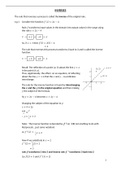
Recall: The reflection of a point (𝑎; 𝑏) about the line 𝑦 = 𝑥 𝑦=𝑥
(1; 2)
is the point (𝑏; 𝑎).
Thus, algebraically, the effect, on an equation, of reflecting
about the line 𝑦 = 𝑥 is that the 𝑥 and 𝑦 – co-ordinates (2; 1)
interchange.
The rule for the inverse function is found by interchanging
the 𝒙 and the 𝒚 in the original equation and then making
𝑦 the subject of the formula.
So 𝑦 = 2𝑥 − 4 becomes 𝑥 = 2𝑦 − 4
Changing the subject of the equation to 𝑦:
𝑥 + 4 = 2𝑦
𝑥+4 y
2 =
∴𝑦= 1𝑥+2
2
Note: The inverse function is denoted by 𝒇−𝟏(𝒙) (NB not anything to do with
Reciprocals …just same notation)
so 𝑓−1(𝑥) = 1
𝑥+2
2
Now if we substitute in 𝑥 = 2
1
𝑓−1(2) = (2) + 2
2
=3
rule 𝒇 transforms 2 into 3 and inverse rule 𝒇−𝟏 transforms 3 back into 2
(so 𝑓(2) = 3 and 𝑓−1(3) = 2)
1
, e.g.2 Given 𝑓(𝑥) = 3𝑥 + 2 (i.e. 𝑦 = 3𝑥 + 2)
a) Sketch 𝑓(𝑥) showing intercepts with the axes.
b) Sketch 𝑦 = 𝑥.
c) Sketch 𝑓−1(𝑥) showing intercepts with the axes.
d) Determine the equation of 𝑓−1(𝑥).
a) Giving an acceptable reason in each case, decide if 𝑓(𝑥) and 𝑓−1(𝑥) are
functions.
Solution:
Method - Sketch𝑓(𝑥) then using the transformation (𝑥; 𝑦) → (𝑦; 𝑥) plot the new
points on the same set of axes.
Draw in the line 𝑦 = 𝑥 and note how it acts as a line of symmetry for the two
graphs.
Label 𝑓(𝑥) and 𝑓−1(𝑥)
a) b) and c) 𝑓(𝑥) 𝑦= 𝑥
𝑵𝑶𝑻𝑬:
The 𝒚 -intercept of 𝒇 is (0;2)
𝑓−1(𝑥)
The 𝒙-intercept of 𝒇−𝟏 is
(2;0)
𝒇 and 𝒇−𝟏 intersect on
the line 𝒚 = 𝒙
d) Inverse function: 𝑥 = 3𝑦 + 2 (interchange 𝑥 and 𝑦)
∴𝑦=1 2 (make 𝑦 the subject)
3𝑥 − 3
1 2
e) In function notation: 𝑓−1(𝑥) = 3 𝑥 − 3
f) 𝑓(𝑥) is a one − to − one relation and therefore a function.
𝑓−1(𝑥) is a one − to − one relation and therefore a function.
NOTE: THE GRAPHS OF 𝒇 AND 𝒇−𝟏 ARE REFLECTIONS OF EACH OTHER IN THE LINE
𝒚 = 𝒙.
2


