
INTERMOLECULAR FORCES
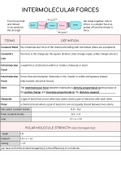
Two forces hold the towel together; Velcro
and thread. Velcro is a weaker force as
it can easily be pulled off and the thread is
the stronger force
TERMS DEFINITION
Covalent Bond the intramolecular force of the chemical bonding with nonmetals (there are exceptions)
Coulomb’s the force is the charge per the square distance [ like charges repel, unlike charges attract]
Law
Intramolecular a weak force of attraction within or inside a molecule or atom.
Force
Intermolecular forces that exist between molecules in the liquids or solids and gaseous phases
Force (electrostatic attractive forces)
Note The intermolecular force between molecules is directly proportional to the product of
the partial charge and inversely proportional to the distance squared
Nonpolar a type of bond that occurs when two atoms share a pair of electrons with each other.
Polar a chemical bond where a pair of electrons are not equally shared between two atoms.
Non-polar covalent bonds 0,0 – 0,2
Polar covalent bonds 0,3 – 1,4
ionic 1,7 < x < 1,9
POLAR MOLECULE STRENGTH (electronegativity):
weak 1,0
medium 1,0 > x < 1,2
strong < 1,2
you have to find the ∆ electronegativity [i.e the difference] of a molecule
, ∆ EN is 3,0 - 2,1 = 0,9 HCl is polar
covalent
∆ EN = 0,9 : weak/medium polar bond
∆ EN = 1,0 : weak/medium polar bond
∆ EN = 1,4 : strong polar bond
CENTRAL ATOM TERMINAL ATOM
The central atom is usually the lowest subscript in Terminal atoms are those atoms that are present at
the molecular formula and forms the most bonds. If both ends. usually the highest subscript in the
all of the atoms usually form the same number of molecular formula and forms the least bonds.
bonds, the least electronegative atom is usually the Usually the highest electronegative. [hydrogen and
central atom. the halogens are usually terminal]
P is the central atom in PH3
• P has the lowest subscript in the molecular
• P can form the most bonds formula
C is the central atom in CF4
• C has the lowest subscript in the molecular
• C has the least electronegative atom formula
N is the central atom in NO3
• N has the lowest subscript in the molecular
• N has the least electronegative atom formula
THE SHAPE OF A MOLECULE
When we have a lone pair on a central atom:
➞ The lone pair takes up more space
➞ The lone pairs push the bonding pairs angular
Why do lone pairs push the bonding pairs?:
Two forces hold the towel together; Velcro
and thread. Velcro is a weaker force as
it can easily be pulled off and the thread is
the stronger force
TERMS DEFINITION
Covalent Bond the intramolecular force of the chemical bonding with nonmetals (there are exceptions)
Coulomb’s the force is the charge per the square distance [ like charges repel, unlike charges attract]
Law
Intramolecular a weak force of attraction within or inside a molecule or atom.
Force
Intermolecular forces that exist between molecules in the liquids or solids and gaseous phases
Force (electrostatic attractive forces)
Note The intermolecular force between molecules is directly proportional to the product of
the partial charge and inversely proportional to the distance squared
Nonpolar a type of bond that occurs when two atoms share a pair of electrons with each other.
Polar a chemical bond where a pair of electrons are not equally shared between two atoms.
Non-polar covalent bonds 0,0 – 0,2
Polar covalent bonds 0,3 – 1,4
ionic 1,7 < x < 1,9
POLAR MOLECULE STRENGTH (electronegativity):
weak 1,0
medium 1,0 > x < 1,2
strong < 1,2
you have to find the ∆ electronegativity [i.e the difference] of a molecule
, ∆ EN is 3,0 - 2,1 = 0,9 HCl is polar
covalent
∆ EN = 0,9 : weak/medium polar bond
∆ EN = 1,0 : weak/medium polar bond
∆ EN = 1,4 : strong polar bond
CENTRAL ATOM TERMINAL ATOM
The central atom is usually the lowest subscript in Terminal atoms are those atoms that are present at
the molecular formula and forms the most bonds. If both ends. usually the highest subscript in the
all of the atoms usually form the same number of molecular formula and forms the least bonds.
bonds, the least electronegative atom is usually the Usually the highest electronegative. [hydrogen and
central atom. the halogens are usually terminal]
P is the central atom in PH3
• P has the lowest subscript in the molecular
• P can form the most bonds formula
C is the central atom in CF4
• C has the lowest subscript in the molecular
• C has the least electronegative atom formula
N is the central atom in NO3
• N has the lowest subscript in the molecular
• N has the least electronegative atom formula
THE SHAPE OF A MOLECULE
When we have a lone pair on a central atom:
➞ The lone pair takes up more space
➞ The lone pairs push the bonding pairs angular
Why do lone pairs push the bonding pairs?:


