
Taal
By Adrian Mackenzie
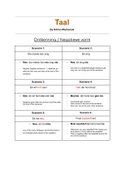
Ontkenning / Negatiewe vorm
Scenario 1: Scenario 2:
Die meisie kan sing Ek sing
- Nee, die meisie kan nie sing nie - Nee, ek sing nie
- Regular negative sentence — negatives go - one verb in a statement/single sentence get
only one ‘nie’ at the end of the sentence.
after the first verb and then at the end of the
sentence.
Scenario 3: Scenario 4:
Ek wil hom sien Gee die hond kos!
- Nee, ek wil hom nie sien nie - Moenie, die hond kos gee nie.
- Negative goes after the pronoun and then after - Commands get ‘moenie’
the end of the sentence - Verb moves to the end of the sentence
- Only one ‘nie’ at the end of the sentence
Scenario 5: Scenario 6:
Ek het iets. Praat asseblief hard
- Nee, ek het niks. - Moet asseblief nie hard praat nie.
- one of the many Afrikaans words that need to - Whenever you see ‘asseblief’ this means you
must place a ‘moet’ before the asseblief
be changed when placed in the negative. - Then a negative after the asseblief and at the
end of the sentence.
, scenario 7: scenario 8:
óf hulle óf hulle ouers sal betaal Iemand het alles gevat
- Nee, nog hulle nog hulle ours sal - Nee, niemand het niks gevat nie
betaal
ooit nooit
altyd nooit
iets niks
êrens nêrens
iewers nêrens
iemand niemand
almal niemand
nog nie meer
elk geen
elkeen geeneen
al nog nie
al ooit nog nooit
al altyd nog nooit
al iets nog niks
By Adrian Mackenzie
, Voegwoorde
Conjunctions
Groep 1 Groep 2 Groep 3
en daarna omdat
,dog daarom voordat
,maar anders wat
of buitendien alhoewel
óf...óf dus sedert
nóg...nóg nogtans indien
sowel...as al dat
want toe* sodat
dan wie
nietemin toe*
gevolglik aangesien
tog tensy
mits totdat
intussen nadat
derhalwe waar
sodra
as
of
Groep 1:
● Sentence stays the same (geen verandering)
e.g) Neelsie is stout. Wilhelm is stout. (Sowel…as)
By Adrian Mackenzie
Ontkenning / Negatiewe vorm
Scenario 1: Scenario 2:
Die meisie kan sing Ek sing
- Nee, die meisie kan nie sing nie - Nee, ek sing nie
- Regular negative sentence — negatives go - one verb in a statement/single sentence get
only one ‘nie’ at the end of the sentence.
after the first verb and then at the end of the
sentence.
Scenario 3: Scenario 4:
Ek wil hom sien Gee die hond kos!
- Nee, ek wil hom nie sien nie - Moenie, die hond kos gee nie.
- Negative goes after the pronoun and then after - Commands get ‘moenie’
the end of the sentence - Verb moves to the end of the sentence
- Only one ‘nie’ at the end of the sentence
Scenario 5: Scenario 6:
Ek het iets. Praat asseblief hard
- Nee, ek het niks. - Moet asseblief nie hard praat nie.
- one of the many Afrikaans words that need to - Whenever you see ‘asseblief’ this means you
must place a ‘moet’ before the asseblief
be changed when placed in the negative. - Then a negative after the asseblief and at the
end of the sentence.
, scenario 7: scenario 8:
óf hulle óf hulle ouers sal betaal Iemand het alles gevat
- Nee, nog hulle nog hulle ours sal - Nee, niemand het niks gevat nie
betaal
ooit nooit
altyd nooit
iets niks
êrens nêrens
iewers nêrens
iemand niemand
almal niemand
nog nie meer
elk geen
elkeen geeneen
al nog nie
al ooit nog nooit
al altyd nog nooit
al iets nog niks
By Adrian Mackenzie
, Voegwoorde
Conjunctions
Groep 1 Groep 2 Groep 3
en daarna omdat
,dog daarom voordat
,maar anders wat
of buitendien alhoewel
óf...óf dus sedert
nóg...nóg nogtans indien
sowel...as al dat
want toe* sodat
dan wie
nietemin toe*
gevolglik aangesien
tog tensy
mits totdat
intussen nadat
derhalwe waar
sodra
as
of
Groep 1:
● Sentence stays the same (geen verandering)
e.g) Neelsie is stout. Wilhelm is stout. (Sowel…as)




