
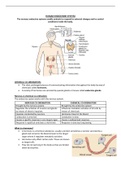
HUMAN ENDOCRINE SYSTEM
The nervous endocrine systems enable animals to respond to external changes and to control
conditions inside the body.
CHEMICAL CO-ORDINATION:
• The slow, prolonged process of communicating information throughout the body by way of
chemicals called hormones.
• A variety of hormones are secreted by special glands or tissues called endocrine glands.
Nervous vs chemical co-ordination:
The endocrine system works with the nervous system.
NERVOUS CO-ORDINATION CHEMICAL CO-ORDINATION
Brought by the nervous system. Brought by the endocrine system.
Regulates the activities of muscles and glands Influences metabolic activities of all cells by
by means of electric impulses. means of chemicals
Impulses conducted by neurons. Hormones travel in the blood.
Conduction is very fast. Conduction is slow.
Causes a specific response in one target organ. Causes a widespread response.
Response is rapid but only lasts a short time. Response is slow but long lasting.
What is a hormone?
• A hormone is a chemical substance, usually a protein sometimes a steroid, secreted by a
gland and carried in the blood stream to the target
organ where it regulates metabolic activities.
• Hormones only affect certain cells. These are known
as target cells.
• They do not last long in the body as they are broken
down by enzymes.
,What is a target organ?
• Cells that have specific receptor sites for hormones.
• Although hormones are carried in the blood throughout the body, they only affect certain
cells.
• The specific cells that respond to a given hormone have receptor sits for that hormone. The
cells are known as target tissue or target organs.
• They can be a single gland or organ scattered throughout the body.
What is an endocrine gland?
• A small, vascular, ductless gland that secretes hormone which are carried in the bloodstream
to their target organs.
Vascular = richly supplied with blood vessels.
How do exo- and endocrine glands differ?
• The secretions of an exocrine gland are carried in ducts to where they are needed (eg:
salivary glands, liver, pancreas).
• Endocrine glands do not have ducts and their secretions are carried in the bloodstream to
their target organs.
ENDOCRINE GLANDS IN THE BODY:
HYPOTHALAMUS:
• Part of the brain - not a gland, situated above the pituitary gland.
• Controls the release of the hormones from pituitary gland.
• Contains osmo-receptors that detect an increase in osmolality in the blood (water potential).
• Controls ADH release from posterior lobe.
• Secretes, amongst others, the hormone ADH (anti-diuretic hormone) to control water levels
of blood.
The role of ADH:
Osmoreceptors in the blood vessels of the hypothalamus detect and increase in the osmolarity (low
water levels) of the blood. The hypothalamus responds and releases ADH.
ADH helps to conserve water if the body is dehydrated.
• It does this by causing more water to be reabsorbed back into the blood from the collecting
ducts of the kidney, so less water is lost in urine.
, ADH secreted to conserve water
• Dehydrated • Not dehydrated
• ADH secreted • Less ADH secreted
• Water absorbed from urine • Less water absorbed from
• Dark yellow urine urine
• Light yellow urine
PITUITARY GLAND:
• This gland acts as the chemical co-ordinator of most of the other endocrine glands.
• Is therefore called the “master gland”.
• Attached to the hypothalamus at the base of the brain by a short stalk.
Hormones secreted by the pituitary gland:
The pituitary gland secretes many hormones. The following is a brief summary of some of these
hormones and their functions.
• Thyroid stimulating hormone (TSH): Stimulates the thyroid gland to secret its hormone,
thyroxine.
• Follicle stimulating hormone (FSH):
▪ In females, FSH stimulates oogenesis in the ovary (ie: the formatting of eggs/ova).
▪ In males, FSH stimulates spermatogenesis in the testes (ie: sperm formation).
• Luteinizing hormone (LH): Stimulates ovulation (release of an egg) from the ovary, as well as
the formatting of the corpus luteum.


