C*FIFGE]I{S elq&E,E.q a;=d &EEIBEE,4$GLES
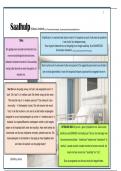
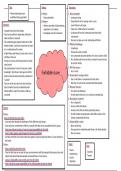
Thebasic formula. Proof in the textbook:
P age 242 Classroom Mathematics
You must knou, how !o deduce the formulas for 2, 3 and 4 from Fbrmula I
cos(ra + B) = co-s,4- ccs B - sin l- sin B Formula ? We use corcpound aagles:
sin(l + B)= sin,4.cos;+ + f6 5implif, orrduce a given expression.
"o.,4=inE Formula 3 * To evaluate using qpecial angles
sin(l - 8) = sinL cos3 - cosl.sing Formula 4 + To evaluate a lrig ratio $om a diagram.
tz.n A: tan B
+ To solve for a given angle in a lrig equation-
anu+
\ / = l-tan A.tanB
B) Formula 5 + To prorre something using solution of triangles.
Ah*-ays look for a "shorter me&od'" rvhen u'ortrring u,ith
Formula6
l+tan A-anB rxrmpound and double atrgles- Don't automaticaill.- expand
the staleneut - this can lead to huge erpressions which are
difficuitto simpli$'.
You must know how to prove formulas 5 and 6.
.BO{rSLE ANGLES
The double aagle formulae caa all be deduced usiag &e compor:nd augle erpansioas:
e.g. Deduce a formula for stnlA sinZA=sin?+ A)
: l- cos I + cos l.
sin sin I
= 2sinl.cosl
silaZA=ZsinAcosA
caszA- gost A*stnx A BasicForEnula We can also evaltiate half angles using&e above
formu lae if necessar-v :
cosz.A= Zcils3l.1 Using cos only
SlnA = Slnl
.{e+ 6)= lsln-.COS-
o o
caszA=1-2*inz A Using sin only
- -
[22)
I
2 2
tAnZA: '*!
1-tfrn'A
Remember this usefid hint: To evaluate sinl 5". cosl 50
sin150. cosl50
We mr.lltiply the nrmerator aad denominaror by 2
_ 2sinl5".cos15"
Then use thedouble angle formula
2
sinz{ts") 1
2
sin30o
=-2)
1
4
, Pepor o$ Cohlpo,roru A*crLE Fpc.r-tqun.
-\
-fo P*r* c-os Ll-rs) = cosA. c-crsB -F Gn^A-s-r^B,.
+
Pfcss". i *;r.*)
L.eE P (css *', eir..r")
\ $ka,6lel *;F)
4 Q (cos pi s.Lt\
ff
be- o.r\r.{ d soinhs ovr c.irck
ces.!w- $ 6 hU.. so.&irrs ot
I trnE.
/\
POQ, ? o(-[s.
APo C-ssl"'e.-
P(t' =l' +- r'- a(DtD. ** (r.- P)
Pq' =a - a.* G-fi)
Lleiv.q fJist,o,nr.e- For,r.r..**\o. :
-Pda
'J
Lt--=.)'*(f,*-t)'
A2
t-J rlh
r\}(. € (c*cr.*. -.o*;r)' + (=i,^.o" - *.r^fS)'
c-odu< - Aeoso(.rxr,F +e-or'fg +eiuSoc -2.*^*sr,^F+€i,il3
= €:j-:y;'* + q{d[;tss}!t\ -f,cssor.r-.op -Zstrrer.sir.p
Pel a - Ilcosx. cgs p - a- sivr< .rd^ F
a
(D=- e
a- f,c.crs = L * Lcosx.co.p - a-.$no( =A.fg
C(- r$ .
- aeos Lt(-A = - ?-cos*.c-osp - a- 6irrs(. Su^[f
f+ -ru .'- c-os fux-p) : c-6E,o(. Cosp + Srrx.. =d^f{
Thebasic formula. Proof in the textbook:
P age 242 Classroom Mathematics
You must knou, how !o deduce the formulas for 2, 3 and 4 from Fbrmula I
cos(ra + B) = co-s,4- ccs B - sin l- sin B Formula ? We use corcpound aagles:
sin(l + B)= sin,4.cos;+ + f6 5implif, orrduce a given expression.
"o.,4=inE Formula 3 * To evaluate using qpecial angles
sin(l - 8) = sinL cos3 - cosl.sing Formula 4 + To evaluate a lrig ratio $om a diagram.
tz.n A: tan B
+ To solve for a given angle in a lrig equation-
anu+
\ / = l-tan A.tanB
B) Formula 5 + To prorre something using solution of triangles.
Ah*-ays look for a "shorter me&od'" rvhen u'ortrring u,ith
Formula6
l+tan A-anB rxrmpound and double atrgles- Don't automaticaill.- expand
the staleneut - this can lead to huge erpressions which are
difficuitto simpli$'.
You must know how to prove formulas 5 and 6.
.BO{rSLE ANGLES
The double aagle formulae caa all be deduced usiag &e compor:nd augle erpansioas:
e.g. Deduce a formula for stnlA sinZA=sin?+ A)
: l- cos I + cos l.
sin sin I
= 2sinl.cosl
silaZA=ZsinAcosA
caszA- gost A*stnx A BasicForEnula We can also evaltiate half angles using&e above
formu lae if necessar-v :
cosz.A= Zcils3l.1 Using cos only
SlnA = Slnl
.{e+ 6)= lsln-.COS-
o o
caszA=1-2*inz A Using sin only
- -
[22)
I
2 2
tAnZA: '*!
1-tfrn'A
Remember this usefid hint: To evaluate sinl 5". cosl 50
sin150. cosl50
We mr.lltiply the nrmerator aad denominaror by 2
_ 2sinl5".cos15"
Then use thedouble angle formula
2
sinz{ts") 1
2
sin30o
=-2)
1
4
, Pepor o$ Cohlpo,roru A*crLE Fpc.r-tqun.
-\
-fo P*r* c-os Ll-rs) = cosA. c-crsB -F Gn^A-s-r^B,.
+
Pfcss". i *;r.*)
L.eE P (css *', eir..r")
\ $ka,6lel *;F)
4 Q (cos pi s.Lt\
ff
be- o.r\r.{ d soinhs ovr c.irck
ces.!w- $ 6 hU.. so.&irrs ot
I trnE.
/\
POQ, ? o(-[s.
APo C-ssl"'e.-
P(t' =l' +- r'- a(DtD. ** (r.- P)
Pq' =a - a.* G-fi)
Lleiv.q fJist,o,nr.e- For,r.r..**\o. :
-Pda
'J
Lt--=.)'*(f,*-t)'
A2
t-J rlh
r\}(. € (c*cr.*. -.o*;r)' + (=i,^.o" - *.r^fS)'
c-odu< - Aeoso(.rxr,F +e-or'fg +eiuSoc -2.*^*sr,^F+€i,il3
= €:j-:y;'* + q{d[;tss}!t\ -f,cssor.r-.op -Zstrrer.sir.p
Pel a - Ilcosx. cgs p - a- sivr< .rd^ F
a
(D=- e
a- f,c.crs = L * Lcosx.co.p - a-.$no( =A.fg
C(- r$ .
- aeos Lt(-A = - ?-cos*.c-osp - a- 6irrs(. Su^[f
f+ -ru .'- c-os fux-p) : c-6E,o(. Cosp + Srrx.. =d^f{