
Tropical cyclones
Names
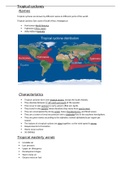
Tropical cyclones are known by different names in different parts of the world:
Tropical cyclone, East coast of South Africa, Madagascar
Hurricanes=North America
Typhoons=China. Japan
Willy Willies=Australia
Characteristics
Tropical cyclones form over tropical oceans, except the South Atlantic.
They develop between 50-300 north and south of the equator.
They occur in late summer to early autumn (RSA Jan- April).
They travel in the easterly winds therefore they move from east to west.
They are accompanied by strong winds, heavy thunderstorms, and flood waves.
They are a centre of very low pressure with a clockwise flow in the southern hemisphere.
They are given names according to the alphabet: named alphabeticly per region per
season.
The isobars of a tropical cyclone are close together, so the wind speed is strong.
Requirements for formation
Warm ocean surface
50-300N&S
Tropical easterly winds
Unstable air
Low pressure
Upper air divergence
Development stages
Warm risinq air
Oceans moist air fuel
, Equator no Coriolis force
Winds cannot circulate
Beyond 300 too cold
Unstable air
Rising air — LP
Rising air Maintains the LP. Initial/ formative stage(Tropical Disturbance/ Wave movement in
tropical easterlies)An easterly wave deepens to form a low-pressure cell.
Tropical easterlies: bend around heat low and get caught up in clockwise circulation.
Pressure is still above 1 000 hPa.
Wind speed reaches quale force (34-47 knots = 63-87 km/h ).
The eye of the cyclone begins to form .
It is large in diameter and generally moves westward .
TROPICAL CYCLONE: DEVELOPMENT
Sotherntpmapt'Ae
Developing or immature stage
The air pressure is still above 1 000 hPa.
Upper air divergence is occurring .
At high levels the vortex creates a space where cool upper air sinks .
Winds reach hurricane strength, 120 km/h .
Surrounding the eye, cumulonimbus clouds reach heights of 10-12 km .


