
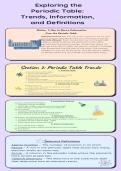
Exploring the
Periodic Table:
Trends, Information,
and Definitions
Section 1: How to Derive Information
from the Periodic Table
GROUPS (Columns): Elements with similar properties in are the same
vertical columns, called groups. Each row is referred to as a period.
Periods (Rows): Each horizontal row on the periodic
table is called a period. All elements in the same
period have the same number of electron shells. As
you go from left to right, the atomic number increases,
and properties like the size of the atom, the energy
needed to remove an electron, and the atom’s ability
to attract electrons all change in predictable ways.
Section 2: Periodic Table Trends 1. Atomic Size
Across a Period (Left to Right):
Atomic size decreases
More protons create a stronger nuclear charge
Electrons are pulled closer to the nucleus
Down a Group:
Atomic size increases
More electron shells create a greater shielding effect
Weaker attraction between the nucleus and outer electrons
2. Reactivity Trends
Metals (Groups 1-2):
More reactive down a group (electrons lost easily)
Non-metals (Groups 16-17):
More reactive up a group (electrons gained easily)
Main points:
Highly positive or negative elements are generally more reactive
Ionic bonding: More reactive elements gain or lose electrons
Covalent bonding: Less reactive elements share electrons
3. Ionization Energy
Across a Period (Left to Right):
Ionization energy increases
Atoms get smaller, and electrons are more tight
More energy is required to remove an electron
Down a Group:
Ionization energy decreases
Outer electrons are further from the nucleus
The shielding weakens nuclear attraction
4. Electron Affinity
Definition: The energy change when an atom gains an electron
A more negative electron affinity means a higher chance of gaining an electron
Increases across a period (left - right)
Noble gases don’t follow this trend
5. Electronegativity
Across a Period (Left - Right):
Increases as atoms attract shared electrons more strongly
Down a Group:
Decreases because to more shielding and weaker nuclear attraction
Relevant Definitions
Atomic Number – The number of protons in an atom.
Period – A row in the periodic table that shows how many
electron shells an atom has.
Group – A column in the periodic table where the elements
have similar properties.
Valence Electrons – The electrons in the outermost shell
that determine how an element reacts.
Periodic Table:
Trends, Information,
and Definitions
Section 1: How to Derive Information
from the Periodic Table
GROUPS (Columns): Elements with similar properties in are the same
vertical columns, called groups. Each row is referred to as a period.
Periods (Rows): Each horizontal row on the periodic
table is called a period. All elements in the same
period have the same number of electron shells. As
you go from left to right, the atomic number increases,
and properties like the size of the atom, the energy
needed to remove an electron, and the atom’s ability
to attract electrons all change in predictable ways.
Section 2: Periodic Table Trends 1. Atomic Size
Across a Period (Left to Right):
Atomic size decreases
More protons create a stronger nuclear charge
Electrons are pulled closer to the nucleus
Down a Group:
Atomic size increases
More electron shells create a greater shielding effect
Weaker attraction between the nucleus and outer electrons
2. Reactivity Trends
Metals (Groups 1-2):
More reactive down a group (electrons lost easily)
Non-metals (Groups 16-17):
More reactive up a group (electrons gained easily)
Main points:
Highly positive or negative elements are generally more reactive
Ionic bonding: More reactive elements gain or lose electrons
Covalent bonding: Less reactive elements share electrons
3. Ionization Energy
Across a Period (Left to Right):
Ionization energy increases
Atoms get smaller, and electrons are more tight
More energy is required to remove an electron
Down a Group:
Ionization energy decreases
Outer electrons are further from the nucleus
The shielding weakens nuclear attraction
4. Electron Affinity
Definition: The energy change when an atom gains an electron
A more negative electron affinity means a higher chance of gaining an electron
Increases across a period (left - right)
Noble gases don’t follow this trend
5. Electronegativity
Across a Period (Left - Right):
Increases as atoms attract shared electrons more strongly
Down a Group:
Decreases because to more shielding and weaker nuclear attraction
Relevant Definitions
Atomic Number – The number of protons in an atom.
Period – A row in the periodic table that shows how many
electron shells an atom has.
Group – A column in the periodic table where the elements
have similar properties.
Valence Electrons – The electrons in the outermost shell
that determine how an element reacts.


