

ELECTROSTATICS: ELECTROSTATIC FORCE
QUESTION 1 (Model 2014)
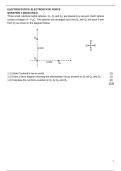
Three small, identical metal spheres, Q1, Q2 and Q3, are placed in a vacuum. Each sphere
carries a charge of – 4 μC. The spheres are arranged such that Q 2 and Q3 are each 3 mm
from Q1 as shown in the diagram below.
1.1) State Coulomb's law in words. (2)
1.2) Draw a force diagram showing the electrostatic forces exerted on Q 1 by Q2 and Q3. (2)
1.3) Calculate the net force exerted on Q1 by Q2 and Q3. (8)
[12]
1
,QUESTION 2 (Feb/Mrc 2014)
Three +100 μC point charges, A, B and C, are equally spaced on a straight line in a vacuum.
The charges are a distance of 3 cm from each other as shown in the sketch below.
2.1) Name the law that describes the electrostatic force exerted by one point charge
on another. (1)
2.2) A learner sketches the electric field pattern produced by the three charges as
shown below.
Write down THREE mistakes the learner made. (3)
2.3) Calculate the net electrostatic force experienced by point charge C. (6)
2.4) Write down the net electrostatic force experienced by point charge B. Give a reason for
the answer. (2)
[12]
2
, QUESTION 3 (Feb/Mrc 2015)
Two identical negatively charged spheres, A and B, having charges of the same magnitude,
are placed 0,5 m apart in vacuum. The magnitude of the electrostatic force that one sphere
exerts on the other is 1,44 x 10⁻¹ N.
3.1) State Coulomb's law in words. (2)
3.2) Calculate the:
3.2.1) Magnitude of the charge on each sphere (4)
3.2.2) Excess number of electrons on sphere B (3)
3.3) P is a point at a distance of 1 m from sphere B.
3.3.1) What is the direction of the net electric field at point P? (1)
3.3.2) Calculate the number of electrons that should be removed from sphere B so that
the net electric field at point P is 3 x 10⁴ N·C-1 to the right. (8)
[18]
3
QUESTION 1 (Model 2014)
Three small, identical metal spheres, Q1, Q2 and Q3, are placed in a vacuum. Each sphere
carries a charge of – 4 μC. The spheres are arranged such that Q 2 and Q3 are each 3 mm
from Q1 as shown in the diagram below.
1.1) State Coulomb's law in words. (2)
1.2) Draw a force diagram showing the electrostatic forces exerted on Q 1 by Q2 and Q3. (2)
1.3) Calculate the net force exerted on Q1 by Q2 and Q3. (8)
[12]
1
,QUESTION 2 (Feb/Mrc 2014)
Three +100 μC point charges, A, B and C, are equally spaced on a straight line in a vacuum.
The charges are a distance of 3 cm from each other as shown in the sketch below.
2.1) Name the law that describes the electrostatic force exerted by one point charge
on another. (1)
2.2) A learner sketches the electric field pattern produced by the three charges as
shown below.
Write down THREE mistakes the learner made. (3)
2.3) Calculate the net electrostatic force experienced by point charge C. (6)
2.4) Write down the net electrostatic force experienced by point charge B. Give a reason for
the answer. (2)
[12]
2
, QUESTION 3 (Feb/Mrc 2015)
Two identical negatively charged spheres, A and B, having charges of the same magnitude,
are placed 0,5 m apart in vacuum. The magnitude of the electrostatic force that one sphere
exerts on the other is 1,44 x 10⁻¹ N.
3.1) State Coulomb's law in words. (2)
3.2) Calculate the:
3.2.1) Magnitude of the charge on each sphere (4)
3.2.2) Excess number of electrons on sphere B (3)
3.3) P is a point at a distance of 1 m from sphere B.
3.3.1) What is the direction of the net electric field at point P? (1)
3.3.2) Calculate the number of electrons that should be removed from sphere B so that
the net electric field at point P is 3 x 10⁴ N·C-1 to the right. (8)
[18]
3


