Liver Function
Liver Function: Learning Outcomes
• Liver function test (LFT)
• Describe bilirubin metabolism
• Know some examples of liver disease
• Understand the process of liver fibrosis
• Define the terms pre-, post- and hepatic jaundice
• The use of the laboratory in the differential diagnosis of jaundice
Liver Structure
Liver Blood
Supply
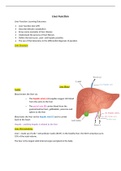
Blood enters the liver via:
– The hepatic artery (A) supplies oxygen rich blood
from the aorta to the liver
– The portal vein (B) carries blood from the
gastrointestinal tract, gallbladder, pancreas and
spleen to the liver
Blood exits the liver via the hepatic vein (C) and is carried
back to the heart.
Hepatic - anything hepatic is related to the liver
Liver Microanatomy
Liver = made up of cells + extracellular matrix (ECM). In the healthy liver, the ECM comprises up to
10% of the total volume.
The liver is the largest solid internal organ and gland in the body.
, Liver cells are called hepatocytes (A). Hepatocytes comprise around 80% of the cells in the
liver and perform the main metabolic functions associated with metabolism and
detoxification.
Sinusoids (B) are blood vessels which mix the oxygen-rich blood from the hepatic artery and
the nutrient-rich blood from the portal vein
Bile canaliculus (C) are thin tubes that collect bile secreted by hepatocytes. Bile then
delivered to gallbladder where it's stored.
Hepatic stellate cells (D) are found in the area between the sinusoids and hepatocytes.
Hepatic stellate cells = resident cells, clear up debris = protective cell
Kupffer cells (E) are a specialized population of macrophages that reside in the liver
Liver Function
Removal of the liver would lead to death from hypoglycaemia long before any toxic metabolites
could accumulate.
The liver has approximately 500 different roles
Removal of toxins (exogenous or lipid soluble)
Protein metabolism – Synthesis of plasma proteins (albumin) some clotting factors, urea
synthesis and nitrogen removal
Metabolism and excretion of bilirubin – Breakdown of RBCs -> Bilirubin
Produces hormones, including angiotensinogen to control blood pressure
Fat metabolism – fatty acids, cholesterol, lipoprotein and bile acid synthesis
Carbohydrate metabolism via gluconeogenesis/glycogen synthesis
Is a major glycogen storage compartment
Storage of vitamins A, B12 and iron
Hydroxylation of Vitamin D
Produces bile which is stored in the gall bladder
Bile helps break down lipids
Liver Function: Learning Outcomes
• Liver function test (LFT)
• Describe bilirubin metabolism
• Know some examples of liver disease
• Understand the process of liver fibrosis
• Define the terms pre-, post- and hepatic jaundice
• The use of the laboratory in the differential diagnosis of jaundice
Liver Structure
Liver Blood
Supply
Blood enters the liver via:
– The hepatic artery (A) supplies oxygen rich blood
from the aorta to the liver
– The portal vein (B) carries blood from the
gastrointestinal tract, gallbladder, pancreas and
spleen to the liver
Blood exits the liver via the hepatic vein (C) and is carried
back to the heart.
Hepatic - anything hepatic is related to the liver
Liver Microanatomy
Liver = made up of cells + extracellular matrix (ECM). In the healthy liver, the ECM comprises up to
10% of the total volume.
The liver is the largest solid internal organ and gland in the body.
, Liver cells are called hepatocytes (A). Hepatocytes comprise around 80% of the cells in the
liver and perform the main metabolic functions associated with metabolism and
detoxification.
Sinusoids (B) are blood vessels which mix the oxygen-rich blood from the hepatic artery and
the nutrient-rich blood from the portal vein
Bile canaliculus (C) are thin tubes that collect bile secreted by hepatocytes. Bile then
delivered to gallbladder where it's stored.
Hepatic stellate cells (D) are found in the area between the sinusoids and hepatocytes.
Hepatic stellate cells = resident cells, clear up debris = protective cell
Kupffer cells (E) are a specialized population of macrophages that reside in the liver
Liver Function
Removal of the liver would lead to death from hypoglycaemia long before any toxic metabolites
could accumulate.
The liver has approximately 500 different roles
Removal of toxins (exogenous or lipid soluble)
Protein metabolism – Synthesis of plasma proteins (albumin) some clotting factors, urea
synthesis and nitrogen removal
Metabolism and excretion of bilirubin – Breakdown of RBCs -> Bilirubin
Produces hormones, including angiotensinogen to control blood pressure
Fat metabolism – fatty acids, cholesterol, lipoprotein and bile acid synthesis
Carbohydrate metabolism via gluconeogenesis/glycogen synthesis
Is a major glycogen storage compartment
Storage of vitamins A, B12 and iron
Hydroxylation of Vitamin D
Produces bile which is stored in the gall bladder
Bile helps break down lipids