
DNA- The code of life
Introduction:
DNA- deoxyribonucleic acid
RNA- ribonucleic acid
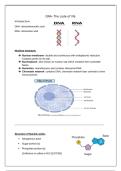
Nucleus structure:
Nuclear membrane- double and continuous with endoplasmic reticulum.
Contains pores on its wall.
Nucleoplasm- also known as nuclear sap which contains free nucleotide
bases.
Nucleolus- manufactures and contains ribosomal RNA.
Chromatin network- contains DNA, chromatin network later unwinds to form
chromosomes.
__________________________________________________________________
Structure of Nucleic acids:
Nitrogenous base
Sugar portion (s)
Phosphate portion (p)
(Collective is called a NUCLEOTIDE)
,Location of DNA: (Deoxyribonucleic acid)
Nucleus- nuclear DNA = make up chromosomes
together with proteins- chromosomal network
Chloroplasts- chloroplastic DNA
Mitochondria- Mitochondrial DNA or mtDNA- used to
trace ancestors.
Structure of DNA:
DNA made up of nucleotides- sugar is deoxyribose
2 groups of nitrogenous bases- purines and pyrimidines
Purines- adenine and guanine/ pyrimidines- cytosine and thymine
Sugar molecule of one nucleotide becomes attached to the phosphate ion of another
sugar-phosphate bond- form long chain
C-G and A-T = complementary base pairs
NB held by weak hydrogen bonds
DNA= structure DOUBLE HELIX
Purines Pyrimidines
Adenine Cytosine
Guanine Thymine
, Functions of DNA:
Nuclear DNA- controls synthesis of proteins. E.g myosin in muscles, collagen in
connective tissue and bone tissue.
DNA control synthesis of enzymes- control all metabolic activities within the cell- cell
resp.
Controls structure and functioning of cells.
Chloroplastic and Mitochondrial DNA synthesize within organelles.
Nuclear DNA transmits hereditary characteristics from parents to offspring- passed
down during production of new cells.
Genes- carry code for a particular protein and formation of particular trait or
characteristic.
Non- coding DNA- do not carry specific codes for proteins or characteristics.
Rosalind Franklin Double helix from x-ray
diffraction pictures.
Maurice Wilkins Showed x-ray diffraction
pictures to James
Watson.
Watson and Crick Found complementary
base pairing- C+G and
A+T
Complementary base
pairing allows DNA to
make exact copies of
itself
Introduction:
DNA- deoxyribonucleic acid
RNA- ribonucleic acid
Nucleus structure:
Nuclear membrane- double and continuous with endoplasmic reticulum.
Contains pores on its wall.
Nucleoplasm- also known as nuclear sap which contains free nucleotide
bases.
Nucleolus- manufactures and contains ribosomal RNA.
Chromatin network- contains DNA, chromatin network later unwinds to form
chromosomes.
__________________________________________________________________
Structure of Nucleic acids:
Nitrogenous base
Sugar portion (s)
Phosphate portion (p)
(Collective is called a NUCLEOTIDE)
,Location of DNA: (Deoxyribonucleic acid)
Nucleus- nuclear DNA = make up chromosomes
together with proteins- chromosomal network
Chloroplasts- chloroplastic DNA
Mitochondria- Mitochondrial DNA or mtDNA- used to
trace ancestors.
Structure of DNA:
DNA made up of nucleotides- sugar is deoxyribose
2 groups of nitrogenous bases- purines and pyrimidines
Purines- adenine and guanine/ pyrimidines- cytosine and thymine
Sugar molecule of one nucleotide becomes attached to the phosphate ion of another
sugar-phosphate bond- form long chain
C-G and A-T = complementary base pairs
NB held by weak hydrogen bonds
DNA= structure DOUBLE HELIX
Purines Pyrimidines
Adenine Cytosine
Guanine Thymine
, Functions of DNA:
Nuclear DNA- controls synthesis of proteins. E.g myosin in muscles, collagen in
connective tissue and bone tissue.
DNA control synthesis of enzymes- control all metabolic activities within the cell- cell
resp.
Controls structure and functioning of cells.
Chloroplastic and Mitochondrial DNA synthesize within organelles.
Nuclear DNA transmits hereditary characteristics from parents to offspring- passed
down during production of new cells.
Genes- carry code for a particular protein and formation of particular trait or
characteristic.
Non- coding DNA- do not carry specific codes for proteins or characteristics.
Rosalind Franklin Double helix from x-ray
diffraction pictures.
Maurice Wilkins Showed x-ray diffraction
pictures to James
Watson.
Watson and Crick Found complementary
base pairing- C+G and
A+T
Complementary base
pairing allows DNA to
make exact copies of
itself


