

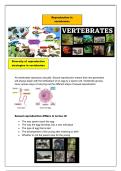
Reproduction in
vertebrates
Diversity of reproductive
strategies in vertebrates
All vertebrates reproduce sexually. Sexual reproduction means that new generation
will always begin with the fertilization of an egg by a sperm cell. Vertebrate groups
have various ways of carrying out the different steps of sexual reproduction.
Sexual reproduction differs in terms of:
• The way sperm reach the egg
• The way the egg develops into a new individual
• The type of egg that is laid
• The development of the young after hatching or birth
• Whether or not the parent care for the young
, Reproductive strategies – ways in which organisms carry out reproduction.
• Enable vertebrate species to produce a new generation successfully.
• Adapted to maximise its reproductive success in its environment.
Types of fertilisation
Fertilization is the joining of an egg by a sperm cell. During fertilization, the sperm
nucleus enters the egg cell and fuses with or joins the egg nucleus. Sperm can move
actively as they are motile. Eggs cannot move therefore sperm are required to swim
or use locomotion. Sperm need to be protected from drying out and need to be guided
to the egg.
External fertilisation
➔ Only possible for animals that can breed
in water.
(Fish and amphibians)
Means of fertilization:
Vertebrates release sperm and egg into water
and fertilisation occurs outside the body of the female.
Huge quantities of sperm and eggs are released due to
a very small chance of sperm cell meeting an egg of
the same species.
Example:
• Some species of fish such as the Cichilid fish
‘dance’ to attract a mate so sperm and egg are released simultaneously.
vertebrates
Diversity of reproductive
strategies in vertebrates
All vertebrates reproduce sexually. Sexual reproduction means that new generation
will always begin with the fertilization of an egg by a sperm cell. Vertebrate groups
have various ways of carrying out the different steps of sexual reproduction.
Sexual reproduction differs in terms of:
• The way sperm reach the egg
• The way the egg develops into a new individual
• The type of egg that is laid
• The development of the young after hatching or birth
• Whether or not the parent care for the young
, Reproductive strategies – ways in which organisms carry out reproduction.
• Enable vertebrate species to produce a new generation successfully.
• Adapted to maximise its reproductive success in its environment.
Types of fertilisation
Fertilization is the joining of an egg by a sperm cell. During fertilization, the sperm
nucleus enters the egg cell and fuses with or joins the egg nucleus. Sperm can move
actively as they are motile. Eggs cannot move therefore sperm are required to swim
or use locomotion. Sperm need to be protected from drying out and need to be guided
to the egg.
External fertilisation
➔ Only possible for animals that can breed
in water.
(Fish and amphibians)
Means of fertilization:
Vertebrates release sperm and egg into water
and fertilisation occurs outside the body of the female.
Huge quantities of sperm and eggs are released due to
a very small chance of sperm cell meeting an egg of
the same species.
Example:
• Some species of fish such as the Cichilid fish
‘dance’ to attract a mate so sperm and egg are released simultaneously.


