

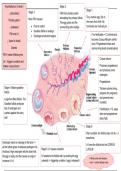
Hypothalamus (in brain) Stage 2:
Stage 1:
↓ (stimulates) Stage 3: FSH from pituitary starts
stimulating the primary follicle. Tiny, inactive egg. Sits in
Pituitary gland More FSH causes:
The egg grows and the the ovary from birth. No
↓ (releases) • Fluid to collect surrounding cells multiply. hormones are involved yet.
• Graafian follicle to enlarge
FSH and LH If no fertilization = CL shrinks and
• Oestrogen production begins
↓ (travel in blood) becomes Corpus Albicans (white
scar). Progesterone drops and
Ovaries uterine lining sheds (menstruation)
FSH- makes follicles grow
Corpus luteum:
LH – triggers ovulation and
makes corpus luteum Produces progesterone
and produces some
oestrogen.
Progesterone:
Stage 4: Mature graafian Thickens uterine lining,
follicle prepares for pregnancy
Large fluid filled follicle. The and prevents new
Graafian follicle produces ovulation.
lots of oestrogen and If fertilization = CL stays
pushes against the ovary alive and progesterone
wall. stays high.
Stage 6:
After ovulation, the follicle does not die – it
transforms.
Oestrogen sends a message to the brain ->
LH turns the follicle into the CORPUS
as the follicle grows it releases oestrogen into
Stage 5: LH causes ovulation LUTEUM
the blood. High oestrogen tells the brain that
the egg is ready, and this causes a surge or LH weakens the follicle wall, by pushing the egg
Follicle bursts and releases
increase in LH. outwards -> triggering ovulation. (egg is released) ovum -> enters fallopian tube.
Stage 1:
↓ (stimulates) Stage 3: FSH from pituitary starts
stimulating the primary follicle. Tiny, inactive egg. Sits in
Pituitary gland More FSH causes:
The egg grows and the the ovary from birth. No
↓ (releases) • Fluid to collect surrounding cells multiply. hormones are involved yet.
• Graafian follicle to enlarge
FSH and LH If no fertilization = CL shrinks and
• Oestrogen production begins
↓ (travel in blood) becomes Corpus Albicans (white
scar). Progesterone drops and
Ovaries uterine lining sheds (menstruation)
FSH- makes follicles grow
Corpus luteum:
LH – triggers ovulation and
makes corpus luteum Produces progesterone
and produces some
oestrogen.
Progesterone:
Stage 4: Mature graafian Thickens uterine lining,
follicle prepares for pregnancy
Large fluid filled follicle. The and prevents new
Graafian follicle produces ovulation.
lots of oestrogen and If fertilization = CL stays
pushes against the ovary alive and progesterone
wall. stays high.
Stage 6:
After ovulation, the follicle does not die – it
transforms.
Oestrogen sends a message to the brain ->
LH turns the follicle into the CORPUS
as the follicle grows it releases oestrogen into
Stage 5: LH causes ovulation LUTEUM
the blood. High oestrogen tells the brain that
the egg is ready, and this causes a surge or LH weakens the follicle wall, by pushing the egg
Follicle bursts and releases
increase in LH. outwards -> triggering ovulation. (egg is released) ovum -> enters fallopian tube.


