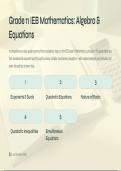
Grade 11 IEB Mathematics: Algebra &
Equations
A comprehensive study guide covering the core algebraic topics in the IEB Grade 11 Mathematics curriculum. This guide takes you
from fundamental exponent laws through to solving complex simultaneous equations — with worked examples, key formulas, and
exam-focused tips at every step.
1 2 3
Exponents & Surds Quadratic Equations Nature of Roots
4 5
Quadratic Inequalities Simultaneous
Equations
© E-Loné Scheepers 2026
, CHAPTER 1
Exponents & Surds — Foundations
A solid understanding of exponent laws is the bedrock of all algebraic manipulation. Before tackling surds and rational exponents,
ensure you can apply the following laws fluently and without hesitation.
Product Rule
1 am ⋅ an = am+n
When multiplying powers with the same base, add the exponents.
Quotient Rule
2 am
an = am−n
When dividing powers with the same base, subtract the exponents.
Power Rule
3 (am )n = amn
When raising a power to another power, multiply the exponents.
Zero Exponent
4 a0 = 1
Any non-zero base raised to the power of zero equals one.
Negative Exponent
5 a−n = 1
an
A negative exponent indicates a reciprocal relationship.
Fractional Exponent
6
m
an =
n
am
The denominator is the root; the numerator is the power.
Always check whether the base is the same before applying the product or quotient rule. A common error is applying
these laws to different bases — e.g., 2³ × 3² ≠ 6⁵.
© E-Loné Scheepers 2026
, CHAPTER 1
Rational Exponents & Simplifying Surds
A surd is an expression that contains an irrational root — a root that cannot be simplified to a rational number. The key link
1
between surds and exponents is the identity a n =
n
a, which allows us to switch freely between surd and exponential notation.
Key Surd Laws Simplification Strategy
a⋅ b=
ab To simplify a surd such as 72, find the largest perfect square
a
factor:
= a
b
b
72 =
36 × 2 = 6 2
( a )2 = a
3
For expressions like 5
,
rationalise the denominator by
a2 = ∣a∣
5
multiplying by :
5
m
n
am = a n
3 5 3 5
× =
5
5
5
1
For binomial denominators like 3+1
, multiply by the
conjugate ( 3 − 1).
When simplifying a2 = ∣a∣, always apply the absolute value — the square root function returns a non-negative result.
This is a frequent source of errors in exam questions.
© E-Loné Scheepers 2026
, CHAPTER 1
Solving Surd Equations
Surd equations contain the unknown under a radical sign. The standard strategy is to isolate the surd and then square both
sides to eliminate it. However, squaring can introduce extraneous roots — solutions that satisfy the squared equation but not the
original. Always substitute your answers back into the original equation to check.
1 Isolate the surd 2 Square both sides
Rearrange the equation so the surd term is alone on Apply the squaring operation to eliminate the radical.
one side. If there are two surds, place one on each side. Remember: ( f (x))2 = f (x), but
(a + b)2 = a2 + 2a b + b — expand carefully.
3 Solve the resulting equation 4 Check for extraneous roots
After squaring, you will typically obtain a linear or Substitute every solution back into the original
quadratic equation. Solve using standard methods. equation. Reject any solution that does not satisfy it or
that makes a square root expression negative.
Worked Example: Solve 2x + 3 = x
Square both sides: 2x + 3 = x2
Rearrange: x2 − 2x − 3 = 0 ⇒ (x − 3)(x + 1) = 0
Solutions: x = 3 or x = −1
Check x = −1: 1 = −1 → FALSE. Reject.
Answer: x = 3 only.
© E-Loné Scheepers 2026
Equations
A comprehensive study guide covering the core algebraic topics in the IEB Grade 11 Mathematics curriculum. This guide takes you
from fundamental exponent laws through to solving complex simultaneous equations — with worked examples, key formulas, and
exam-focused tips at every step.
1 2 3
Exponents & Surds Quadratic Equations Nature of Roots
4 5
Quadratic Inequalities Simultaneous
Equations
© E-Loné Scheepers 2026
, CHAPTER 1
Exponents & Surds — Foundations
A solid understanding of exponent laws is the bedrock of all algebraic manipulation. Before tackling surds and rational exponents,
ensure you can apply the following laws fluently and without hesitation.
Product Rule
1 am ⋅ an = am+n
When multiplying powers with the same base, add the exponents.
Quotient Rule
2 am
an = am−n
When dividing powers with the same base, subtract the exponents.
Power Rule
3 (am )n = amn
When raising a power to another power, multiply the exponents.
Zero Exponent
4 a0 = 1
Any non-zero base raised to the power of zero equals one.
Negative Exponent
5 a−n = 1
an
A negative exponent indicates a reciprocal relationship.
Fractional Exponent
6
m
an =
n
am
The denominator is the root; the numerator is the power.
Always check whether the base is the same before applying the product or quotient rule. A common error is applying
these laws to different bases — e.g., 2³ × 3² ≠ 6⁵.
© E-Loné Scheepers 2026
, CHAPTER 1
Rational Exponents & Simplifying Surds
A surd is an expression that contains an irrational root — a root that cannot be simplified to a rational number. The key link
1
between surds and exponents is the identity a n =
n
a, which allows us to switch freely between surd and exponential notation.
Key Surd Laws Simplification Strategy
a⋅ b=
ab To simplify a surd such as 72, find the largest perfect square
a
factor:
= a
b
b
72 =
36 × 2 = 6 2
( a )2 = a
3
For expressions like 5
,
rationalise the denominator by
a2 = ∣a∣
5
multiplying by :
5
m
n
am = a n
3 5 3 5
× =
5
5
5
1
For binomial denominators like 3+1
, multiply by the
conjugate ( 3 − 1).
When simplifying a2 = ∣a∣, always apply the absolute value — the square root function returns a non-negative result.
This is a frequent source of errors in exam questions.
© E-Loné Scheepers 2026
, CHAPTER 1
Solving Surd Equations
Surd equations contain the unknown under a radical sign. The standard strategy is to isolate the surd and then square both
sides to eliminate it. However, squaring can introduce extraneous roots — solutions that satisfy the squared equation but not the
original. Always substitute your answers back into the original equation to check.
1 Isolate the surd 2 Square both sides
Rearrange the equation so the surd term is alone on Apply the squaring operation to eliminate the radical.
one side. If there are two surds, place one on each side. Remember: ( f (x))2 = f (x), but
(a + b)2 = a2 + 2a b + b — expand carefully.
3 Solve the resulting equation 4 Check for extraneous roots
After squaring, you will typically obtain a linear or Substitute every solution back into the original
quadratic equation. Solve using standard methods. equation. Reject any solution that does not satisfy it or
that makes a square root expression negative.
Worked Example: Solve 2x + 3 = x
Square both sides: 2x + 3 = x2
Rearrange: x2 − 2x − 3 = 0 ⇒ (x − 3)(x + 1) = 0
Solutions: x = 3 or x = −1
Check x = −1: 1 = −1 → FALSE. Reject.
Answer: x = 3 only.
© E-Loné Scheepers 2026