

Summary organic chemistry-cracking
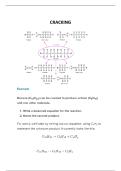
# Cracking in Organic Chemistry – Complete Notes Understand **Cracking** in a simple and clear way with these well-structured chemistry notes. Perfect for revision and exam preparation. --- ## What is Cracking? Cracking is the process of breaking down large hydrocarbon molecules into smaller, more useful molecules. It is used in petroleum industries to convert long-chain hydrocarbons into fuels and useful chemicals. --- ## Why is Cracking Important? * Produces **more useful fuels** like petrol and diesel * Produces **alkenes**, which are used to make plastics * Increases efficiency of crude oil usage --- ## Types of Cracking: ### 1. Thermal Cracking * Uses **high temperature and high pressure** * Breaks large molecules without a catalyst * Produces a mixture of alkanes and alkenes --- ### 2. Catalytic Cracking * Uses a **catalyst** (usually zeolite) * Lower temperature and pressure than thermal cracking * Produces more petrol and useful alkenes * Faster and more efficient --- ## General Idea of Cracking: Large alkane → smaller alkane + alkene Example: C₁₀H₂₂ → C₈H₁₈ + C₂H₄ --- ## Key Products: * **Alkanes** → used as fuels * **Alkenes** → used to make plastics and chemicals --- ## Conditions Needed: * Heat (high temperature) * Sometimes pressure * Catalyst (for catalytic cracking) --- ## Why These Notes? * Simple explanations for easy understanding * Clear examples for exams * Well-structured for quick revision * Helps with memorizing key concepts --- ## Best For: * High school chemistry students * Exam revision * Self-study learners --- ## Format: Neatly organized, easy to read, and ready for instant download. Master cracking with confidence using these clear and concise notes.
Document information
- Uploaded on
- April 27, 2026
- Number of pages
- 4
- Written in
- 2024/2025
- Type
- Summary


