

Chapter 1
Business Environments
Macro Environment
- External, no control. Design strategies to adapt to situations
- Micro can impact macro
● Strikes
● Retrenchment
● Effect of business operations on the physical environment
Competitive Advantage
Describes how the business has the edge in the market or over competitors
(local or international.) If business has CA, enables them to exploit this
advantage to sell more, attract more customers, or reduce expenses = MORE
PROFIT
Analyse macro
- Environmental scan
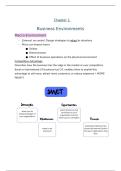
- SWOT -Opportunities and threats
,PESTLE
Either threaten business or used as an opportunity to strengthen
business
● Political
- Local and world political situation/stability where business
operates
- Constitution and Laws
- Government interference (capitalism vs socialism)
- Political ties with other countries - trade agreements
- Media freedom/ freedom of speech
● Economic
- Economic growth and development rates
- Inflation rates
- Interest rates in banks (ROI)
- Exchange rates (strength of local currency compared to other
countries)
- Unemployment rates (people don’t have money to buy products)
- Taxes (Income tax, VAT, import duties.)
● Ethical
- principles/ values to determine actions are acceptable
- Guideline to act in ‘right’ way.
- May be legal but not ethical in particular situation
- Fair Trade (respect and transparency in business dealings, and
acknowledging one party will not exploit another)
- CSR (giving back to community)
- Employee’s privacy vs rights of business to expect responsible
behaviour.
● Social/ socio-economic
- Impact of social trends on economy
- Businesses and consumers behaviour and lifestyles
, - Social media and different marketing strategies
- Age and life expectancy of population(health conscious)
- Number of single parents
- Infection and disease( HIV/Aids, TB, Malaria
- Levels of literacy/ education
- Unemployment
- Personal safety and crime
- Pollution and recycling
- Distribution of wealth/poverty
- Role of women in society
● Technological
- Equipment used (buy, manufacture, advertise,sell)
- Rapid development in social media
- Automation of different processes(lower-skilled labour)
- Online money transfers(internet banking, EFT)
- Online shopping (E-commerce)
- Quicker sales through EPOSSE pay points.
- Product innovation through research & development
● Legal
- Laws that impact business
- Labour legislation
- Consumer protection act
- Laws that protect environment( exploitation and pollution)
- Criminal justice (protection against piracy and rip-offs)
- Paying tax
- Registering business
- Health and safety specifications
● Environmental
- Growing awareness to protect the environment & to prevent
negative consequences (global warming, weather)
- Emphasis placed on recycling, hybrid cars, higher air taxes.
, Market Environment
- Goods and services are bought and sold
- SWOT (Opportunities and threats)
Strategies
Either be a formal business plan to achieve long or short-term goal, or it can
simply be a plan of action, implemented to improve the overall performance of
the business.
- Porter's Six Forces
1. Current Competitors
- Where competitors are not performing well = opportunity
- Competitors are successful = threat
Compare:
- Size & financial resources of business
- Market share
- Quality
- Brand loyalty
- Pricing
- Convenience (location & distribution)
- Trading hours
Strategies to ‘outperform competitors
- Customer loyalty programs
- Reducing the price of product/service
2. Threat of new entrants
- pose a threat to the market share and profits of existing
businesses.
- Registering a patent to keep competitors out
- Big retailers in malls negotiate to prevent too many competitors
- Intense advertising and promotions, difficult for new businesses
- Tax on imported goods, to protect the local market
Business Environments
Macro Environment
- External, no control. Design strategies to adapt to situations
- Micro can impact macro
● Strikes
● Retrenchment
● Effect of business operations on the physical environment
Competitive Advantage
Describes how the business has the edge in the market or over competitors
(local or international.) If business has CA, enables them to exploit this
advantage to sell more, attract more customers, or reduce expenses = MORE
PROFIT
Analyse macro
- Environmental scan
- SWOT -Opportunities and threats
,PESTLE
Either threaten business or used as an opportunity to strengthen
business
● Political
- Local and world political situation/stability where business
operates
- Constitution and Laws
- Government interference (capitalism vs socialism)
- Political ties with other countries - trade agreements
- Media freedom/ freedom of speech
● Economic
- Economic growth and development rates
- Inflation rates
- Interest rates in banks (ROI)
- Exchange rates (strength of local currency compared to other
countries)
- Unemployment rates (people don’t have money to buy products)
- Taxes (Income tax, VAT, import duties.)
● Ethical
- principles/ values to determine actions are acceptable
- Guideline to act in ‘right’ way.
- May be legal but not ethical in particular situation
- Fair Trade (respect and transparency in business dealings, and
acknowledging one party will not exploit another)
- CSR (giving back to community)
- Employee’s privacy vs rights of business to expect responsible
behaviour.
● Social/ socio-economic
- Impact of social trends on economy
- Businesses and consumers behaviour and lifestyles
, - Social media and different marketing strategies
- Age and life expectancy of population(health conscious)
- Number of single parents
- Infection and disease( HIV/Aids, TB, Malaria
- Levels of literacy/ education
- Unemployment
- Personal safety and crime
- Pollution and recycling
- Distribution of wealth/poverty
- Role of women in society
● Technological
- Equipment used (buy, manufacture, advertise,sell)
- Rapid development in social media
- Automation of different processes(lower-skilled labour)
- Online money transfers(internet banking, EFT)
- Online shopping (E-commerce)
- Quicker sales through EPOSSE pay points.
- Product innovation through research & development
● Legal
- Laws that impact business
- Labour legislation
- Consumer protection act
- Laws that protect environment( exploitation and pollution)
- Criminal justice (protection against piracy and rip-offs)
- Paying tax
- Registering business
- Health and safety specifications
● Environmental
- Growing awareness to protect the environment & to prevent
negative consequences (global warming, weather)
- Emphasis placed on recycling, hybrid cars, higher air taxes.
, Market Environment
- Goods and services are bought and sold
- SWOT (Opportunities and threats)
Strategies
Either be a formal business plan to achieve long or short-term goal, or it can
simply be a plan of action, implemented to improve the overall performance of
the business.
- Porter's Six Forces
1. Current Competitors
- Where competitors are not performing well = opportunity
- Competitors are successful = threat
Compare:
- Size & financial resources of business
- Market share
- Quality
- Brand loyalty
- Pricing
- Convenience (location & distribution)
- Trading hours
Strategies to ‘outperform competitors
- Customer loyalty programs
- Reducing the price of product/service
2. Threat of new entrants
- pose a threat to the market share and profits of existing
businesses.
- Registering a patent to keep competitors out
- Big retailers in malls negotiate to prevent too many competitors
- Intense advertising and promotions, difficult for new businesses
- Tax on imported goods, to protect the local market


