1.5 Problem 4
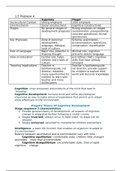
Vygotsky Piaget
Sociocultural Context Strong emphasis Little emphasis
Constructivism Social constructivist Cognitive Constructivist
Stages No general stages of Strong emphasis on stages
development proposed (sensorimotor, preoperational,
concrete operational, formal
operational)
Key Processes Zone of proximal Schema, assimilation,
development, accommodation, operations,
language, dialogue, conservation, classification
tools of culture
Role of Language Major role, powerful in Minimal role, cognition
shaping thought primarily directs language
View on Education Central role, helps Just refines child’s cognitive
children learn tools of skills that have already
culture emerged
Teaching Implications Teacher is Teacher is facilitator/guide,
facilitator/guide, not not director; provide support
director; establish for children to explore their
many opportunities for world and discover knowledge
children to learn with
teacher and more-
skilled peers
Cognition- inner processes and products of the mind that lead to
“knowing”
Cognitive development- humans build and refine psychological
structures as way to make sense of experience that permit us to adapt
more effectively to the environment
Piaget’s Theory Of Cognitive Development
Stage sequence 3 characteristics:
1. Provide general theory of development- all aspects of cognition
change in integrated fashion following a similar course
2. Stages invariant- always occur in fixed order, no stage can be
skipped
3. Stages universal- assumed to characterise children everywhere
Intelligence- a basic life function that enables an organism to adapt to
it’s environment
Balance between assimilation and accommodation vary with time :
Cognitive equilibrium- comfortable state, children little change=
assimilate more than accommodate
Cognitive disequilibrium- uncomfortable state, time of rapid
cognitive change
, Constructivist approach: children actively have to construct knowledge
themselves by acting on novel objects and events. This causes children to
gain understanding of essential features of these objects and events.
Schemes- organised ways of making sense of experience, change with
age
-Organisation- scheme changing occurring internally, not through
direct contact with environment
-Adaptation- building schemes through direct interaction with
environment
Made up of 2 complementary activities:
Assimilation- use our current schemes to interpret the
external world (child calling camel a horse, as don’t know
camel)
Accommodation- create new schemes or adjust old ones
after noticing our current way of thinking does not capture
environment completely (child now revises scheme
realising camels aren’t horse)
Piaget’s stages of cognitive development:
1.Sensorimotor stage: 0-2 years
o Infants/toddlers “think” with eyes, ears, hands, other
sensorimotor equipment
-Substages
1.Reflex activity: birth-1 months
new-born reflexes
2.Primary circular reactions: 1-4 months
simple motor habits centred around the infant’s
own body
limited anticipation of events
voluntary control over actions, repeating chance
behaviours largely motivated by basic needs
3.Secondary circular reactions: 4-8 months
actions aimed at repeating interesting events in
surrounding world
imitation of familiar behaviours
infants sit up, skilled at reaching for/manipulating
objects
4.Coordination of secondary schemes: 8-12 months
intentional, goal-directed, behaviour
object permanence
improved anticipation of events
imitation of behaviours slightly different from
those infant usually performs
foundation for all problem solving
5.Tertiary circular reactions: 12-18 months
exploration of properties of objects by acting on
them in novel ways
imitation of novel behaviours
Vygotsky Piaget
Sociocultural Context Strong emphasis Little emphasis
Constructivism Social constructivist Cognitive Constructivist
Stages No general stages of Strong emphasis on stages
development proposed (sensorimotor, preoperational,
concrete operational, formal
operational)
Key Processes Zone of proximal Schema, assimilation,
development, accommodation, operations,
language, dialogue, conservation, classification
tools of culture
Role of Language Major role, powerful in Minimal role, cognition
shaping thought primarily directs language
View on Education Central role, helps Just refines child’s cognitive
children learn tools of skills that have already
culture emerged
Teaching Implications Teacher is Teacher is facilitator/guide,
facilitator/guide, not not director; provide support
director; establish for children to explore their
many opportunities for world and discover knowledge
children to learn with
teacher and more-
skilled peers
Cognition- inner processes and products of the mind that lead to
“knowing”
Cognitive development- humans build and refine psychological
structures as way to make sense of experience that permit us to adapt
more effectively to the environment
Piaget’s Theory Of Cognitive Development
Stage sequence 3 characteristics:
1. Provide general theory of development- all aspects of cognition
change in integrated fashion following a similar course
2. Stages invariant- always occur in fixed order, no stage can be
skipped
3. Stages universal- assumed to characterise children everywhere
Intelligence- a basic life function that enables an organism to adapt to
it’s environment
Balance between assimilation and accommodation vary with time :
Cognitive equilibrium- comfortable state, children little change=
assimilate more than accommodate
Cognitive disequilibrium- uncomfortable state, time of rapid
cognitive change
, Constructivist approach: children actively have to construct knowledge
themselves by acting on novel objects and events. This causes children to
gain understanding of essential features of these objects and events.
Schemes- organised ways of making sense of experience, change with
age
-Organisation- scheme changing occurring internally, not through
direct contact with environment
-Adaptation- building schemes through direct interaction with
environment
Made up of 2 complementary activities:
Assimilation- use our current schemes to interpret the
external world (child calling camel a horse, as don’t know
camel)
Accommodation- create new schemes or adjust old ones
after noticing our current way of thinking does not capture
environment completely (child now revises scheme
realising camels aren’t horse)
Piaget’s stages of cognitive development:
1.Sensorimotor stage: 0-2 years
o Infants/toddlers “think” with eyes, ears, hands, other
sensorimotor equipment
-Substages
1.Reflex activity: birth-1 months
new-born reflexes
2.Primary circular reactions: 1-4 months
simple motor habits centred around the infant’s
own body
limited anticipation of events
voluntary control over actions, repeating chance
behaviours largely motivated by basic needs
3.Secondary circular reactions: 4-8 months
actions aimed at repeating interesting events in
surrounding world
imitation of familiar behaviours
infants sit up, skilled at reaching for/manipulating
objects
4.Coordination of secondary schemes: 8-12 months
intentional, goal-directed, behaviour
object permanence
improved anticipation of events
imitation of behaviours slightly different from
those infant usually performs
foundation for all problem solving
5.Tertiary circular reactions: 12-18 months
exploration of properties of objects by acting on
them in novel ways
imitation of novel behaviours