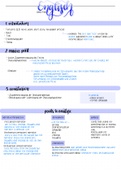
C21: How to do a survey C22: What is the target market segment?
• Questionnaires are valuable for gathering information • Target marketing involves focusing on a specific group
from large groups and can be analysed statistically. of customers rather than trying to sell the same product
• Provide clear instructions. to everyone.
• Keep questions brief. • A market segment consists of customers with common
• Prioritise necessary information. needs and interests, distinct from other groups, and
• Distribute questionnaires to relevant individuals. likely to respond similarly to marketing efforts.
•
Personal interviews
C21: Concept •
The marketing process
• testing and needs •
• Face-to-face interviews effectively enhance survey • Situation analysis - identify gaps between what
results through non-verbal communication - body identification consumers want, and what’s available.
language and facial expressions. • Marketing strategy - select a target market segment
Sample
• Prepare a suitable introduction in advance. and position the product in that segment.
• Maintain a relaxed and informal atmosphere. C22: Marketing
• Marketing mix decisions – product, price, place,
• Use the respondent's preferred language. promotion and people.
• . • Implementation and control - adapt the advertising
message to address changes in consumer wants.
Summaries after sample
•
Observation
•• Observational techniques allow for direct observation of customer
behaviour - provide greater accuracy than self-reported behaviour.
•
Guidelines for a successful advertisement
•
• This method removes common errors in market research like memory • Keep it short and simple for easy readability.
loss and poor recall, as well as overcoming language barriers. • Make accurate product descriptions.
• . • Use catchy phrases to attract potential customers' attention.
• Highlight the best features.
• The product life cycle and its stages • Provide enough background space.
• Use a font that’s easy to read.
•• Introduction stage – low sales where a market is established and demand is built.
• Growth stage – rapid growth, the product is a success, and competitors emerge in
the last part of this stage. •
• Maturity stage – most profitable, sales increase at a slower pace, and competition 6 core marketing principles
may cause decreased market share. •
• Produce what consumers want, analyse competitors’ products,
• Decline stage – sales decline as the market becomes saturated, and you need to target specific markets, grow networks and build relationships,
change the product or make a new product to suit current trends. satisfy customer needs, and create a profitable sales volume.
•
GR11 CS T3-T6 Mindmap Focus • Copyright © www.summariessa.co.za (DO NOT COPY)
,Sample
Summaries after sample
,Sample
Summaries after sample
• Questionnaires are valuable for gathering information • Target marketing involves focusing on a specific group
from large groups and can be analysed statistically. of customers rather than trying to sell the same product
• Provide clear instructions. to everyone.
• Keep questions brief. • A market segment consists of customers with common
• Prioritise necessary information. needs and interests, distinct from other groups, and
• Distribute questionnaires to relevant individuals. likely to respond similarly to marketing efforts.
•
Personal interviews
C21: Concept •
The marketing process
• testing and needs •
• Face-to-face interviews effectively enhance survey • Situation analysis - identify gaps between what
results through non-verbal communication - body identification consumers want, and what’s available.
language and facial expressions. • Marketing strategy - select a target market segment
Sample
• Prepare a suitable introduction in advance. and position the product in that segment.
• Maintain a relaxed and informal atmosphere. C22: Marketing
• Marketing mix decisions – product, price, place,
• Use the respondent's preferred language. promotion and people.
• . • Implementation and control - adapt the advertising
message to address changes in consumer wants.
Summaries after sample
•
Observation
•• Observational techniques allow for direct observation of customer
behaviour - provide greater accuracy than self-reported behaviour.
•
Guidelines for a successful advertisement
•
• This method removes common errors in market research like memory • Keep it short and simple for easy readability.
loss and poor recall, as well as overcoming language barriers. • Make accurate product descriptions.
• . • Use catchy phrases to attract potential customers' attention.
• Highlight the best features.
• The product life cycle and its stages • Provide enough background space.
• Use a font that’s easy to read.
•• Introduction stage – low sales where a market is established and demand is built.
• Growth stage – rapid growth, the product is a success, and competitors emerge in
the last part of this stage. •
• Maturity stage – most profitable, sales increase at a slower pace, and competition 6 core marketing principles
may cause decreased market share. •
• Produce what consumers want, analyse competitors’ products,
• Decline stage – sales decline as the market becomes saturated, and you need to target specific markets, grow networks and build relationships,
change the product or make a new product to suit current trends. satisfy customer needs, and create a profitable sales volume.
•
GR11 CS T3-T6 Mindmap Focus • Copyright © www.summariessa.co.za (DO NOT COPY)
,Sample
Summaries after sample
,Sample
Summaries after sample