General definitions:
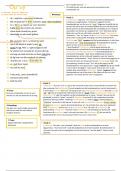
Obiter dicta: (things said ‘by the way’ not binding) a judge’s expression of opinion uttered in
court or in written judgement, but not essential to the decision and therefore is not legally
binding as a precedent
Ratio decidendi: (the reason for the decision) the rule of law on which a judicial decision is
based
Appellant: (a person who brings an appeal to the higher court) a person who applies to a higher
court for a reversal of the decision of a lower court
Respondent: (a person who has to respond to an appeal brought by the appellant) a party against
whom a petition is filed, especially one in an appeal or a divorce case
Plaintiff: (the one who sues; the one whose right has been infringed) a person who brings a case
against another in a court of law
Defendant: (the one who is sued) an individual, company, or institution sued or accused in a
court of law
Precedent: a decision which is binding on the court of the same level or lower where similar
facts occur
Topic 2: The Law of Tort and Negligence
2.1 What is Tort?
Tort: Derived from “torts” and “tortus”, a latin term, it is defined as a civil (civil refers to a
person with the right to no harm) wrong.
Tortious: An act which is a civil wrong.
Tortfeasor: the party committing a tort or the wrong-doer.The modern term for a tortfeasor is the
“wrong doer”
Liability in tort: based on the concept of a legal duty not to injure other persons or their property
interests.
When harmed, the person who causes harm has infringed the victim’s rights. Legal/civil
action will be taken in court to get monetary compensation. The victim will be the plaintiff
and the other person will be the defendant.
Torts: Usually classified as either “intentional” or “unintentional’
Intentional Torts Unintentional Torts
Assult - act, words with unwanted language, fear Indifferent to effects of action or unaware of
consequences of action = tort of negligence
- Careless , no intention to carry out the
particular action
Battery - touch without their concent
Grievous bodily harm - wounded, broken bones,
, serious permanent damage
False imprisonment - no serious permanent
damage
Defamation - harm their reputation
More information about defamation
Defamation is divided into libel and slander.
Libel - defamation in a permanent ( eg: in writing, print, film, radio or television boradcast ) tangible
goods
Slander - defamation in a non-permanent ( eg: an oral statement, in a video cassatte )
Defamation Act 1957, s 5 : In an action for slander in respect of words calculated to disparage ( play
down ) the plaintiff in any office, profession, calling, trade or business .. . Not necessary to allege or
prove special damage.
Defamation Act 1957, s 4: … words which impute ( represent ) unchastity or adultery to any woman
or girl shall not require special damage to render ( give) them actionable ( giving sufficient reason
to take legal action )
2.2 Difference between tort and criminal law
Tort law Criminal law
Onus on State (offence against the state e.g.
Standard of proof Plaintiff (e.g plaintiff v. public offencer v. the criminal)
defendant)
Criminal Liability
→ beyond reasonable doubt (innocent
Civil Liability until proven guilty; the defendant can
→ balance of probabilities continue to raise doubt to avoid getting
(weigh evidence from both punished)
sides)
Monetary compensation (due Punishment e.g
Sanctions and to suffering losses) imprisonment
remedies (Objectives)
,2.3 Difference between contract and tort Contract
Tort
No parties involved. Imposes standards of
Obligations of the parties to the contract
conduct upon society as a whole.
arise from agreement between them. -
Sources of obligations that a person has - Obligations are imposed by the law -
consented to follow
Consent is not likely
- The consent must be given freely
2.4 What is the tort of negligence
Negligence: “Negligence is the omission to do something which the reasonable man, guided
upon those considerations which ordinarily regulate the conduct of human affairs, would do, or
do something which a prudent and reasonable man would not do.” - Blyth v Birmingham
Waterworks Co (1856) 11 Ex.781, per Alderson B
2.5 Elements of Negligence [4 steps]
Summary:
1. The defendant owed the plaintiff a duty of care. → Neighbour principle
2. The defendant has breached that duty of care. → Standard of care
3. Causation: The defendant’s act caused the plaintiff physical/mental harm
or economic loss. → But for test
4. Remoteness of damage: Harm suffered by the plaintiff was reasonably foreseeable.
Finally: Check for defences
In depth:
1. Duty of Care
The defendant owes a duty of care to his neighbour.
The neighbour principle: “persons who are so closely and directly affected by my act
that I ought reasonably to have them in contemplation as long as so affected when I am
directing my mind to the acts or omissions that are called in question.” - Donoghue v
Stevenson [1932] HL
→ a test of reasonable foreseeability (reasonably see that someone can be hurt by
your actions or omissions, these people will be your neighbours) and proximity (very
close proximity of relationship; relationship between the defendant and the activity
which caused harm to the claimant) The Law of Tort in Hong Kong (Butterworths
, 1995), p. 123.
Donoghue v Stevenson [1932] AC 562
The case involved Mrs Donoghue drinking a bottle of ginger beer in a café in Paisley, Renfrewshire.
A dead snail was in the bottle. She fell ill, and she sued the ginger beer manufacturer, Mr
Stevenson. The House of Lords held that the manufacturer owed a duty of care to her, which was
breached, because it was reasonably foreseeable that failure to ensure the product's safety would
lead to harm to consumers. There was also a sufficiently proximate relationship between consumers
and product manufacturers.
➔ The HoLs departed from the traditional view of imposing duty of care based on contractual
obligation.
→ English House of Lords decided a person could be liable for negligence even
though there was no contract between them (thus, manufacturers and other chains of
supply owe duty of care to the ultimate consumer; or road used to road user; or employer
to employee[health and safety in the workplace])
→ Another example case:
Bourhill v Young [1943] AC 92
Mr Young had been negligently riding a motorcycle along a road, and was involved in a collision
with a car, fatally injuring him. At the time of the crash, Mrs Bourhill was about to leave a tram
which she had been riding, around 50 ft from the scene of the accident. She approached the scene
of
the accident, seeing the blood remaining from the crash. Mrs Bourhill, at the time, eight months
pregnant, later gave birth to a stillborn child, and claimed she had suffered nervous shock, stress
and sustained loss due to Mr Young.
➔ How extensive an individual's duty is to ensure others are not harmed by their activities. The
case established important boundaries on the scope of recovery for bystanders, or those
uninvolved with physical harm. Where a woman suffered psychiatric harm after walking onto
the scene of a motorcycle accident, she was deemed not to be a foreseeable victim, having not
been in immediate danger of physical harm. She was also physically outside the area of
foreseeable danger and this in itself was sufficient to prevent her from recovering.
2.5.1 Development of duty of care: Three-fold test
Caparo Industries plc v Dickman [1990] UKHL 2
A leading English tort law cause on the test for a duty of care. The House of Lords, following
the Court of Appeal, set out a “three-fold test”. In order for a duty of care to arise in negligence:
1. Reasonable foresight of harm as a result of the defendant’s conduct (as
established in Donoghue v Stevenson)
2. Sufficient proximity of relationship (between plaintiff and defendant)
3. Fair just and reasonable to impose a liability
Obiter dicta: (things said ‘by the way’ not binding) a judge’s expression of opinion uttered in
court or in written judgement, but not essential to the decision and therefore is not legally
binding as a precedent
Ratio decidendi: (the reason for the decision) the rule of law on which a judicial decision is
based
Appellant: (a person who brings an appeal to the higher court) a person who applies to a higher
court for a reversal of the decision of a lower court
Respondent: (a person who has to respond to an appeal brought by the appellant) a party against
whom a petition is filed, especially one in an appeal or a divorce case
Plaintiff: (the one who sues; the one whose right has been infringed) a person who brings a case
against another in a court of law
Defendant: (the one who is sued) an individual, company, or institution sued or accused in a
court of law
Precedent: a decision which is binding on the court of the same level or lower where similar
facts occur
Topic 2: The Law of Tort and Negligence
2.1 What is Tort?
Tort: Derived from “torts” and “tortus”, a latin term, it is defined as a civil (civil refers to a
person with the right to no harm) wrong.
Tortious: An act which is a civil wrong.
Tortfeasor: the party committing a tort or the wrong-doer.The modern term for a tortfeasor is the
“wrong doer”
Liability in tort: based on the concept of a legal duty not to injure other persons or their property
interests.
When harmed, the person who causes harm has infringed the victim’s rights. Legal/civil
action will be taken in court to get monetary compensation. The victim will be the plaintiff
and the other person will be the defendant.
Torts: Usually classified as either “intentional” or “unintentional’
Intentional Torts Unintentional Torts
Assult - act, words with unwanted language, fear Indifferent to effects of action or unaware of
consequences of action = tort of negligence
- Careless , no intention to carry out the
particular action
Battery - touch without their concent
Grievous bodily harm - wounded, broken bones,
, serious permanent damage
False imprisonment - no serious permanent
damage
Defamation - harm their reputation
More information about defamation
Defamation is divided into libel and slander.
Libel - defamation in a permanent ( eg: in writing, print, film, radio or television boradcast ) tangible
goods
Slander - defamation in a non-permanent ( eg: an oral statement, in a video cassatte )
Defamation Act 1957, s 5 : In an action for slander in respect of words calculated to disparage ( play
down ) the plaintiff in any office, profession, calling, trade or business .. . Not necessary to allege or
prove special damage.
Defamation Act 1957, s 4: … words which impute ( represent ) unchastity or adultery to any woman
or girl shall not require special damage to render ( give) them actionable ( giving sufficient reason
to take legal action )
2.2 Difference between tort and criminal law
Tort law Criminal law
Onus on State (offence against the state e.g.
Standard of proof Plaintiff (e.g plaintiff v. public offencer v. the criminal)
defendant)
Criminal Liability
→ beyond reasonable doubt (innocent
Civil Liability until proven guilty; the defendant can
→ balance of probabilities continue to raise doubt to avoid getting
(weigh evidence from both punished)
sides)
Monetary compensation (due Punishment e.g
Sanctions and to suffering losses) imprisonment
remedies (Objectives)
,2.3 Difference between contract and tort Contract
Tort
No parties involved. Imposes standards of
Obligations of the parties to the contract
conduct upon society as a whole.
arise from agreement between them. -
Sources of obligations that a person has - Obligations are imposed by the law -
consented to follow
Consent is not likely
- The consent must be given freely
2.4 What is the tort of negligence
Negligence: “Negligence is the omission to do something which the reasonable man, guided
upon those considerations which ordinarily regulate the conduct of human affairs, would do, or
do something which a prudent and reasonable man would not do.” - Blyth v Birmingham
Waterworks Co (1856) 11 Ex.781, per Alderson B
2.5 Elements of Negligence [4 steps]
Summary:
1. The defendant owed the plaintiff a duty of care. → Neighbour principle
2. The defendant has breached that duty of care. → Standard of care
3. Causation: The defendant’s act caused the plaintiff physical/mental harm
or economic loss. → But for test
4. Remoteness of damage: Harm suffered by the plaintiff was reasonably foreseeable.
Finally: Check for defences
In depth:
1. Duty of Care
The defendant owes a duty of care to his neighbour.
The neighbour principle: “persons who are so closely and directly affected by my act
that I ought reasonably to have them in contemplation as long as so affected when I am
directing my mind to the acts or omissions that are called in question.” - Donoghue v
Stevenson [1932] HL
→ a test of reasonable foreseeability (reasonably see that someone can be hurt by
your actions or omissions, these people will be your neighbours) and proximity (very
close proximity of relationship; relationship between the defendant and the activity
which caused harm to the claimant) The Law of Tort in Hong Kong (Butterworths
, 1995), p. 123.
Donoghue v Stevenson [1932] AC 562
The case involved Mrs Donoghue drinking a bottle of ginger beer in a café in Paisley, Renfrewshire.
A dead snail was in the bottle. She fell ill, and she sued the ginger beer manufacturer, Mr
Stevenson. The House of Lords held that the manufacturer owed a duty of care to her, which was
breached, because it was reasonably foreseeable that failure to ensure the product's safety would
lead to harm to consumers. There was also a sufficiently proximate relationship between consumers
and product manufacturers.
➔ The HoLs departed from the traditional view of imposing duty of care based on contractual
obligation.
→ English House of Lords decided a person could be liable for negligence even
though there was no contract between them (thus, manufacturers and other chains of
supply owe duty of care to the ultimate consumer; or road used to road user; or employer
to employee[health and safety in the workplace])
→ Another example case:
Bourhill v Young [1943] AC 92
Mr Young had been negligently riding a motorcycle along a road, and was involved in a collision
with a car, fatally injuring him. At the time of the crash, Mrs Bourhill was about to leave a tram
which she had been riding, around 50 ft from the scene of the accident. She approached the scene
of
the accident, seeing the blood remaining from the crash. Mrs Bourhill, at the time, eight months
pregnant, later gave birth to a stillborn child, and claimed she had suffered nervous shock, stress
and sustained loss due to Mr Young.
➔ How extensive an individual's duty is to ensure others are not harmed by their activities. The
case established important boundaries on the scope of recovery for bystanders, or those
uninvolved with physical harm. Where a woman suffered psychiatric harm after walking onto
the scene of a motorcycle accident, she was deemed not to be a foreseeable victim, having not
been in immediate danger of physical harm. She was also physically outside the area of
foreseeable danger and this in itself was sufficient to prevent her from recovering.
2.5.1 Development of duty of care: Three-fold test
Caparo Industries plc v Dickman [1990] UKHL 2
A leading English tort law cause on the test for a duty of care. The House of Lords, following
the Court of Appeal, set out a “three-fold test”. In order for a duty of care to arise in negligence:
1. Reasonable foresight of harm as a result of the defendant’s conduct (as
established in Donoghue v Stevenson)
2. Sufficient proximity of relationship (between plaintiff and defendant)
3. Fair just and reasonable to impose a liability