Peripheral ns - Study guides, Revision notes & Summaries

Looking for the best study guides, study notes and summaries about Peripheral ns? On this page you'll find 6 study documents about Peripheral ns.

All 6 results

Sort by:
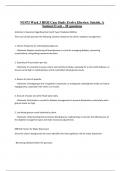
NU473 Week 3 HESI Case Study Evolve Elsevier: Suicide, A  Sentinel Event - 28 questions
  • Exam (elaborations)

    NU473 Week 3 HESI Case Study Evolve Elsevier: Suicide, A Sentinel Event - 28 questions

  • NU473 Week 3 HESI Case Study Evolve Elsevier: Suicide, A Sentinel Event - 28 questions Activities to Question Regarding Client with Type II Diabetes Mellitus The nurse should question the following activities related to the client’s diabetes management: 1. Client’s frequency for checking blood glucose. - Rationale: Regular monitoring of blood glucose is crucial for managing diabetes, preventing complications, and guiding treatment decisions. 2. Quantity of Ensure taken per day. -...
  • bestscores1
    £8.46 More Info
Basic Pharmacology For Nurses 17Th Ed By Clayton -Test Bank
  • Exam (elaborations)

    Basic Pharmacology For Nurses 17Th Ed By Clayton -Test Bank

  • Chapter 03: Drug Action Across the Life Span Clayton/Willihnganz: Basic Pharmacology for Nurses, 17th Edition MULTIPLE CHOICE 1. What time will the trough blood level need to be drawn if the nurse administers the intravenous medication dose at 9:00 AM? a. 6:30 AM b. 8:30 AM c. 9:30 AM d. 11:30 AM ANS: B Trough blood levels measure the lowest blood level of medicine and are obtained just before the dose is administered. In this case, 6:30 AM is too early to obtain the blood ...
  • ExamsExpert
    £16.99 More Info
1Exam 1 Med Surg
  • Exam (elaborations)

    1Exam 1 Med Surg

  • 1Exam 1 Med Surg QUESTIONS AND CORRECT ANSWERS GRADE A+ 1. Who can insert peripheral IV? Who is responsible for all infusion aspects including delegation? What is infusion therapy? What is the most common reason for infusion therapy? What is infusion therapy? The RN can insert and is responsible for all infusion aspects and deligation Infusion therapy is administration of medication's or fluids via paternal route, using a needle to pierce through skin catheter DIR...
  • NursingCourses
    £6.95 More Info
EMT FISDAP Readiness Exam (TCC) Terms and Questions Correctly Explained  (Verified 100%).
  • Exam (elaborations)

    EMT FISDAP Readiness Exam (TCC) Terms and Questions Correctly Explained (Verified 100%).

  • EMT FISDAP Readiness Exam (TCC) Terms and Questions Correctly Explained (Verified 100%). EMT FISDAP Readiness Exam (TCC) Scope of practice The range of clinical procedures and activities that are allowed by EMS provider standard of care care that should be provided for any level of training, what is expected of you Duty to Act EMR have duty to provide care while on duty Negligence failure to provide expected standard of care 4 things of negligence duty of care breach of duty cau...
  • grade_bender
    £10.82 More Info
Pediatric Advanced Life Support 2023 Exam / PALS 2023 Exam (answered) Pediatric Advanced Life Support 2023 Exam / PALS 2023 Exam (answered)
  • Exam (elaborations)

    Pediatric Advanced Life Support 2023 Exam / PALS 2023 Exam (answered)

  • 1. The PALS systemic approach algorithm begins with the initial impression. This is an assessment of which 3 characteristics? 2. The right branch of the systemic approach algo- rithm focuses on what sequence to prevent cardiopul- monary arrest? 3. The evaluate portion of the sequence consists of three assessment tools: 4. What is included in the primary assessment of a pa- tient? 5. What is included in the secondary assessment of a patient? 6. The initial impression of the PALS systematic ...
  • YOURVERIFIEDEXAMPLUG
    £8.88 More Info
AHA ACLS Written Test Answered 50 out of 50(100% scored) 2021/2022
  • Exam (elaborations)

    AHA ACLS Written Test Answered 50 out of 50(100% scored) 2021/2022

  • 1. You find an unresponsive pt. who is not breathing. Start chest com- After activating the emergency response system, you pressions of at determine there is no pulse. What is your next action? 2. You are evaluating a 58 year old man with chest pain. The BP is 92/50 and a heart rate of 92/min, non-labored respiratory rate is 14 breaths/min and the pulse O2 is 97%. What assessment step is most important now? 3. What is the preferred method of access for epi admin- istration during cardiac arres...
  • YOURVERIFIEDEXAMPLUG
    £8.50 More Info
Make study stress less painful
Study stress? For sellers on Stuvia, these are actually golden times. KA-CHING! Earn from your revision notes too and start uploading now.