

Nelson Mandela Metropolitan University (NMMU)
Latest uploads at Nelson Mandela Metropolitan University (NMMU). Looking for notes at Nelson Mandela Metropolitan University (NMMU)? We have lots of notes, study guides and revision notes available for your school.
-
113
-
12
-
6
All courses for Nelson Mandela Metropolitan University (NMMU)
-
Child and Family Care 1
-
Communication 1
-
Constitutional Law JJTV200 1
-
EB121 Business Management 1 EB121 1
-
Geology GGLV101 1
-
LAW MISC 2
-
Macro Economics ECC201 4
-
Psychology 1
-
TEFL 5
-
TEFLE LEVEL 5 1
Popular books Nelson Mandela Metropolitan University (NMMU)
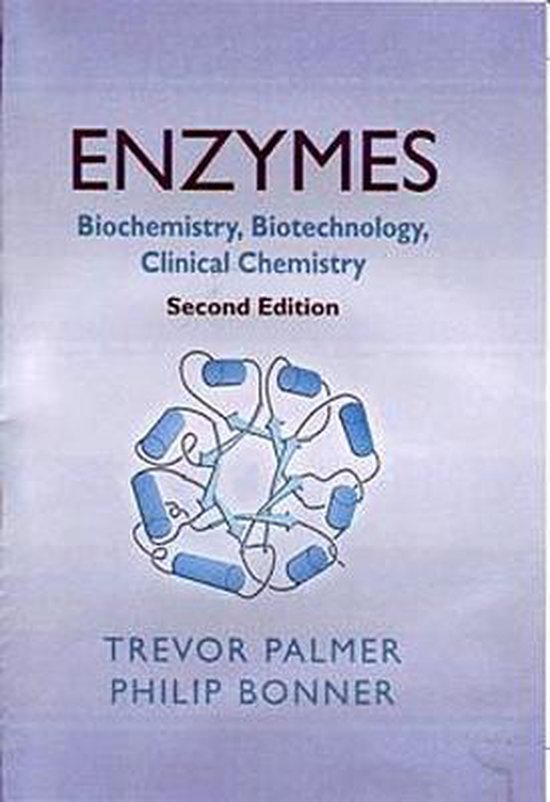
T Palmer, P L Bonner • ISBN 9781904275275
Latest content Nelson Mandela Metropolitan University (NMMU)
Get a comprehensive overview of infectious diseases caused by viruses, bacteria, fungi, and prions! This document covers airborne, waterborne, zoonotic, and opportunistic diseases, detailing their symptoms, treatments, and key characteristics. Perfect for microbiology students looking to ace their exams or deepen their understanding of pathogens and disease mechanisms. Study smarter with MicroBio Masterclass!
- Summary
- • 12 pages's •
-
Nelson Mandela Metropolitan University•Medical Microbiology
Preview 2 out of 12 pages
Getting your document ready...
Get a comprehensive overview of infectious diseases caused by viruses, bacteria, fungi, and prions! This document covers airborne, waterborne, zoonotic, and opportunistic diseases, detailing their symptoms, treatments, and key characteristics. Perfect for microbiology students looking to ace their exams or deepen their understanding of pathogens and disease mechanisms. Study smarter with MicroBio Masterclass!
Master the principles of chemical control with these well-structured notes! Covering everything from historical antiseptics to modern disinfectants, this document breaks down key chemical agents like phenols, alcohols, halogens, heavy metals, and more. Learn how they work, their effectiveness, and their applications in microbiology. Perfect for students looking to ace exams or reinforce their understanding of microbial control methods!
- Summary
- • 11 pages's •
-
Nelson Mandela Metropolitan University•Introductory Microbiology
Preview 2 out of 11 pages
Getting your document ready...
Master the principles of chemical control with these well-structured notes! Covering everything from historical antiseptics to modern disinfectants, this document breaks down key chemical agents like phenols, alcohols, halogens, heavy metals, and more. Learn how they work, their effectiveness, and their applications in microbiology. Perfect for students looking to ace exams or reinforce their understanding of microbial control methods!
Amino acids are the building blocks of proteins, classified into five groups based on their side chains. They play crucial roles in biological functions such as catalysis, transport, structure, and motion. All organisms share a common set of 20 amino acids, which are chiral except for glycine.
- Summary
- • 4 pages's •
-
Nelson Mandela Metropolitan University•Introductory Biochemistry and Genetics
Preview 1 out of 4 pages
Getting your document ready...
Amino acids are the building blocks of proteins, classified into five groups based on their side chains. They play crucial roles in biological functions such as catalysis, transport, structure, and motion. All organisms share a common set of 20 amino acids, which are chiral except for glycine.
Chromosomes are condensed DNA structures that package genes, with eukaryotic genomes containing multiple linear chromosomes and introns. The central dogma of molecular biology describes DNA replication, transcription, and translation processes. Supercoiling and topoisomerases regulate DNA structure and function, affecting gene expression and cellular processes. Epigenetic modifications influence gene activity without altering DNA sequences.
- Package deal
- Lecture notes
- • 16 pages's •
-
Nelson Mandela Metropolitan University•Introductory Biochemistry and Genetics
-
Introductory Biochemistry and Genetics• ByMichaelgoodwin17
Preview 3 out of 16 pages
Getting your document ready...
Chromosomes are condensed DNA structures that package genes, with eukaryotic genomes containing multiple linear chromosomes and introns. The central dogma of molecular biology describes DNA replication, transcription, and translation processes. Supercoiling and topoisomerases regulate DNA structure and function, affecting gene expression and cellular processes. Epigenetic modifications influence gene activity without altering DNA sequences.
Gene regulation in bacteria involves operons like the lac operon, which is controlled by glucose and lactose levels. In eukaryotes, transcription is more complex, involving chromatin remodeling, transcription factors, and regulatory proteins that enhance or inhibit gene expression. Translational control is also significant, with mechanisms like RNA interference and the role of small RNAs in regulating mRNA translation.
- Package deal
- Lecture notes
- • 40 pages's •
-
Nelson Mandela Metropolitan University•Introductory Biochemistry and Genetics
-
Introductory Biochemistry and Genetics• ByMichaelgoodwin17
Preview 4 out of 40 pages
Getting your document ready...
Gene regulation in bacteria involves operons like the lac operon, which is controlled by glucose and lactose levels. In eukaryotes, transcription is more complex, involving chromatin remodeling, transcription factors, and regulatory proteins that enhance or inhibit gene expression. Translational control is also significant, with mechanisms like RNA interference and the role of small RNAs in regulating mRNA translation.
Protein synthesis involves five stages: activation of amino acids, initiation, elongation, termination, and post-translational processing. The genetic code is universal, consisting of triplet codons that specify amino acids, with redundancy allowing for mutation resistance. Signal sequences direct proteins to their cellular destinations, and degradation mechanisms recycle amino acids and regulate protein levels.
- Package deal
- Lecture notes
- • 28 pages's •
-
Nelson Mandela Metropolitan University•Introductory Biochemistry and Genetics
-
Introductory Biochemistry and Genetics• ByMichaelgoodwin17
Preview 3 out of 28 pages
Getting your document ready...
Protein synthesis involves five stages: activation of amino acids, initiation, elongation, termination, and post-translational processing. The genetic code is universal, consisting of triplet codons that specify amino acids, with redundancy allowing for mutation resistance. Signal sequences direct proteins to their cellular destinations, and degradation mechanisms recycle amino acids and regulate protein levels.
RNA metabolism involves various types of RNA including mRNA, tRNA, and rRNA, with transcription being the process where RNA is synthesized from DNA. Key stages include initiation, elongation, and termination, regulated by promoter sequences and transcription factors, with distinct mechanisms in prokaryotes and eukaryotes. Inhibitors like Actinomycin D and Rifampicin can selectively block RNA polymerase activity.
- Package deal
- Lecture notes
- • 16 pages's •
-
Nelson Mandela Metropolitan University•Introductory Biochemistry and Genetics
-
Introductory Biochemistry and Genetics• ByMichaelgoodwin17
Preview 3 out of 16 pages
Getting your document ready...
RNA metabolism involves various types of RNA including mRNA, tRNA, and rRNA, with transcription being the process where RNA is synthesized from DNA. Key stages include initiation, elongation, and termination, regulated by promoter sequences and transcription factors, with distinct mechanisms in prokaryotes and eukaryotes. Inhibitors like Actinomycin D and Rifampicin can selectively block RNA polymerase activity.
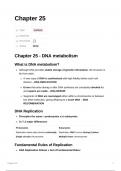
DNA metabolism encompasses replication, repair, and recombination processes. Key aspects include semiconservative replication, the role of various DNA polymerases, and multiple repair mechanisms to maintain genetic integrity, ensuring accurate DNA synthesis and repair in both prokaryotes and eukaryotes.
- Package deal
- Lecture notes
- • 29 pages's •
-
Nelson Mandela Metropolitan University•Introductory Biochemistry and Genetics
-
Introductory Biochemistry and Genetics• ByMichaelgoodwin17
Preview 3 out of 29 pages
Getting your document ready...
DNA metabolism encompasses replication, repair, and recombination processes. Key aspects include semiconservative replication, the role of various DNA polymerases, and multiple repair mechanisms to maintain genetic integrity, ensuring accurate DNA synthesis and repair in both prokaryotes and eukaryotes.
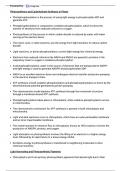
An easy to understand summary of Photophosphorylation and Photosynthesis , which will help you to better understand the topic and prepare for exams.
- Package deal
- Summary
- • 2 pages's •
-
Nelson Mandela Metropolitan University•Metabolism
-
Metabolism Summary• ByMichaelgoodwin17
Preview 1 out of 2 pages
Getting your document ready...
An easy to understand summary of Photophosphorylation and Photosynthesis , which will help you to better understand the topic and prepare for exams.
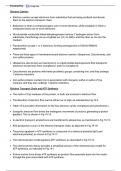
An easy to understand summary of Oxidative Phosphorylation and Electron Transport chain, which will help you to better understand the topic and prepare for exams.
- Package deal
- Summary
- • 2 pages's •
-
Nelson Mandela Metropolitan University•Metabolism
-
Metabolism Summary• ByMichaelgoodwin17
Preview 1 out of 2 pages
Getting your document ready...
An easy to understand summary of Oxidative Phosphorylation and Electron Transport chain, which will help you to better understand the topic and prepare for exams.