WACC & COST OF CAPITAL EXPLAINED
FINN1011 Finance | Complete Mini-Guide
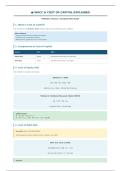
1. What is Cost of Capital?
Cost of capital is the minimum return investors require to provide financing to a company.
Why It Matters:
• Used as the discount rate for NPV calculations
• Hurdle rate for investment decisions
• Measures the "opportunity cost" of using funds
2. Components of Cost of Capital
Source Cost Why?
Equity (Re) Higher Shareholders bear most risk (paid last)
Debt (Rd) Lower Creditors have priority + tax shield
3. Cost of Equity (Re)
Two methods to calculate cost of equity:
Method 1: CAPM
Re = Rf + β × (Rm - Rf)
Risk-free rate + Beta × Market Risk Premium
Method 2: Dividend Discount Model (DDM)
Re = (D₁ / P₀) + g
Dividend Yield + Growth Rate
CAPM Example:
Rf = 4%, Rm = 10%, β = 1.2
Re = 4% + 1.2 × (10% - 4%) = 4% + 7.2% = 11.2%
4. Cost of Debt (Rd)
Key Point: Debt is TAX-DEDUCTIBLE!
Interest payments reduce taxable income, creating a "tax shield."
After-Tax Cost of Debt:
Rd (after-tax) = Rd × (1 - Tc)
Pre-tax cost of debt × (1 - Tax rate)
Example:
FINN1011 Finance | Complete Mini-Guide
1. What is Cost of Capital?
Cost of capital is the minimum return investors require to provide financing to a company.
Why It Matters:
• Used as the discount rate for NPV calculations
• Hurdle rate for investment decisions
• Measures the "opportunity cost" of using funds
2. Components of Cost of Capital
Source Cost Why?
Equity (Re) Higher Shareholders bear most risk (paid last)
Debt (Rd) Lower Creditors have priority + tax shield
3. Cost of Equity (Re)
Two methods to calculate cost of equity:
Method 1: CAPM
Re = Rf + β × (Rm - Rf)
Risk-free rate + Beta × Market Risk Premium
Method 2: Dividend Discount Model (DDM)
Re = (D₁ / P₀) + g
Dividend Yield + Growth Rate
CAPM Example:
Rf = 4%, Rm = 10%, β = 1.2
Re = 4% + 1.2 × (10% - 4%) = 4% + 7.2% = 11.2%
4. Cost of Debt (Rd)
Key Point: Debt is TAX-DEDUCTIBLE!
Interest payments reduce taxable income, creating a "tax shield."
After-Tax Cost of Debt:
Rd (after-tax) = Rd × (1 - Tc)
Pre-tax cost of debt × (1 - Tax rate)
Example: