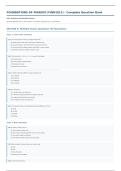
FOUNDATIONS OF FINANCE (FINN1011) - Complete Question Bank
100+ Questions with Detailed Answers
Sections: Multiple Choice | Short Answer | True/False | Spot the Error | Calculations
SECTION A: Multiple Choice Questions (45 Questions)
Topic 1: Time Value of Money
Q1. The time value of money concept states that:
A) Money loses value over time due to inflation only
B) A pound today is worth more than a pound tomorrow
C) Future money is always worth more than current money
D) Interest rates don't affect money's value
Q2. The formula FV = PV × (1 + r)ⁿ is used to calculate:
A) Present value
B) Future value (compounding)
C) Net present value
D) Internal rate of return
Q3. £1,000 invested at 8% for 3 years will grow to:
A) £1,240.00
B) £1,259.71
C) £1,080.00
D) £1,331.00
Q4. An annuity is:
A) A single lump sum payment
B) A series of equal payments at regular intervals
C) A payment that grows each period
D) An irregular series of payments
Q5. The present value of a perpetuity paying £100/year at 5% is:
A) £500
B) £1,000
C) £2,000
D) Infinite
Topic 2: Bond Valuation
Q6. A bond's coupon rate is:
A) The market interest rate
B) The annual interest payment as a % of face value
C) The bond's yield to maturity
D) The discount rate used to price the bond
Q7. When market interest rates rise, bond prices:
A) Rise
B) Fall
C) Stay the same
D) Become more volatile
Q8. A premium bond has:
, A) Price below par and YTM above coupon rate
B) Price above par and YTM below coupon rate
C) Price equal to par
D) No coupon payments
Q9. A zero-coupon bond:
A) Pays interest annually
B) Has no maturity date
C) Is sold at a discount and pays face value at maturity
D) Always trades at par
Q10. Which bond is most sensitive to interest rate changes?
A) 5-year, 10% coupon
B) 10-year, 10% coupon
C) 10-year, 5% coupon
D) 30-year, 5% coupon
Topic 3: Stock Valuation
Q11. The Gordon Growth Model assumes:
A) Dividends remain constant forever
B) Dividends grow at a constant rate forever
C) Dividends grow at varying rates
D) No dividends are paid
Q12. In the formula P₀ = D₁/(r-g), if r = g, the stock price would be:
A) Zero
B) Infinite (undefined)
C) Equal to D₁
D) Negative
Q13. A stock pays D₀ = £2, g = 4%, r = 10%. The stock price is:
A) £33.33
B) £34.67
C) £20.00
D) £50.00
Q14. The required return on a stock equals:
A) Dividend yield only
B) Capital gains yield only
C) Dividend yield + Capital gains yield
D) Dividend yield × Capital gains yield
Q15. If a stock's price is £50, D₁ = £3, and g = 5%, the required return is:
A) 6%
B) 11%
C) 8%
D) 5%
Topic 4: Investment Appraisal
Q16. NPV stands for:
A) Net Profit Value
B) Net Present Value
C) New Project Value
D) Nominal Present Value
100+ Questions with Detailed Answers
Sections: Multiple Choice | Short Answer | True/False | Spot the Error | Calculations
SECTION A: Multiple Choice Questions (45 Questions)
Topic 1: Time Value of Money
Q1. The time value of money concept states that:
A) Money loses value over time due to inflation only
B) A pound today is worth more than a pound tomorrow
C) Future money is always worth more than current money
D) Interest rates don't affect money's value
Q2. The formula FV = PV × (1 + r)ⁿ is used to calculate:
A) Present value
B) Future value (compounding)
C) Net present value
D) Internal rate of return
Q3. £1,000 invested at 8% for 3 years will grow to:
A) £1,240.00
B) £1,259.71
C) £1,080.00
D) £1,331.00
Q4. An annuity is:
A) A single lump sum payment
B) A series of equal payments at regular intervals
C) A payment that grows each period
D) An irregular series of payments
Q5. The present value of a perpetuity paying £100/year at 5% is:
A) £500
B) £1,000
C) £2,000
D) Infinite
Topic 2: Bond Valuation
Q6. A bond's coupon rate is:
A) The market interest rate
B) The annual interest payment as a % of face value
C) The bond's yield to maturity
D) The discount rate used to price the bond
Q7. When market interest rates rise, bond prices:
A) Rise
B) Fall
C) Stay the same
D) Become more volatile
Q8. A premium bond has:
, A) Price below par and YTM above coupon rate
B) Price above par and YTM below coupon rate
C) Price equal to par
D) No coupon payments
Q9. A zero-coupon bond:
A) Pays interest annually
B) Has no maturity date
C) Is sold at a discount and pays face value at maturity
D) Always trades at par
Q10. Which bond is most sensitive to interest rate changes?
A) 5-year, 10% coupon
B) 10-year, 10% coupon
C) 10-year, 5% coupon
D) 30-year, 5% coupon
Topic 3: Stock Valuation
Q11. The Gordon Growth Model assumes:
A) Dividends remain constant forever
B) Dividends grow at a constant rate forever
C) Dividends grow at varying rates
D) No dividends are paid
Q12. In the formula P₀ = D₁/(r-g), if r = g, the stock price would be:
A) Zero
B) Infinite (undefined)
C) Equal to D₁
D) Negative
Q13. A stock pays D₀ = £2, g = 4%, r = 10%. The stock price is:
A) £33.33
B) £34.67
C) £20.00
D) £50.00
Q14. The required return on a stock equals:
A) Dividend yield only
B) Capital gains yield only
C) Dividend yield + Capital gains yield
D) Dividend yield × Capital gains yield
Q15. If a stock's price is £50, D₁ = £3, and g = 5%, the required return is:
A) 6%
B) 11%
C) 8%
D) 5%
Topic 4: Investment Appraisal
Q16. NPV stands for:
A) Net Profit Value
B) Net Present Value
C) New Project Value
D) Nominal Present Value