

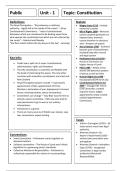
Public Unit - 1 Topic: Constitution
Definitions Statute
The Royal Prerogative – “Discretionary or arbitrary Magna Carta 1215 – limited
authority… legally left in the hands of the crown” – Dicey monarchy’s power
Constitutional Conventions – “rules of constitutional Bill of Rights 1689 – Monarch
behaviour which are considered to be binding upon those cannot suspend parliament or
who operate the constitution but which are not enforced by impose taxes; monarch
law courts” – Marshal and Moodie cannot interfere in elections;
“the flesh which clothes the dry bones of the law” - Jennings art9 – freedom of speech
Act of Unions 1706 – Scotland
became part of Great Britain;
Scotland keep their church
and legal system
Key Info: Parliament Acts 1911/49 –
House of Commons can
Public law is split into 3 areas: Constitutional,
bypass House of Lords
administrative, rights and freedoms. PACE 1984 – details arrest,
The UKs constitution is unwritten and flexible with search and detention powers
the head of state being the queen. The only other of police as well as limits
countries with unwritten constitutions are Israel and Human Rights Act 1998 –
New Zealand. Incorporated ECHR to UK law
Royal Prerogative powers include – royal assent; Constitutional Reform Act
appointment of QCs; appointment of Prime 2005 – Changed the role of
Ministers; declaration of war; deployment of armed Lord Chancellor; created
forces; entering treaties; mercy and pardons. Supreme Court; Judges
Conventions can change – Tony Blair was the first to appointed by newly created
Judicial Appointments
attend a select committee – PMs now also tend to
Commission.
seek permission to go to war or use military
interventions
Parliament is supreme
There are many sources of Public Law: statute, case
law, conventions, expert writing
Cases
Entick v Carrington (1765) – all
state actions must have legal
authority
Attorney General v De
Conventions Keyser’s Royal Hotel (1920) –
Sewel convention – Parliament cannot legislate on statute takes precedent over
devolved matters prerogative
Salisbury convention – The House of Lords won’t block Attorney General v Johnathan
legislation in a governing party’s manifesto Cape (1976) – recognised
Collective Ministerial Responsibility – Parliament is convention in legal verdict
collectively responsible for actions in its proceedings (collective Ministerial
Responsibility)
Definitions Statute
The Royal Prerogative – “Discretionary or arbitrary Magna Carta 1215 – limited
authority… legally left in the hands of the crown” – Dicey monarchy’s power
Constitutional Conventions – “rules of constitutional Bill of Rights 1689 – Monarch
behaviour which are considered to be binding upon those cannot suspend parliament or
who operate the constitution but which are not enforced by impose taxes; monarch
law courts” – Marshal and Moodie cannot interfere in elections;
“the flesh which clothes the dry bones of the law” - Jennings art9 – freedom of speech
Act of Unions 1706 – Scotland
became part of Great Britain;
Scotland keep their church
and legal system
Key Info: Parliament Acts 1911/49 –
House of Commons can
Public law is split into 3 areas: Constitutional,
bypass House of Lords
administrative, rights and freedoms. PACE 1984 – details arrest,
The UKs constitution is unwritten and flexible with search and detention powers
the head of state being the queen. The only other of police as well as limits
countries with unwritten constitutions are Israel and Human Rights Act 1998 –
New Zealand. Incorporated ECHR to UK law
Royal Prerogative powers include – royal assent; Constitutional Reform Act
appointment of QCs; appointment of Prime 2005 – Changed the role of
Ministers; declaration of war; deployment of armed Lord Chancellor; created
forces; entering treaties; mercy and pardons. Supreme Court; Judges
Conventions can change – Tony Blair was the first to appointed by newly created
Judicial Appointments
attend a select committee – PMs now also tend to
Commission.
seek permission to go to war or use military
interventions
Parliament is supreme
There are many sources of Public Law: statute, case
law, conventions, expert writing
Cases
Entick v Carrington (1765) – all
state actions must have legal
authority
Attorney General v De
Conventions Keyser’s Royal Hotel (1920) –
Sewel convention – Parliament cannot legislate on statute takes precedent over
devolved matters prerogative
Salisbury convention – The House of Lords won’t block Attorney General v Johnathan
legislation in a governing party’s manifesto Cape (1976) – recognised
Collective Ministerial Responsibility – Parliament is convention in legal verdict
collectively responsible for actions in its proceedings (collective Ministerial
Responsibility)


