

1(a). GRAM-NEGATIVE
BACTERIA
Created Oct 25, 2019 259 PM
Tags
Updated Nov 18, 2019 231 PM
BACTERIA AND ARCHAEA
Definitions:
Taxonomy
the classification of biological organisms based on shared
characteristics (overall similarity)
eg. Kingdom: Animalia; Phylum: Chordata; Class: Mammalia; Order:
Primates; Family: Hominidae; Genus: Homo; Species: Sapien
Phylogeny
the measure of evolutionary relationships between biological organisms
1(a). GRAMNEGATIVE BACTERIA 1
, Steps in Taxonomic Classification of Microbes
Classification:
The organisms are ordered into groups, based on shared properties
Nomenclature:
The classified organisms are named
Identification:
Data on the properties of an unknown organism is obtained and its
species is determined based on direct comparison with known groups
Classification of Bacteria
There are traditional or newer methods that are used in aiding the classification
of bacteria
Traditional methods - these use the tradition of classifying bacteria based
on properties such as:
morphology (microscopy)
response to oxygen
to test the ability of the bacterium to thrive in varying oxygen
conditions
aerobes, anaerobes, facultative aerobes/anaerobes,
microaerophiles
example:
Hugh and Liefson test
mode of energy synthesis/source of carbon
to test the ability of the bacterium to utilise certain sources of
energy
photoautotrophs, chemoautotrophs, photoheterotrophs,
chemoheterotrophs
example:
citrate utilisation test
inositol and trehalose media, etc.
presence of enzyme types
1(a). GRAMNEGATIVE BACTERIA 2
, to test the presence of certain enzymes produced by the bacterium
example:
oxidase and catalase test
nitrate reduction test
phenylalanine deaminase test
urease test, etc.
Phylogeny: Evolutionary Relationships
Basics of phylogeny:
all living things have genes which will mutate randomly (changing of bases)
at a low frequency
all the following progeny will carry the mutation while other mutations
mutate randomly at a low frequency
the organisms that differ by a few DNA base changes have a more recent
common ancestor as opposed to the organisms that differ by more bases
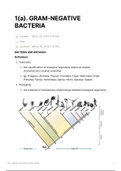
the universal phylogenetic tree is based on analysis of the 16S sRNA in
organisms
thus the three domains of life, bacteria, archaea, and eukaryota, were
formed
sub-species/strain classifications:
biovar
variants based biochemically or physiologically
morphovar
variants based on the differing morphology
serovar/serotype
variants based on the antigenic differences
Salmonella classification example
Salmonella enterica serovar gallinarum biovar pullorum and Salmonella
enterica serovar gallinarum biovar gallinarum were identified and
distinguished from each other in a recent study
1(a). GRAMNEGATIVE BACTERIA 3
, these are distinct from other S. enterica due to differences such as host
range and absence of flagella
Bacteria vs Archaea
Similarities
the two types generally share shape, size, and microscopic appearances
eg. rods, cocci, spirals, coiled, etc.
differentiation between the two is difficult with just a microscope
however some are distinguished by their square-edged appearance
they multiply by binary fission
if motile, they primarily move by means of flagella
Differences
some archaea are more angular/square-shaped than bacteria
archaea do not have peptidoglycan
in bacteria, cell walls are composed of peptidoglycan
in archaea, cell walls are composed of pseudopeptidoglycan,
polysaccharides, glycoproteins or pure proteins
may have protein S-layers (surface layer)
found in almost all archaea
also found in many bacteria
archaea genes are more similar to eukaryotes than bacteria
they have different 70S ribosomes and a more complex RNA
polymerase which is more akin to eukaryotes
bacterial RNA polymerase is relatively simple, containing 5 different
proteins
RNA polymerases of methanogens and halophiles (both archaea)
contain 8 proteins
Extremophiles:
methanogens
withstand high concentrations of methane
1(a). GRAMNEGATIVE BACTERIA 4
BACTERIA
Created Oct 25, 2019 259 PM
Tags
Updated Nov 18, 2019 231 PM
BACTERIA AND ARCHAEA
Definitions:
Taxonomy
the classification of biological organisms based on shared
characteristics (overall similarity)
eg. Kingdom: Animalia; Phylum: Chordata; Class: Mammalia; Order:
Primates; Family: Hominidae; Genus: Homo; Species: Sapien
Phylogeny
the measure of evolutionary relationships between biological organisms
1(a). GRAMNEGATIVE BACTERIA 1
, Steps in Taxonomic Classification of Microbes
Classification:
The organisms are ordered into groups, based on shared properties
Nomenclature:
The classified organisms are named
Identification:
Data on the properties of an unknown organism is obtained and its
species is determined based on direct comparison with known groups
Classification of Bacteria
There are traditional or newer methods that are used in aiding the classification
of bacteria
Traditional methods - these use the tradition of classifying bacteria based
on properties such as:
morphology (microscopy)
response to oxygen
to test the ability of the bacterium to thrive in varying oxygen
conditions
aerobes, anaerobes, facultative aerobes/anaerobes,
microaerophiles
example:
Hugh and Liefson test
mode of energy synthesis/source of carbon
to test the ability of the bacterium to utilise certain sources of
energy
photoautotrophs, chemoautotrophs, photoheterotrophs,
chemoheterotrophs
example:
citrate utilisation test
inositol and trehalose media, etc.
presence of enzyme types
1(a). GRAMNEGATIVE BACTERIA 2
, to test the presence of certain enzymes produced by the bacterium
example:
oxidase and catalase test
nitrate reduction test
phenylalanine deaminase test
urease test, etc.
Phylogeny: Evolutionary Relationships
Basics of phylogeny:
all living things have genes which will mutate randomly (changing of bases)
at a low frequency
all the following progeny will carry the mutation while other mutations
mutate randomly at a low frequency
the organisms that differ by a few DNA base changes have a more recent
common ancestor as opposed to the organisms that differ by more bases
the universal phylogenetic tree is based on analysis of the 16S sRNA in
organisms
thus the three domains of life, bacteria, archaea, and eukaryota, were
formed
sub-species/strain classifications:
biovar
variants based biochemically or physiologically
morphovar
variants based on the differing morphology
serovar/serotype
variants based on the antigenic differences
Salmonella classification example
Salmonella enterica serovar gallinarum biovar pullorum and Salmonella
enterica serovar gallinarum biovar gallinarum were identified and
distinguished from each other in a recent study
1(a). GRAMNEGATIVE BACTERIA 3
, these are distinct from other S. enterica due to differences such as host
range and absence of flagella
Bacteria vs Archaea
Similarities
the two types generally share shape, size, and microscopic appearances
eg. rods, cocci, spirals, coiled, etc.
differentiation between the two is difficult with just a microscope
however some are distinguished by their square-edged appearance
they multiply by binary fission
if motile, they primarily move by means of flagella
Differences
some archaea are more angular/square-shaped than bacteria
archaea do not have peptidoglycan
in bacteria, cell walls are composed of peptidoglycan
in archaea, cell walls are composed of pseudopeptidoglycan,
polysaccharides, glycoproteins or pure proteins
may have protein S-layers (surface layer)
found in almost all archaea
also found in many bacteria
archaea genes are more similar to eukaryotes than bacteria
they have different 70S ribosomes and a more complex RNA
polymerase which is more akin to eukaryotes
bacterial RNA polymerase is relatively simple, containing 5 different
proteins
RNA polymerases of methanogens and halophiles (both archaea)
contain 8 proteins
Extremophiles:
methanogens
withstand high concentrations of methane
1(a). GRAMNEGATIVE BACTERIA 4



