15/10/2019
Lecture 3 – Agreement
4 KEY QUESTIONS TO CONTRACT LAW:
1) When is a contract formed?
2) What does it require of the parties?
3) Can a party escape from the contract?
4) What happens if the contract isn’t formed?
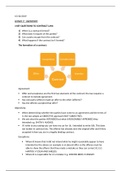
The formation of a contract:
Agreement:
Offer and acceptance are the first two elements of the contract; the law requires a
contract to include agreement.
Has one party (offeror) made an offer to the other (offeree)?
Has the offeree accepted that offer?
Objectivity:
When determining whether the parties have come to an agreement and the terms of
it, the law adopts an OBJECTIVE approach (NOT SUBJECTIVE).
We ask what the parties INTENDED but what it REASONABLY APPEARED they
intended e.g. SMITH V HUGHES.
If I write to you saying you can have my car for 1k, I intended to write 10k. This does
not matter in contract law. The offeree has already seen the original offer and if they
accepted it then you are in a legally binding contract.
Exceptions:
Where B knows that A did not intend what he might reasonably appear to have
intended (so the above car example is an absurd offer so the offeree must be
able to show the offeror that they made a mistake so they can correct it). E.G
HARTOG V COLIN AND SHIELDS.
Where B is responsible for A’s mistake: E.g. SCRIVEN BROS V HINDLEY
, Offer:
What is an offer? : A COMMITMENT TO CONTRACT ON A STSTAED SET OF TERMS, TO
BECOME BINDING SIMPLY ON THE OTHER PARTY’S ACCEPTANCE. (offers are
promises/undertakings).
KEY CASE: GIBSON V MANCHESTER CC
A man who was buying a council house for 2180 quid after the Conservative city
council policy sent him a letter saying they ‘may be prepared to sell the house’. But
Labour took control in the next election. Conservatives claimed no contract – the
council made no offer to Gibson but only an ‘invitation to treat’ (Lords agreed). ‘May’
isn’t a promise, just an offer. They had not made a proper offer yet declaring they
are definitely selling the house to Gibson.
KEY CASE: PHARMACEUTICAL SOCIETY V BOOTS
Boots was charged with an offence under s 18 of the Pharmacy and Poisons Act 1933
(REQUIRES A SUPERVISED PHARMACIST PRESENT TO SELL THE DRUGS TO
CUSTOMER). The court had to determine when the sales actually took place since
Boots pharmacists were at the tills, not the shelves.
Held: display of goods wasn’t an offer: the contract of sale wasn’t concluded when
customers took the goods from shelves. They enter into a contract with Boots only
after buying the goods at the tills. In fact the law is vague in terms of when exactly
during the transaction you enter a contract but for the most part this does not
matter.
REVOCATION (the official cancellation of a decision, decree, or promise)
Offers can be revoked (ordinarily) at any point prior to acceptance. This is true even
if the offeror has promised to keep the offer open for a period of time.
Revocation is effective only when communicated and communication can come from
3rd parties E.G DICKINSON V DODDS.
ACCEPTANCE
If an offer is a commitment to contract on a stated set of terms, to be binding simply
on acceptance, an acceptance is the offeree’s unqualified agreement to that same
set of terms.
THREE REQUIREMENTS: 1. NEXUS, 2. CORRESPONDENCE AND 3. COMMUNICATION
CORRESPONDENCE:
To accept an offer, the offeree must accept the full set of terms proposed by the
offeror (the MIRROR IMAGE RULE).
Any deviation from these terms cannot count as an acceptance but instead
represents a fresh offer.
The effect of such a counter-offer is to ‘kill off’ the prior offer EG HYDE V WRENCH.
Lecture 3 – Agreement
4 KEY QUESTIONS TO CONTRACT LAW:
1) When is a contract formed?
2) What does it require of the parties?
3) Can a party escape from the contract?
4) What happens if the contract isn’t formed?
The formation of a contract:
Agreement:
Offer and acceptance are the first two elements of the contract; the law requires a
contract to include agreement.
Has one party (offeror) made an offer to the other (offeree)?
Has the offeree accepted that offer?
Objectivity:
When determining whether the parties have come to an agreement and the terms of
it, the law adopts an OBJECTIVE approach (NOT SUBJECTIVE).
We ask what the parties INTENDED but what it REASONABLY APPEARED they
intended e.g. SMITH V HUGHES.
If I write to you saying you can have my car for 1k, I intended to write 10k. This does
not matter in contract law. The offeree has already seen the original offer and if they
accepted it then you are in a legally binding contract.
Exceptions:
Where B knows that A did not intend what he might reasonably appear to have
intended (so the above car example is an absurd offer so the offeree must be
able to show the offeror that they made a mistake so they can correct it). E.G
HARTOG V COLIN AND SHIELDS.
Where B is responsible for A’s mistake: E.g. SCRIVEN BROS V HINDLEY
, Offer:
What is an offer? : A COMMITMENT TO CONTRACT ON A STSTAED SET OF TERMS, TO
BECOME BINDING SIMPLY ON THE OTHER PARTY’S ACCEPTANCE. (offers are
promises/undertakings).
KEY CASE: GIBSON V MANCHESTER CC
A man who was buying a council house for 2180 quid after the Conservative city
council policy sent him a letter saying they ‘may be prepared to sell the house’. But
Labour took control in the next election. Conservatives claimed no contract – the
council made no offer to Gibson but only an ‘invitation to treat’ (Lords agreed). ‘May’
isn’t a promise, just an offer. They had not made a proper offer yet declaring they
are definitely selling the house to Gibson.
KEY CASE: PHARMACEUTICAL SOCIETY V BOOTS
Boots was charged with an offence under s 18 of the Pharmacy and Poisons Act 1933
(REQUIRES A SUPERVISED PHARMACIST PRESENT TO SELL THE DRUGS TO
CUSTOMER). The court had to determine when the sales actually took place since
Boots pharmacists were at the tills, not the shelves.
Held: display of goods wasn’t an offer: the contract of sale wasn’t concluded when
customers took the goods from shelves. They enter into a contract with Boots only
after buying the goods at the tills. In fact the law is vague in terms of when exactly
during the transaction you enter a contract but for the most part this does not
matter.
REVOCATION (the official cancellation of a decision, decree, or promise)
Offers can be revoked (ordinarily) at any point prior to acceptance. This is true even
if the offeror has promised to keep the offer open for a period of time.
Revocation is effective only when communicated and communication can come from
3rd parties E.G DICKINSON V DODDS.
ACCEPTANCE
If an offer is a commitment to contract on a stated set of terms, to be binding simply
on acceptance, an acceptance is the offeree’s unqualified agreement to that same
set of terms.
THREE REQUIREMENTS: 1. NEXUS, 2. CORRESPONDENCE AND 3. COMMUNICATION
CORRESPONDENCE:
To accept an offer, the offeree must accept the full set of terms proposed by the
offeror (the MIRROR IMAGE RULE).
Any deviation from these terms cannot count as an acceptance but instead
represents a fresh offer.
The effect of such a counter-offer is to ‘kill off’ the prior offer EG HYDE V WRENCH.