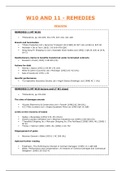
W10 AND 11 - REMEDIES
READING
REMEDIES 1 (MT W10)
*McKendrick, pp 194-205, 361-375, 407-410, 421-428
Breach and termination
*Photo Production Ltd v Securicor Transport Ltd [1980] AC 827 (HL) at 844-5, 847-50
Hochster v De la Tour (1853) 3 El & Bl 678 (QB)
Hong Kong Fir Shipping Co Ltd v Kawasaki Kisen Kaisha Ltd [1962] 2 QB 26 (CA) at 26-8,
54-73
Restitutionary claims to benefits transferred under terminated contracts
Rowland v Divall [1923] 2 KB 500 (CA)
Actions for debt
Hoenig v Isaacs [1952] 2 All ER 176 (CA)
White & Carter (Councils) Ltd v McGregor [1962] AC 413 (HL)
Sale of Goods Act 1979, s 49
Specific performance
*Co-operative Insurance Society Ltd v Argyll Stores (Holdings) Ltd [1998] AC 1 (HL)
REMEDIES 2 (MT W10 lecture and LT W1 class)
*McKendrick, pp 376-405
The aims of damages awards
*Ruxley Electronics & Construction Ltd v Forsyth [1996] AC 344 (HL)
CCC Films (London) Ltd v Impact Quadrant Films Ltd [1985] QB 16 (QB)
Limits on the recovery of losses
Hadley v Baxendale (1854) 9 Ex 351 (Exch)
Victoria Laundry (Windsor) Ltd v Newman Industries Ltd [1949] 2 KB 528 (CA)
*Transfield Shipping Inc v Mercator Shipping Inc (The Achilleas) [2008] UKHL 48, [2009] 1
AC 61
*Farley v Skinner [2001] UKHL 49, [2002] 2 AC 732
Disgorgement of gains
Attorney General v Blake [2001] 1 AC 268 (HL)
Optional further reading
Friedmann, ‘The Performance Interest in Contract Damages’ (1995) 111 LQR 628
Webb, ‘Performance and Compensation: An Analysis of Contract Damages and Contractual
Obligation’ (2006) 26 OJLS 41
, 1. What legal remedy might a claimant want following a breach of contract?
An innocent party may claim damages from the party in breach in respect of all breaches
of contract. The damages may be nominal or substantial. Nominal damages are awarded
where the innocent party has suffered no loss as a result of the other's breach and
substantial damages are awarded as monetary compensation for loss suffered as a result
of the other party’s breach.
For an innocent party to obtain substantial damages he must show that he has suffered
loss as a result of the breach (remoteness) and the amount of his loss (measure). It is up
to the party in breach to argue that the innocent party has failed to mitigate his loss.
The innocent party may only recover damages for loss suffered as a result of the breach
provided it is not too remote. The aim of damages is to put him in the position he would
have been had the contract been properly performed.
The principles of remoteness are given in Hadley v Baxendale ([1854] 9 Exch. 341) and
provide that the following losses are recoverable:
All loss which flows naturally from the breach.
All loss which was in the contemplation of the parties at the time the contract was made as
a probable result of the breach.
If the loss does not fall within the above categories, then it will be too remote and will not
be recoverable.
The rule in Hadley v Baxendale has been interpreted to mean that only loss which is within
the reasonable contemplation of the parties may be recovered (The Heron II[1969] 1 AC
350).
Self-help vs. court ordered.
Damages are not a discretionary remedy so is not always available in circumstances of
breach of contract. (Robinson case).
2. When can a claimant terminate the contract following a breach? What is the effect of
termination of a contract?
EFFECT: termination has the effect of cancelling prospective obligations under the
contract. The innocent party can terminate a contract for breach when conditions have
been breached, or when innominate terms are breached (but has to get to the root of the
contract first of all) (Hong Kong Kawasaki case).
Where a repudiatory breach has occurred (e.g. being unhappy with the contract and can
sue for damages) then an innocent party may elect to terminate (or affirm) a contract.
Anticipatory breach may also allow for termination. An example is the case of Hochster v
De La Tour: C agrees to provide courier services for D, when a month later D declares he
no longer requires this service because C is refusing/unable to perform his part of the
contract.
Easy to do so if there is a statute saying you can terminate a contract when it is breached.
"does the occurrence of [an] event [which breaches the contract] deprive the [innocent]
party of substantially the whole benefit [of] the contract that he should obtain [under the
contract]?"
Bungy and Tradex
The innominate term approach was established in the case of Hong Kong Fir Shipping.
Rather than classifying the terms themselves as conditions or warranties, the innominate
term approach looks to the effect of the breach and questions whether the innocent party
to the breach was deprived of substantially the whole benefit of the contract. Only where
the innocent party was substantially deprived of the whole benefit, will they be able to
treat the contract as at an end:
Hong Kong Fir Shipping v Kawasaki Kisen Kaisha [1962] 2 QB 26
This approach has been criticised for sacrificing certainty. Also the innocent party may well
be liable for wrongful repudiation if they treat the contract as at an end where it is found
that the breach did not deprive them of substantially the whole benefit of the contract.
Even where the parties have themselves classified the term as a condition the courts can
hold that it was in fact only a minor term and therefore a breach of that term would not
give rise to the right to repudiate the contract.
Lord Diplock in Securicar case: ‘every breach of a primary obligation gives rise to pay a
secondary obligation’. After a breach, outstanding primary obligations subsist, unless the
innocent party ELECTS TO TERMINATE. Then the primary obligations are discharged and
READING
REMEDIES 1 (MT W10)
*McKendrick, pp 194-205, 361-375, 407-410, 421-428
Breach and termination
*Photo Production Ltd v Securicor Transport Ltd [1980] AC 827 (HL) at 844-5, 847-50
Hochster v De la Tour (1853) 3 El & Bl 678 (QB)
Hong Kong Fir Shipping Co Ltd v Kawasaki Kisen Kaisha Ltd [1962] 2 QB 26 (CA) at 26-8,
54-73
Restitutionary claims to benefits transferred under terminated contracts
Rowland v Divall [1923] 2 KB 500 (CA)
Actions for debt
Hoenig v Isaacs [1952] 2 All ER 176 (CA)
White & Carter (Councils) Ltd v McGregor [1962] AC 413 (HL)
Sale of Goods Act 1979, s 49
Specific performance
*Co-operative Insurance Society Ltd v Argyll Stores (Holdings) Ltd [1998] AC 1 (HL)
REMEDIES 2 (MT W10 lecture and LT W1 class)
*McKendrick, pp 376-405
The aims of damages awards
*Ruxley Electronics & Construction Ltd v Forsyth [1996] AC 344 (HL)
CCC Films (London) Ltd v Impact Quadrant Films Ltd [1985] QB 16 (QB)
Limits on the recovery of losses
Hadley v Baxendale (1854) 9 Ex 351 (Exch)
Victoria Laundry (Windsor) Ltd v Newman Industries Ltd [1949] 2 KB 528 (CA)
*Transfield Shipping Inc v Mercator Shipping Inc (The Achilleas) [2008] UKHL 48, [2009] 1
AC 61
*Farley v Skinner [2001] UKHL 49, [2002] 2 AC 732
Disgorgement of gains
Attorney General v Blake [2001] 1 AC 268 (HL)
Optional further reading
Friedmann, ‘The Performance Interest in Contract Damages’ (1995) 111 LQR 628
Webb, ‘Performance and Compensation: An Analysis of Contract Damages and Contractual
Obligation’ (2006) 26 OJLS 41
, 1. What legal remedy might a claimant want following a breach of contract?
An innocent party may claim damages from the party in breach in respect of all breaches
of contract. The damages may be nominal or substantial. Nominal damages are awarded
where the innocent party has suffered no loss as a result of the other's breach and
substantial damages are awarded as monetary compensation for loss suffered as a result
of the other party’s breach.
For an innocent party to obtain substantial damages he must show that he has suffered
loss as a result of the breach (remoteness) and the amount of his loss (measure). It is up
to the party in breach to argue that the innocent party has failed to mitigate his loss.
The innocent party may only recover damages for loss suffered as a result of the breach
provided it is not too remote. The aim of damages is to put him in the position he would
have been had the contract been properly performed.
The principles of remoteness are given in Hadley v Baxendale ([1854] 9 Exch. 341) and
provide that the following losses are recoverable:
All loss which flows naturally from the breach.
All loss which was in the contemplation of the parties at the time the contract was made as
a probable result of the breach.
If the loss does not fall within the above categories, then it will be too remote and will not
be recoverable.
The rule in Hadley v Baxendale has been interpreted to mean that only loss which is within
the reasonable contemplation of the parties may be recovered (The Heron II[1969] 1 AC
350).
Self-help vs. court ordered.
Damages are not a discretionary remedy so is not always available in circumstances of
breach of contract. (Robinson case).
2. When can a claimant terminate the contract following a breach? What is the effect of
termination of a contract?
EFFECT: termination has the effect of cancelling prospective obligations under the
contract. The innocent party can terminate a contract for breach when conditions have
been breached, or when innominate terms are breached (but has to get to the root of the
contract first of all) (Hong Kong Kawasaki case).
Where a repudiatory breach has occurred (e.g. being unhappy with the contract and can
sue for damages) then an innocent party may elect to terminate (or affirm) a contract.
Anticipatory breach may also allow for termination. An example is the case of Hochster v
De La Tour: C agrees to provide courier services for D, when a month later D declares he
no longer requires this service because C is refusing/unable to perform his part of the
contract.
Easy to do so if there is a statute saying you can terminate a contract when it is breached.
"does the occurrence of [an] event [which breaches the contract] deprive the [innocent]
party of substantially the whole benefit [of] the contract that he should obtain [under the
contract]?"
Bungy and Tradex
The innominate term approach was established in the case of Hong Kong Fir Shipping.
Rather than classifying the terms themselves as conditions or warranties, the innominate
term approach looks to the effect of the breach and questions whether the innocent party
to the breach was deprived of substantially the whole benefit of the contract. Only where
the innocent party was substantially deprived of the whole benefit, will they be able to
treat the contract as at an end:
Hong Kong Fir Shipping v Kawasaki Kisen Kaisha [1962] 2 QB 26
This approach has been criticised for sacrificing certainty. Also the innocent party may well
be liable for wrongful repudiation if they treat the contract as at an end where it is found
that the breach did not deprive them of substantially the whole benefit of the contract.
Even where the parties have themselves classified the term as a condition the courts can
hold that it was in fact only a minor term and therefore a breach of that term would not
give rise to the right to repudiate the contract.
Lord Diplock in Securicar case: ‘every breach of a primary obligation gives rise to pay a
secondary obligation’. After a breach, outstanding primary obligations subsist, unless the
innocent party ELECTS TO TERMINATE. Then the primary obligations are discharged and