Hesi Grammar
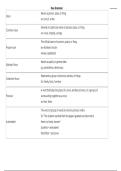
Names a person, place or thing
Noun
ex: church, writer
General not particular name of person, place, or thing
Common noun
ex: nurse, hospital, syringe
The official name of a person, place, or thing.
Proper noun ex: Abraham Lincoln
Always capitalized
Names a quality or general idea
Abstract Noun
e.g. persistence, democracy
Represents a group of persons, animals, or things.
Collective Noun
Ex. Family, flock, furniture
A word that takes the place of a noun, another pronoun, or a groups of
Pronoun words acting together as a noun.
ex: their, them
The word of group of words to which a pronoun refers
Ex: "The students wanted their test papers graded and returned to
Antecedent them in a timely manner"
students = antecedent
them/their = pronouns
, Hesi Grammar
Refers to a specific person, place, thing, or idea indicating the person
speaking (first person), the person spoken to (second person), or any
other noun being talked about (third person)
Personal Pronoun
- Either plural or singular - expresses number
ex: We(1st plural) were going to ask you (2nd singular) to give them
(3rd plural) a ride to the office
A form of personal noun that shows possession or ownership.
e. g. my, mine, his
Possessive Pronoun
Ex. This is my book or that book is mine or that is his book
Do not contain apostrophe
Only at end when noun to relate it back to or at the beginning ex. I
Where to use pronouns ending in -
myself did......., or Sara did ......herself.
self
No such words as hisself, theirself, theirselves
Word, phrase, or clause that modifies a noun or pronoun.
e.g. He is nice. (nice is the adjective)
Adjective
Answers the question what kind (a hard test), which one (an English
test), how many (3 tests), or how much (many tests).
Verbs as function adjectives are participle usually ending in -ing or -ed.
Ex. Verb: the scowling professor, the worried student, the broken
How can verbs, pronouns, and
pencil
nouns act as adjectives
Ex. Pronoun: my book, your class, that book, this class
Ex.noun: the professor's class, the biology class
, Hesi Grammar
Type of verb that functions as an adjective, usually ending in -ing or -
Participle ed.
e.g. the absent-minded professor
Phrase used to express an action or state of being.
Verb
Express time through tense
Present- Mary works
3 types of tense Past- Mary worked
Future- Mary will work
Verbs that link, join, the subject of a sentence to a a noun, pronoun, or
predicate adjective.
- DO NOT SHOW ACTION
- Most commonly used are forms of the verb 'to be': am, is, are, was,
Linking verbs
were, being, been
- Forms of the verb relate to senses: look, sound, smell, feel, and taste
- Forms of verb relate to state of being: seem, become, grows, turn,
prove, and remain
A word, phrase, or clause that modifies a verb, an adjective, or another
verb.
Adverb ex: Verb - The physician operates quickly
Adjective - She wears very colorful clothes
Adverb - She scored quite badly on the test
A word showing the relationship of a noun or pronoun to some other
Preposition word in the sentence.
ex: in, from, about
Names a person, place or thing
Noun
ex: church, writer
General not particular name of person, place, or thing
Common noun
ex: nurse, hospital, syringe
The official name of a person, place, or thing.
Proper noun ex: Abraham Lincoln
Always capitalized
Names a quality or general idea
Abstract Noun
e.g. persistence, democracy
Represents a group of persons, animals, or things.
Collective Noun
Ex. Family, flock, furniture
A word that takes the place of a noun, another pronoun, or a groups of
Pronoun words acting together as a noun.
ex: their, them
The word of group of words to which a pronoun refers
Ex: "The students wanted their test papers graded and returned to
Antecedent them in a timely manner"
students = antecedent
them/their = pronouns
, Hesi Grammar
Refers to a specific person, place, thing, or idea indicating the person
speaking (first person), the person spoken to (second person), or any
other noun being talked about (third person)
Personal Pronoun
- Either plural or singular - expresses number
ex: We(1st plural) were going to ask you (2nd singular) to give them
(3rd plural) a ride to the office
A form of personal noun that shows possession or ownership.
e. g. my, mine, his
Possessive Pronoun
Ex. This is my book or that book is mine or that is his book
Do not contain apostrophe
Only at end when noun to relate it back to or at the beginning ex. I
Where to use pronouns ending in -
myself did......., or Sara did ......herself.
self
No such words as hisself, theirself, theirselves
Word, phrase, or clause that modifies a noun or pronoun.
e.g. He is nice. (nice is the adjective)
Adjective
Answers the question what kind (a hard test), which one (an English
test), how many (3 tests), or how much (many tests).
Verbs as function adjectives are participle usually ending in -ing or -ed.
Ex. Verb: the scowling professor, the worried student, the broken
How can verbs, pronouns, and
pencil
nouns act as adjectives
Ex. Pronoun: my book, your class, that book, this class
Ex.noun: the professor's class, the biology class
, Hesi Grammar
Type of verb that functions as an adjective, usually ending in -ing or -
Participle ed.
e.g. the absent-minded professor
Phrase used to express an action or state of being.
Verb
Express time through tense
Present- Mary works
3 types of tense Past- Mary worked
Future- Mary will work
Verbs that link, join, the subject of a sentence to a a noun, pronoun, or
predicate adjective.
- DO NOT SHOW ACTION
- Most commonly used are forms of the verb 'to be': am, is, are, was,
Linking verbs
were, being, been
- Forms of the verb relate to senses: look, sound, smell, feel, and taste
- Forms of verb relate to state of being: seem, become, grows, turn,
prove, and remain
A word, phrase, or clause that modifies a verb, an adjective, or another
verb.
Adverb ex: Verb - The physician operates quickly
Adjective - She wears very colorful clothes
Adverb - She scored quite badly on the test
A word showing the relationship of a noun or pronoun to some other
Preposition word in the sentence.
ex: in, from, about