

ATI quiz 6
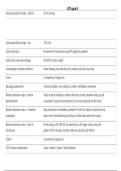
Acid-base ABG normals - PaCO2 35-45 mmHg.
Acid-base ABG normals - pH 7.35-7.45.
Active transport Movement of molecules using ATP against a gradient.
Adult body water percentage 50-60% of body weight.
Advantages of primary intention Faster healing, less infection risk, smaller scar, less tissue loss.
Anion A negatively charged ion.
Bandage assessment Check circulation, skin integrity, comfort, ventilation, movement.
Blood transfusion steps - before Verify order & indication, obtain informed consent, baseline vitals, type &
administration crossmatch, inspect blood product, two-nurse patient & unit ID check.
Blood transfusion steps - if reaction Stop transfusion immediately, maintain IV with NS, notify provider & blood
suspected bank, return blood/tubing for testing, monitor vitals and urine output.
Blood transfusion steps - start of Prime tubing with 0.9% NS (no dextrose or LR), begin slowly, stay with
transfusion patient first 15 minutes, monitor vitals per protocol (q5-15min).
Cation A positively charged ion.
CDC wound classification Class I clean to Class IV dirty/infected.
, ATI quiz 6
Primary: thin linear scar; Secondary: wider, more granulation tissue and
Characteristics of scars - primary vs
fibrous scar; Tertiary: may have moderate scarring depending on
secondary
contamination and closure timing.
A client's arterial blood gas (ABG) Abnormally Alkaline. A pH above $7.45$, such as $7.50$, is considered
results show a pH of 7.50. The nurse abnormally alkaline (basic) or alkalotic.
correctly interprets this value as...
A. Normal pH
B. Abnormally acidic
C. Abnormally alkaline
D. Fatally acidic
Daily fluid intake/output Approximately 2500 mL/day.
Dehiscence Wound layers separate; patient may feel something "gave way."
Diffusion Movement of particles from high to low concentration.
Longer healing time, higher infection risk, larger scar and contraction,
Disadvantages of secondary intention
frequent dressing changes.
Dry dressing purpose For wounds with little drainage.
Electrolyte: Calcium (Ca2+) ionized - 4.5-5.6 mEq/dL (ionized) / total ~8.5-10.5 mg/dL.
normal range
Electrolyte: Chloride (Cl-) - normal 96-106 mEq/L.
range
, ATI quiz 6
Electrolyte ImbalanceThe nurse Potassium. Potassium is the major intracellular cation, and even slight
understands that which electrolyte is deviations from its normal range can significantly impair cardiac muscle
the major intracellular cation, and its function.
imbalance has the potential to cause
life-threatening cardiac conditions?
A. Sodium (Na)
B. Calcium (Ca^{2+})
C. Potassium (K^)
D. Magnesium (Mg^{2+})
Electrolyte: Magnesium (Mg2+) - 1.5-2.5 mEq/L.
normal range
Electrolyte: Phosphate (PO4/HPO4) - 2.4-4.1 mEq/L (or 2.5-4.5 mg/dL depending on units).
normal range
Electrolyte: Potassium (K+) - normal 3.5-5.0 mEq/L.
range
Electrolyte: Sodium (Na+) - normal 135-145 mEq/L.
range
Evisceration Organs protrude through incision; medical emergency.
Extracellular fluid Fluid outside the cells including interstitial and intravascular fluid.
Factors that impair healing Poor nutrition, infection, obesity, smoking, chronic diseases.
Filtration Movement of fluid caused by hydrostatic pressure.
First action for transfusion reaction Stop the transfusion immediately.
Acid-base ABG normals - PaCO2 35-45 mmHg.
Acid-base ABG normals - pH 7.35-7.45.
Active transport Movement of molecules using ATP against a gradient.
Adult body water percentage 50-60% of body weight.
Advantages of primary intention Faster healing, less infection risk, smaller scar, less tissue loss.
Anion A negatively charged ion.
Bandage assessment Check circulation, skin integrity, comfort, ventilation, movement.
Blood transfusion steps - before Verify order & indication, obtain informed consent, baseline vitals, type &
administration crossmatch, inspect blood product, two-nurse patient & unit ID check.
Blood transfusion steps - if reaction Stop transfusion immediately, maintain IV with NS, notify provider & blood
suspected bank, return blood/tubing for testing, monitor vitals and urine output.
Blood transfusion steps - start of Prime tubing with 0.9% NS (no dextrose or LR), begin slowly, stay with
transfusion patient first 15 minutes, monitor vitals per protocol (q5-15min).
Cation A positively charged ion.
CDC wound classification Class I clean to Class IV dirty/infected.
, ATI quiz 6
Primary: thin linear scar; Secondary: wider, more granulation tissue and
Characteristics of scars - primary vs
fibrous scar; Tertiary: may have moderate scarring depending on
secondary
contamination and closure timing.
A client's arterial blood gas (ABG) Abnormally Alkaline. A pH above $7.45$, such as $7.50$, is considered
results show a pH of 7.50. The nurse abnormally alkaline (basic) or alkalotic.
correctly interprets this value as...
A. Normal pH
B. Abnormally acidic
C. Abnormally alkaline
D. Fatally acidic
Daily fluid intake/output Approximately 2500 mL/day.
Dehiscence Wound layers separate; patient may feel something "gave way."
Diffusion Movement of particles from high to low concentration.
Longer healing time, higher infection risk, larger scar and contraction,
Disadvantages of secondary intention
frequent dressing changes.
Dry dressing purpose For wounds with little drainage.
Electrolyte: Calcium (Ca2+) ionized - 4.5-5.6 mEq/dL (ionized) / total ~8.5-10.5 mg/dL.
normal range
Electrolyte: Chloride (Cl-) - normal 96-106 mEq/L.
range
, ATI quiz 6
Electrolyte ImbalanceThe nurse Potassium. Potassium is the major intracellular cation, and even slight
understands that which electrolyte is deviations from its normal range can significantly impair cardiac muscle
the major intracellular cation, and its function.
imbalance has the potential to cause
life-threatening cardiac conditions?
A. Sodium (Na)
B. Calcium (Ca^{2+})
C. Potassium (K^)
D. Magnesium (Mg^{2+})
Electrolyte: Magnesium (Mg2+) - 1.5-2.5 mEq/L.
normal range
Electrolyte: Phosphate (PO4/HPO4) - 2.4-4.1 mEq/L (or 2.5-4.5 mg/dL depending on units).
normal range
Electrolyte: Potassium (K+) - normal 3.5-5.0 mEq/L.
range
Electrolyte: Sodium (Na+) - normal 135-145 mEq/L.
range
Evisceration Organs protrude through incision; medical emergency.
Extracellular fluid Fluid outside the cells including interstitial and intravascular fluid.
Factors that impair healing Poor nutrition, infection, obesity, smoking, chronic diseases.
Filtration Movement of fluid caused by hydrostatic pressure.
First action for transfusion reaction Stop the transfusion immediately.



